
From Textbook to “I Was There”: How Virtual Reality (VR) Is Transforming Classrooms
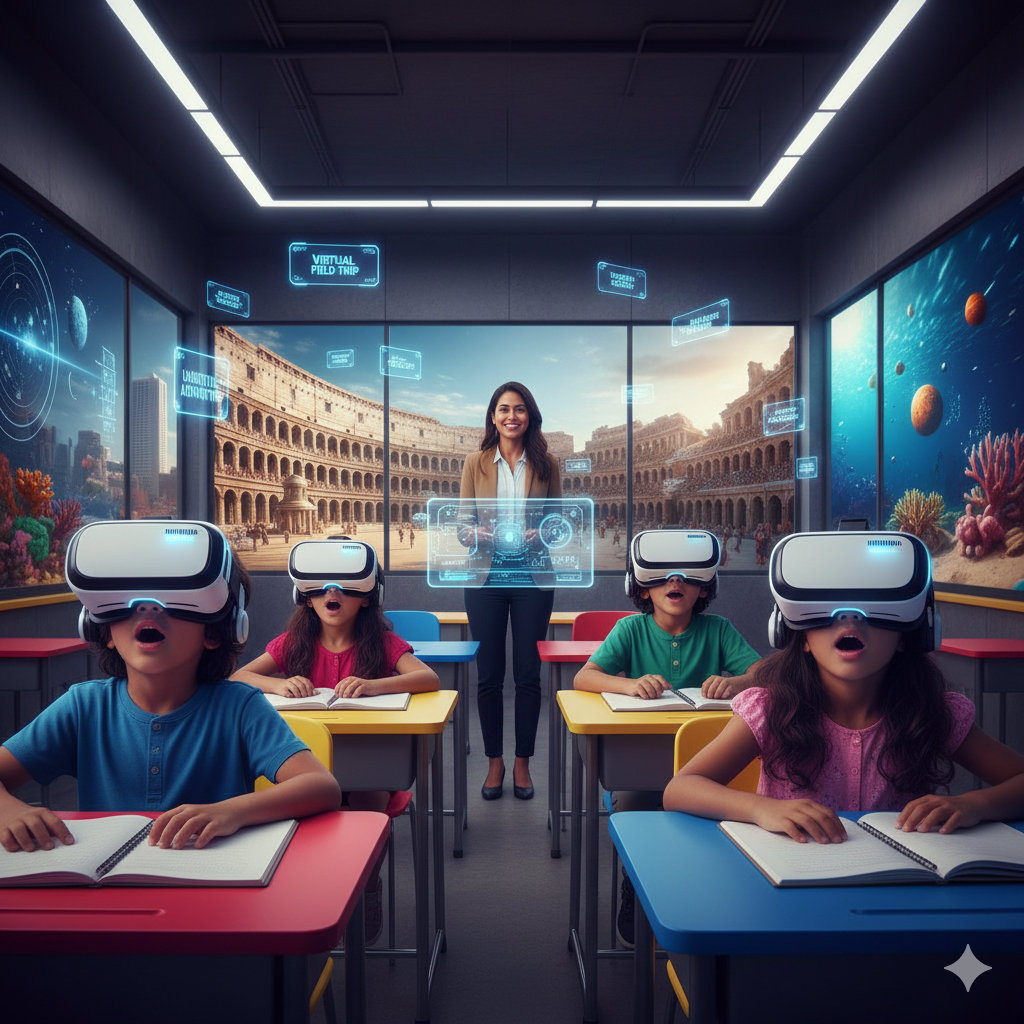
For decades, textbooks have been the foundation of classroom learning. Children read about historical monuments they have never visited, scientific processes they have never seen, and environments they struggle to imagine. While textbooks provide knowledge, they often lack experience.
Virtual Reality (VR) changes that.
When a student removes a headset and says, “I felt like I was there,” learning shifts from memorization to meaningful understanding.
At Samabhavana, innovative learning approaches aim to make education more experiential, inclusive, and engaging — especially for children in resource-limited environments.
Why Traditional Learning Feels Passive
In a regular classroom setting, learning is often passive:
- Students read chapters
- Teachers explain concepts
- Pupils memorize information for exams
While some children adapt easily, others struggle to connect abstract ideas with real-world understanding.
Virtual Reality transforms this dynamic.
Instead of imagining a place or process, children can:
- Look around inside a historical monument
- Observe the solar system from space
- Explore underwater ecosystems
- Experience scientific phenomena visually
VR replaces imagination gaps with immersive presence.
And presence changes learning.
VR in Indian Classrooms: Bridging the Exposure Gap
In many Indian classrooms — particularly in government schools and low-resource communities — exposure beyond textbooks is limited.
Field trips are rare due to:
- Financial constraints
- Logistical challenges
- Safety concerns
Many children may never visit:
- Museums
- Science labs
- Historical monuments
- Natural reserves
Virtual Reality becomes a powerful alternative when real-world exposure is not feasible.
According to UNESCO’s Digital Learning Framework, immersive technologies can significantly improve accessibility and experiential learning in underserved regions.
(Source: https://www.unesco.org/en/digital-learning)
By integrating VR thoughtfully, schools can provide experiences that were previously inaccessible.
How VR Improves Focus and Participation
When students experience VR for the first time, teachers often observe:
- Increased curiosity
- Deep concentration
- Unexpected silence
- Active participation
Even distracted students become attentive.
Why?
Because VR captures attention through immersion — not force.
Experiences activate the brain differently than text alone. Studies by EdTech research groups and institutions like Harvard Graduate School of Education suggest that experiential learning improves engagement and comprehension.
(Source: https://www.gse.harvard.edu/)
When students feel present, learning becomes personal.
Equalizing the Learning Environment
One of VR’s most powerful impacts is reducing learning gaps.
In traditional settings, understanding often depends on:
- Reading ability
- Language fluency
- Memorization skills
With VR, learning becomes:
- Visual
- Experiential
- Interactive
Students who struggle with language comprehension often perform equally well in immersive learning sessions.
This creates a more inclusive classroom.
👉 Learn more about Samabhavana’s inclusive education initiatives:
https://samabhavana.in/
Why Students Remember VR Experiences Longer
Research and classroom observations consistently show:
Children remember experiences more than written information.
When recalling a VR lesson, students describe:
- What they saw
- Where they looked
- What surprised them
- How they felt
Because memories are rooted in experience, retention improves naturally.
Emotion plays a key role here.
Traditional education often separates emotion from learning. VR reconnects them. When children feel awe, curiosity, or excitement, understanding deepens.
The Role of Teachers in VR-Based Learning
Virtual Reality does not replace teachers.
It transforms their role.
Instead of only delivering information, teachers become:
- Experience facilitators
- Discussion leaders
- Reflection guides
The most effective VR sessions include:
- A short immersive experience
- Guided classroom discussion
- Questions and analysis
- Written reflection
Balanced integration ensures VR enhances learning rather than becoming entertainment.
At Samabhavana, experiential learning tools are introduced thoughtfully — always aligned with educational objectives.
Building Confidence Through Experience
VR also reduces anxiety around complex subjects.
When children feel like they have “been inside” a topic, it becomes less intimidating.
This is especially important for:
- First-generation learners
- Students with self-doubt
- Children hesitant to participate
Confidence grows when learning feels accessible.
Parents often notice changes too. Children talk more about school, describe experiences vividly, and show deeper curiosity at home.
Education begins to feel relevant — not routine.
Is VR Expensive? Rethinking the Infrastructure Question
Cost is often seen as a barrier.
However, meaningful VR integration does not require advanced infrastructure.
Even:
- A single headset
- Rotational use
- Clear lesson objectives
- Structured reflection
can create measurable impact.
The key lies in planning, moderation, and purpose — not overuse.
From Information to Understanding
Virtual Reality in classrooms is not just about technology.
It is about shifting how children perceive knowledge.
When learning feels like experience:
- Curiosity increases
- Participation improves
- Confidence builds
- Understanding deepens
VR reduces the gap between textbook knowledge and real-world comprehension.
It moves education from:
“I read about it.”
to
“I was there.”
And when children feel present in what they are learning, true education begins.
Conclusion: Experience as the Future of Learning
In today’s rapidly evolving world, education must go beyond memorization.
It must inspire curiosity.
It must build confidence.
It must create connection.
By integrating experiential tools like Virtual Reality with guided reflection and thoughtful facilitation, schools can transform classrooms into spaces of discovery.
At Samabhavana, the focus remains on making learning: