
STEM Education in India: Why It Belongs in Every Classroom — Not Just Toppers
Introduction: The Label That Limits
For too long, STEM education in India has carried an invisible label: for bright students only.
Walk into most Indian classrooms and you will find this belief quietly at work. The “topper” gets called to solve the equation on the board. The “average” student is guided toward arts or commerce. The child who struggles with marks is told — directly or through silence — that science and mathematics are not for them.
This is not just wrong. It is damaging. And it is costing India the potential of millions of children who have been sorted out of STEM before they ever had a fair chance in it.
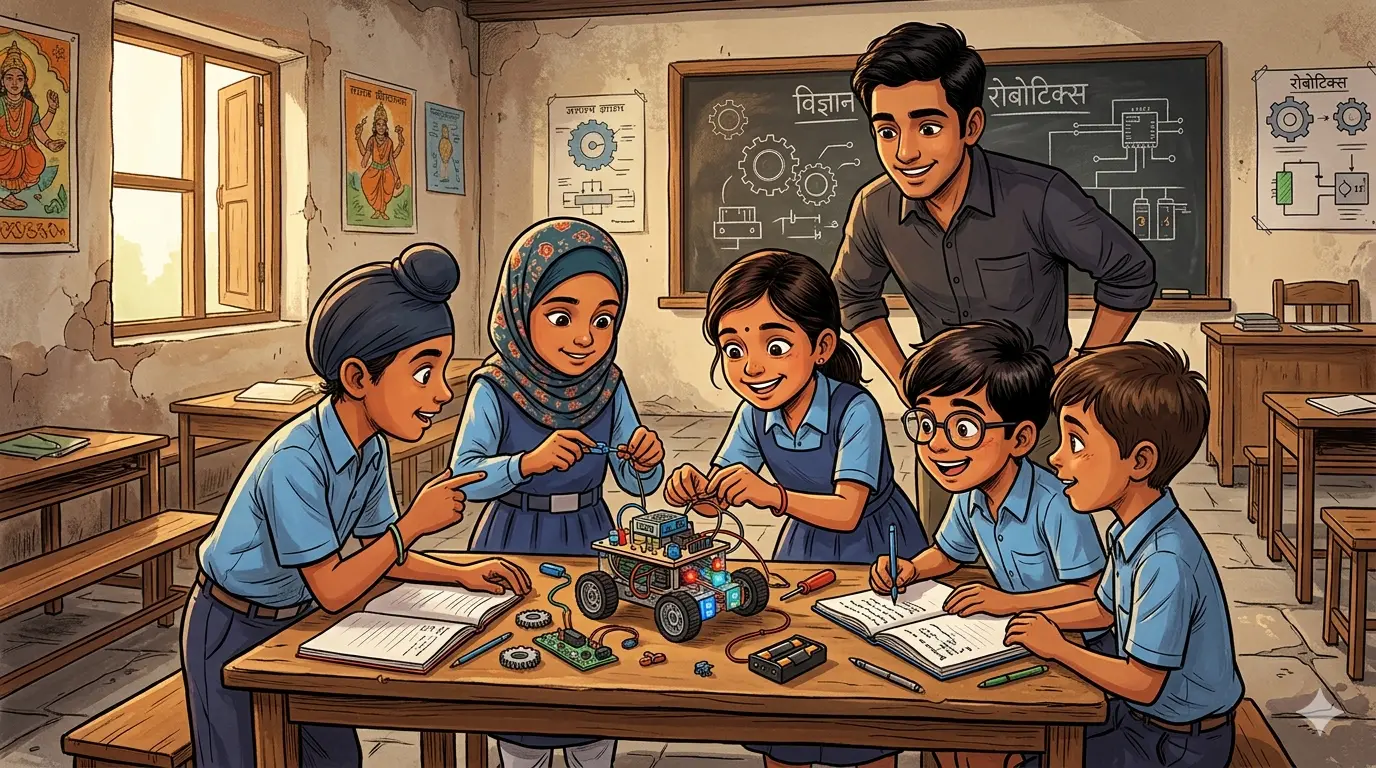
At Samabhavana, through the Smile Hub Programme, we have seen what happens when that label is removed — when a child who has been told they are “weak in science” is given a model to build, a problem to solve, or a robotics kit to program.
What happens, consistently, is this: they discover they are not weak in science at all. They were just being taught in a way that didn’t reach them.
STEM — Science, Technology, Engineering, and Mathematics — is not about speed, memorisation, or marks. It is about curiosity, observation, experimentation, and the willingness to try again when something fails. And those qualities exist in every child.
The State of STEM Education in India: What the Numbers Show
STEM education in India is at a pivotal moment. The infrastructure is growing rapidly, but access remains deeply uneven.
In the CSR space, the impact is also measurable: corporate-funded STEM programmes have collectively reached 20 lakh+ students across 5,800+ schools and 400+ districts, supported by 30,000+ trained teachers. (India CSR, 2026)
These are real achievements. But they also reveal the gap. India has over 1.5 million schools. The children in the hundreds of thousands of government schools that don’t yet have ATLs, STEM labs, or experiential learning programmes are still learning science from textbooks — and being evaluated by whether they can memorise it.
STEM education in India has the policy, the funding intent, and the corporate investment. What it still lacks, in too many classrooms, is the implementation that gets it to children who have been systematically excluded from it.
Why Early Labels Are So Destructive
In Indian classrooms, academic categorisation happens early — and it sticks.
By Class 5 or 6, many children have already absorbed a fixed belief about where they sit in the academic hierarchy. “Good at studies.” “Weak in maths.” “Not a science type.”
These labels are not conclusions children reach about themselves through neutral observation. They are conclusions formed through comparison, grading, and the responses of adults around them.
When a child repeatedly fails written tests in science, they do not conclude that written tests are a poor measure of scientific ability. They conclude that they are poor at science. The distinction matters enormously, because only one of those conclusions is true.
The problem with how STEM is taught in many Indian schools is not the content — it is the medium. When the primary delivery method is textbook reading and the primary assessment is written recall, the children who excel are those who learn well through reading and writing.
Children who learn through doing, building, discussing, or visualising are systematically disadvantaged — not because they lack aptitude, but because the classroom was never designed for how they learn.
Hands-on STEM changes this. It creates multiple pathways to competence, and it surfaces intelligence that written exams leave invisible.
What Happens When STEM Becomes Experiential
The shift that occurs when children engage with hands-on STEM education is one that teachers describe with consistent surprise.
A child who cannot recall Newton’s laws from a textbook will intuitively grasp the principle of inertia when a ball rolls off a table in a structured experiment. A student who freezes during maths assessments will estimate, calculate, and adjust confidently when building a model bridge under load.
A girl who has been told she is “not good at science” may turn out to be the most precise observer in the room when given a specimen to examine.
This is not exceptional. It is typical — once the medium changes.
Experiential learning works because it activates multiple cognitive pathways simultaneously. Doing, seeing, discussing, adjusting, and reflecting encode information far more durably than reading a static page. It also removes the performance anxiety that written assessment creates.
When the goal is to make the experiment work rather than to produce the correct answer on paper, children engage differently — more fully, more honestly, and more effectively.
At Samabhavana’s Smile Hub centres, this is the foundation of how STEM is delivered. Activities are designed around curiosity and construction. Mistakes are built into the process.
The question is not “did you get it right?” but “what did you observe, and what does that tell you?”
STEM, Girls, and Marginalized Communities
Inclusive STEM education in India has a specific and urgent gender dimension.
Despite India’s growing presence in global technology and space science, women remain significantly underrepresented across STEM fields. An EY report published in January 2026, Breaking the Code: The Rise of Women in India’s STEM Landscape, documents both the progress made and the persistent barriers — particularly for girls from lower-income, first-generation learner households. (EY, 2026)
The barriers are not intellectual. They are social and structural. Girls in many communities receive subtle and not-so-subtle messages that STEM careers are not for them — from families, from peer groups, and sometimes from the school environment itself. Early exposure to STEM in a genuinely inclusive, non-competitive setting disrupts this trajectory before it becomes entrenched.
The same logic applies for children from marginalised communities, first-generation learners, and students with learning differences. Hands-on, experiential STEM creates a classroom where participation does not require reading fluency, prior educational advantage, or the kind of cultural capital that urban, upper-income households provide by default.
Samabhavana’s Smile Hub programmes deliberately include girls, children from marginalised communities, and students who have been performing poorly in conventional academic settings — because these are precisely the children for whom inclusive STEM education has the highest transformative potential.
The CSR Case: Why STEM in Government Schools Deserves Corporate Investment
STEM education in India — specifically in government and low-resource schools — is one of the most compelling CSR investments available under Schedule VII of the Companies Act, 2013. It qualifies under education, skill development, and promotion of scientific temper, providing multiple Schedule VII compliance pathways.
The case for corporate investment is strong and multidimensional:
India’s STEM workforce gap is real. NASSCOM estimates India needs to add over one million skilled technology workers annually to meet digital economy demand through 2030. The pipeline begins in school — and it cannot be built from the top of the academic distribution alone.
The multiplier effect is significant. One well-equipped STEM programme in a government school cluster reaches hundreds of children per year, for the duration of the programme. Teacher training components extend impact to every cohort those teachers subsequently teach.
Government co-investment creates leverage. With PM SHRI schools, ATL infrastructure, and NEP implementation all creating public investment in STEM, corporate CSR supplements rather than duplicates — extending the reach of government programmes into communities and schools that the flagship schemes haven’t yet reached.
Impact measurement is structured and MCA-compliant. Pre- and post-assessments, teacher observation data, and participation records provide the documented outcome evidence that PSU CSR teams and corporate sustainability reports require.
Samabhavana works with CSR partners to design and implement STEM education programmes aligned with Schedule VII requirements — with full compliance documentation for CSR-2 filing and annual reporting.
🔗 Explore Samabhavana’s Education programmes: Education
🔗 See the full Smile Hub STEM curriculum: Smart Digital Class
🔗 Partner with us for CSR implementation: Donors & Partners
Samabhavana’s Smile Hub: STEM for Every Child
The Smile Hub Programme at Samabhavana is built on a foundational conviction: that STEM education should reach every child — not just those in well-resourced schools or those who score well in written examinations.
Smile Hub delivers an integrated STEM curriculum that includes:
- Robotics and engineering — building, programming, and testing robots using age-appropriate kits, developing logical thinking and collaborative problem-solving
- Astronomy and space science — hands-on sky observation, solar system models, and India’s space story through ISRO
- Digital literacy and AI basics — practical computer skills, coding fundamentals, and an introduction to how artificial intelligence works
- Virtual reality learning — immersive, curriculum-mapped experiences that bring textbook concepts to life
- Smart classroom technology — interactive learning tools that make abstract concepts visible and engaging
Every programme component is designed for low-resource settings, delivered by trained facilitators, and assessed at baseline and endline.
CSR partners receive structured impact reports documenting knowledge gains, participation levels, and qualitative observations from educators.
Frequently Asked Questions
1. Is STEM education in India only for academically strong students?
Absolutely not — and this is the most important misconception to correct. STEM education in India’s most effective programmes is specifically designed to reach children who have struggled in conventional academic settings, because hands-on, experiential learning surfaces intelligence and aptitude that written-exam systems miss entirely.
Curiosity and problem-solving ability are not correlated with exam scores.
2. How does hands-on STEM improve learning outcomes?
Experiential learning activates multiple cognitive pathways simultaneously — doing, observing, adjusting, and reflecting. Research consistently shows that children retain and apply knowledge significantly better when they have engaged with it physically and practically.
STEM activities also reduce the performance anxiety associated with written tests, allowing more children to participate fully.
3. Is STEM CSR eligible under Schedule VII?
Yes. STEM education programmes in schools qualify under the education and vocational skills provisions of Schedule VII of the Companies Act, 2013.
They also align with the promotion of scientific temper — a value enshrined in Article 51A(h) of the Indian Constitution — providing an additional compliance narrative particularly relevant for PSU CSR teams.
4. How can STEM education support girls’ advancement in India?
Early, positive exposure to STEM in a supportive, non-competitive environment directly counters the social messaging that tells girls science and technology are not for them.
Programmes that actively include and encourage girls — particularly in communities where this messaging is strongest — show measurable improvement in STEM confidence, participation, and aspiration.
Samabhavana’s Smile Hub is designed with gender inclusion as a structural priority.
5. Can STEM be taught effectively in schools without laboratories or infrastructure?
Yes. The most important ingredient in effective STEM education is not equipment — it is a pedagogical approach. Well-designed STEM activities using low-cost materials, structured observation exercises, and project-based challenges can produce genuine learning outcomes in any classroom.
Smile Hub is specifically designed for resource-constrained government school settings.
6. What does Samabhavana’s STEM programme deliver for CSR partners?
Samabhavana provides CSR partners with programme design, educator training, material development and delivery, structured baseline and endline assessments, quarterly progress reports, and full MCA-compliant documentation for CSR-2 filing.
Our programmes are designed to be delivered in or near your operational geography, with measurable outcomes reported across student, teacher, and school levels.
Conclusion: STEM Education Belongs to Every Child in India
STEM education in India is not a privilege. It is not a reward for academic performance. And it is not reserved for children who already know how to succeed in school.
It belongs to the child who has been told they are weak in maths. It belongs to the girl who has been quietly guided away from science. It belongs to the first-generation learner in a government school who has never seen a working model, conducted an experiment, or been asked to solve a real problem.
India’s ambitions — in space, in technology, in manufacturing, in healthcare — require a workforce that is not drawn from the top 10% of the academic distribution. They require thinkers and problem-solvers from every community, every background, every type of mind.
STEM education in India that is inclusive, hands-on, and community-rooted is not a compromise on standards. It is the only version that actually builds India’s future.
At Samabhavana, this belief drives everything we do.
Every child has the capacity to observe, question, and create. When STEM education is designed to meet children where they are — rather than where a textbook assumes they should be — that capacity emerges consistently, and powerfully.
Samabhavana is a Mumbai-based NGO with 25+ years of experience in CSR implementation across education, health, skill development, and community development.
Our Smile Hub programme delivers inclusive STEM education across robotics, astronomy, digital literacy, AI basics, and VR in government schools.
To explore how your organisation can fund this work through CSR, get in touch with us.