
Social Responsibility Projects That Are Changing Lives Across India
There is a version of corporate social responsibility that looks great in an annual report and does very little on the ground. A nicely photographed tree plantation. A one-day health camp in an accessible urban neighbourhood. A donation to a cause that sounds impressive in a press release.
And then there is the other kind — the social responsibility projects that quietly, persistently, and measurably change the trajectory of a child’s education, a woman’s financial independence. A community’s access to healthcare, or a young person’s ability to earn a dignified livelihood.
India is home to both. But increasingly, the second kind is winning.
This article is about the social responsibility projects that are actually getting that work done. Across education, health, skills development, women empowerment, workplace safety, and mental health. And why the organisations delivering them at the grassroots level matter just as much as the corporates funding them.
What Makes a Social Responsibility Project Actually Work?
Before diving into the projects themselves, it is worth asking an honest question: what separates a social responsibility project that changes lives from one that merely spends money?
The answer, consistently, comes down to three things: community rootedness, sector expertise, and accountability.
A social responsibility project that is designed in a boardroom and dropped into a community it doesn’t understand tends to produce activity — not change. It reaches the easiest-to-access beneficiaries, generates the most photogenic outputs, and wraps up on schedule regardless of whether the underlying problem has shifted at all.
A project designed with genuine community input, implemented by an organisation with real on-ground experience in that sector, and measured against baseline indicators that reflect what actually matters to beneficiaries — that is a different animal entirely.
Organisations like Samabhavana — a Mumbai-based not-for-profit with 25 years of experience across education, health, skills development, women empowerment, POSH awareness, diversity and inclusivity, and men’s mental health — have built their entire approach around this philosophy. Integration over differentiation. Community trust before programme launch. Measurable outcomes built into every project from day one.
With that frame in mind, here are the social responsibility projects that are genuinely moving the needle across India.
Education: Building Classrooms That Produce Learners
Education has consistently been the single largest category for social responsibility projects in India. And for good reason — the gaps are vast, the need is undeniable, and the long-term return on investment is as high as any social intervention can produce.
CSR contributions have significantly enhanced the educational landscape, fostering infrastructure development, providing scholarships, and promoting digital literacy across millions of students. But the most effective education social responsibility projects have moved well beyond building classrooms.
The real transformation is happening in learning outcomes, teacher quality, and the connection between education and economic opportunity.
Digital classrooms and SMART learning
Post-pandemic, one of the fastest-growing categories of social responsibility projects has been the establishment of SMART digital classrooms in government and under-resourced schools.
Companies across sectors are funding smart boards, digital content libraries, and internet connectivity in schools that previously operated with nothing more than a chalkboard and a textbook. Digital education CSR initiatives are being replicated by dozens of companies working with NGO partners across the country.
Samabhavana’s education programmes take this a step further by pairing infrastructure investment with teacher training — addressing the reality that technology in a classroom without a trained teacher to use it produces very little learning.
Their approach to creating inclusive, supportive learning environments that produce actual academic outcomes rather than just equipment installations reflects exactly the kind of depth that distinguishes genuinely impactful social responsibility projects from superficial ones.
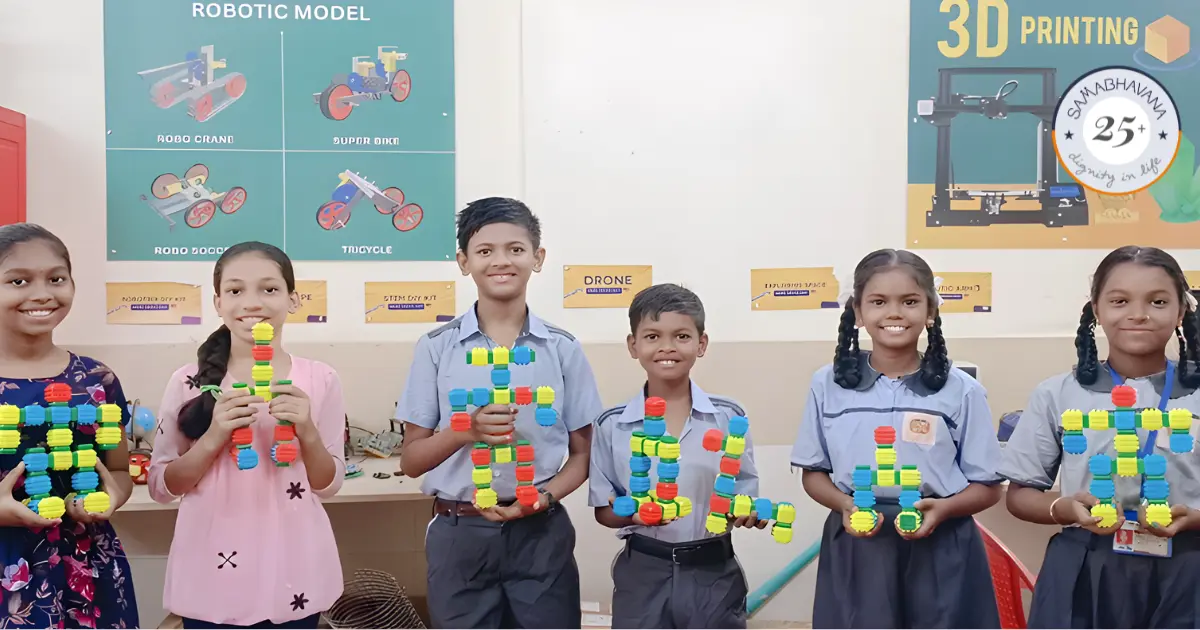
STEM, robotics, and future-ready learning
Among the most forward-thinking social responsibility projects in education are those focused on STEM — science, technology, engineering, and mathematics — particularly at the primary and secondary school level.
Various skill development programmes have provided cutting-edge resources and training in emerging technologies like AI, robotics, and IoT, enhancing accessibility and equipping teachers to deliver effective STEM education.
These programmes are not just about technology literacy — they are about giving children from underserved communities a genuine shot at careers in sectors that would otherwise remain permanently out of reach.
Health: From Health Camps to Long-Term Community Care
Healthcare social responsibility projects have undergone a significant evolution in India. The one-day health camp model — where a corporate team sets up in a community, sees patients, distributes medicines, and leaves — is still common. But it is increasingly being replaced by something more meaningful: structured, long-term community health programmes that build local capacity and address healthcare access at the systemic level.
Samabhavana’s health programmes are built on a similarly sustained approach. With over 52 hospital assessments conducted and a long-standing focus on community welfare, Samabhavana works not just on access to healthcare services but on the upstream conditions that determine whether people are able to use those services in the first place — awareness, trust, economic barriers, and social stigmas that prevent vulnerable communities from seeking care.
This includes work on child protection and safeguarding — a dimension of health and wellbeing that is often overlooked in narrower definitions of healthcare CSR but which Samabhavana has addressed directly for over two decades through its POSCO awareness and child protection programmes.
Skills Development and Vocational Training: The Most Direct Route to Economic Dignity
If education is about building the foundation, skills development and social responsibility projects are about delivering the outcome — a person with the capability to earn a livelihood, support a family, and participate meaningfully in the economy.
India’s skills gap is significant. Millions of young people leave the formal education system each year without the practical, market-relevant skills that employers are actually looking for.
Social responsibility projects in skills development and vocational training are among the most direct and measurable interventions available — and among the most urgently needed.
Samabhavana’s skills development and vocational training programmes follow this logic precisely. Rather than generic training designed to satisfy a reporting requirement.
Samabhavana’s programmes are built around real labour market demand and real community context — equipping participants with skills that translate directly into employment or self-employment outcomes.
The organisation’s 3C programme takes this even further, building the capacity of other NGOs to deliver skills and livelihood programmes more effectively — a multiplier effect that extends the social impact of every rupee invested far beyond any single project.
Women Empowerment: Moving Beyond Awareness Into Economic Agency
Women empowerment is one of the most active categories of social responsibility projects in India — and also one of the most inconsistently executed. The gap between organisations that run sensitisation workshops and call it empowerment, and those that actually shift women’s economic participation, safety, and decision-making agency, is enormous.
The most impactful women empowerment social responsibility projects combine multiple dimensions simultaneously: economic opportunity, safety and legal awareness, health and wellbeing, and the kind of community-level norm change that makes economic gains sustainable over time.
Samabhavana’s women empowerment programmes operate with precisely this level of ambition — not just awareness, but economic agency. Their work addresses the full spectrum of barriers women face, from vocational skills and livelihood training to legal literacy, health access, and the social conditions that either enable or undermine women’s independence.
Samabhavana also works on gender-neutral advancement — addressing the male side of gender equity by running programmes that promote positive masculinity, emotional expression, and the dismantling of harmful stereotypes that damage both men and women.
POSH, POSCO, and Workplace Safety: The Social Responsibility Projects Most Companies Get Wrong
Prevention of Sexual Harassment (POSH) and Protection of Children from Sexual Offences (POSCO) training represent a category of social responsibility projects that is both legally mandated and chronically under-executed.
Most companies run a POSH training session once a year, collect the attendance sheets, file the compliance report, and consider the obligation discharged. What they rarely do is invest in the deeper organisational culture change that makes POSH training actually reduce harassment — which is, of course, the actual point.
Samabhavana has been running POSH and POSCO awareness programmes since before most companies had even heard of the Prevention of Sexual Harassment Act. This is not a side service — it is a core programme area, delivered by practitioners who understand both the legal framework and the community and organisational dynamics that determine whether that framework translates into safer workplaces and safer communities.
The organisation’s diversity and inclusivity seminars address the broader context in which POSH and POSCO issues arise — challenging the attitudes, assumptions, and power dynamics that create the conditions for harassment in the first place.
Social responsibility projects in this space, done well, create measurable cultural change. Done poorly, they create paperwork. Samabhavana consistently delivers the former.
Men’s Mental Health: The Social Responsibility Project India Has Been Ignoring
Of all the areas where social responsibility projects are genuinely underinvested in India, men’s mental health may be the most striking gap. The statistics are sobering: men account for approximately 70% of suicide deaths in India.
Yet mental health programmes directed specifically at men — that address the cultural barriers to help-seeking, the stigma around emotional expression, and the specific stressors of masculinity in Indian social contexts — remain rare.
Corporate Social Responsibility is evolving beyond traditional philanthropy, with organisations recognising that healthy and purpose-driven workplaces and communities are a fundamental driver of societal growth.
Men’s mental health fits directly into this framework — not as a niche concern but as a mainstream social responsibility project area with significant, measurable community welfare implications.
Samabhavana has been working in this space for years, running programmes on men’s mental health awareness, positive masculinity, and emotional well-being — work that connects directly to its broader vision of gender-neutral advancement and human rights.
Their approach recognises something that most CSR programmes miss: that sustainable gender equity requires addressing the experiences and social conditioning of men alongside those of women. A community where men are healthier, more emotionally literate, and less bound by harmful stereotypes is a community where women are also safer and more empowered.
The PRISM Initiative: Building the Infrastructure for Better Social Responsibility Projects
Behind all of Samabhavana’s on-ground programme work sits a structural contribution to India’s social responsibility ecosystem that deserves its own recognition.
In 2013, Samabhavana organised India’s first CSR conference — the PRISM initiative (Partnering Resources for India in Sustainable Movement). At a time when the Companies Act had just made CSR mandatory and most companies were still figuring out what that meant in practice, PRISM created a platform for dialogue between government, corporates, and civil society — the kind of cross-sector collaboration infrastructure that makes effective social responsibility projects possible at scale.
PRISM has since evolved into a podcast platform on YouTube, a space for thought leadership on CSR and ESG, and a connector between the worlds of corporate investment and community need. It is, in many ways, a social responsibility project about social responsibility projects — building the knowledge, relationships, and shared frameworks that make the whole ecosystem more effective.
What the Best Social Responsibility Projects Have in Common
Across all of these sectors — education, health, skills development, women empowerment, POSH, men’s mental health — the projects that genuinely change lives share a recognisable set of characteristics.
These are designed with communities, not just for them. They are implemented by organisations with real sector expertise and established community relationships. They measure what actually matters — not just outputs like the number of people who attended a session, but outcomes like whether lives measurably improved as a result.
With communities developing the ownership and capacity to carry the work forward beyond the initial funding cycle. And they are delivered by partners who are fully accountable — financially transparent, legally compliant, and genuinely invested in results.
Samabhavana’s 25-year body of work across education, health, skills development, vocational training, women empowerment, POSH, POSCO, diversity and inclusivity, and men’s mental health reflects all of these characteristics.
With full regulatory compliance — CSR-1 registration, 80G, 12A, NITI Aayog recognition, Maharashtra Charity Commissioner registration, and IICA-MCA acknowledgement — and a published capability statement and audited annual reports available on their website, Samabhavana represents the kind of accountable, experienced implementing partner that the best corporate social responsibility programmes are built on.
If your company is looking for social responsibility projects that deliver measurable community impact, strengthen your ESG narrative, and create the kind of long-term social change that actually justifies the investment — the conversation starts here.
Contact Samabhavana: 📞 022-45658306 📧 info@samabhavana.in 🌐 www.samabhavana.in
Frequently Asked Questions
What are social responsibility projects?
Social responsibility projects are structured programmes implemented by companies, NGOs, or government bodies to address social, environmental, or developmental challenges in communities.
In India, they are most commonly funded through the mandatory 2% CSR spend under Section 135 of the Companies Act 2013, and implemented across areas like education, healthcare, skills development, women empowerment, and environmental sustainability.
Which social responsibility projects have the highest impact in India?
The highest-impact social responsibility projects in India consistently fall into education, skills development, healthcare, and women empowerment categories.
Projects that combine direct beneficiary services with long-term capacity building — such as STEM education labs, vocational training programmes linked to employment, community health programmes, and POSH training embedded in genuine culture change — tend to produce the most measurable, sustainable outcomes.
How do companies choose social responsibility projects to fund?
Companies typically align their social responsibility projects with Schedule VII of the Companies Act 2013, which defines eligible CSR activity categories.
The best companies go further — choosing projects based on alignment with their core business values, geographic proximity to their operations, community need assessments, and the track record of the NGO partner implementing the programme on the ground.
What is the role of NGOs in social responsibility projects?
NGOs are the primary implementing partners for most social responsibility projects in India. They provide the community access, sector expertise, last-mile delivery networks, and compliance infrastructure that corporate teams cannot replicate in-house. Approximately 60% of India’s CSR expenditure flows through NGO implementing agencies, making NGO selection one of the most important decisions in any CSR programme.
How can an NGO become a partner for social responsibility projects?
To qualify as an implementing partner for corporate social responsibility projects in India, an NGO must hold CSR-1 registration on the National CSR Portal, 12A and 80G certifications under the Income Tax Act, and a minimum three-year operational track record.
Organisations like Samabhavana, which hold all required certifications and have 25 years of verified field experience, are well-positioned to support companies across multiple social responsibility project categories simultaneously.
How do you measure the success of social responsibility projects?
The most credible social responsibility projects measure success against pre-defined baseline indicators — changes in literacy rates, health outcomes, income levels, employment rates, or social safety metrics — rather than simply counting activities completed.
Third-party impact assessments, quarterly beneficiary reports, and Social Return on Investment (SROI) calculations are the gold standard for accountability. Mandatory independent impact assessment is required for companies with CSR obligations above Rs 10 crore.