
SMILE HUB vs. Standalone STEM Labs: What CSR Managers Should Know Before Choosing
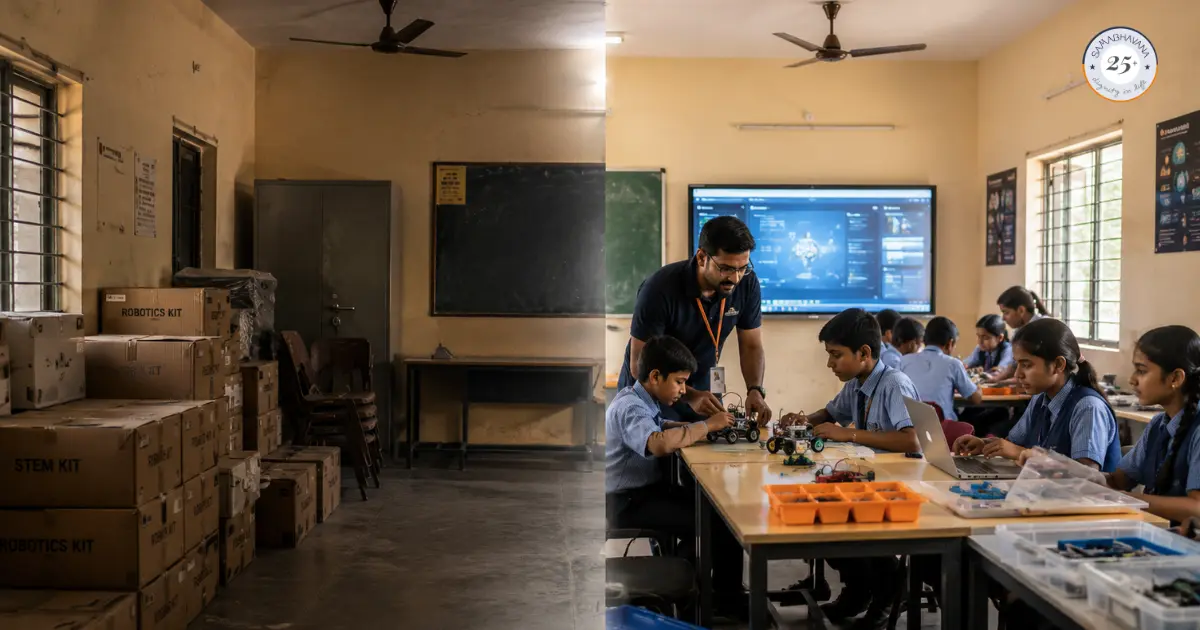
Every CSR manager evaluating a STEM education programme faces the same choice at some point: buy equipment and donate it to a school, or invest in a full programme that includes a trainer, curriculum, teacher development, and impact reporting. The first option looks cheaper.
The second option looks complicated. This guide cuts through both impressions and gives you a clear, honest comparison — so you can make the decision that is right for your company’s CSR goals, compliance requirements, and reputation.
What a Standalone STEM Lab Actually Gives You
A standalone STEM lab is exactly what it sounds like: a set of equipment — STEM models, robotics kits, computers, science instruments — procured and installed in a school. The school takes ownership from day one.
In ideal conditions, a motivated teacher picks up the material, figures out how to use it, integrates it into teaching, and sustains the programme independently.
SMILE HUB vs. Standalone STEM Labs for CSR
In practice, this happens in a minority of schools. What more commonly happens: equipment is installed, a photograph is taken for the CSR report, and within 12–18 months the lab is locked because no one knows how to run it, the equipment has not been maintained, and the school’s daily schedule has not been adjusted to accommodate it.
This is not a hypothetical — it is a pattern that is well-documented across India’s CSR landscape.
Our post on Inside a Robotics CSR Project in Rural Schools covers what actually happens when technology CSR is implemented without sustained support — and what a properly run programme looks like instead.
What SMILE HUB Gives You
SMILE HUB is not a product. It is a programme. The distinction matters because it changes what you are actually buying.
When you invest in SMILE HUB through Samabhavana, you are not buying equipment — you are buying a running programme that produces documented outcomes. What that includes:
- 9 technology learning modules — STEM, Robotics, AI, IoT, Astronomy, VR, Coding, Smart Digital Classroom, and Computer Literacy — integrated into a single programme.
- A dedicated on-site trainer who runs daily student sessions and monthly teacher training throughout the programme period.
- NCERT/SCERT-mapped curriculum for every grade level served.
- Quarterly impact reports with student outcome data — pre/post assessments, session hours, beneficiary demographics.
- Equipment maintenance support throughout the programme.
- Full documentation for Schedule VII compliance, CSR-2 filing, and Principal 8 disclosure.
Head-to-Head Comparison – SMILE HUB vs standalone STEM lab CSR
| Factor | Standalone STEM Lab | SMILE HUB Full Programme |
| What’s included | Equipment only | Equipment + Trainer + Curriculum + Reports |
| Teachers Training | Twice or thrice a year only | Scheduled once a month Teachers training |
| Dedicated trainer | No | Yes — daily student sessions |
| Curriculum mapping | NCERT/SCERT: rarely | Yes — mapped to all grade levels |
| Impact reporting | Output data only | Full outcome data + documentation |
| Schedule VII fit | Borderline (equipment only) | Strong — structured education programme |
| BRSR compliance | Weak | Full Principal 8 support provided |
| Programme life | Equipment degrades, no sustainability | Sustained — trainer maintains engagement |
| CSR-2 filing support | None | Included — utilisation certificate + reports |
| Typical cost range | ₹8–20 lakh | ₹20–50 lakh per school (full programme) |
The Trainer Question: Why It Is Non-Negotiable
The single most important variable in any STEM education CSR programme is whether there is a dedicated, trained person running it every day. This is not a nice-to-have. It is the difference between a programme that works and one that doesn’t.
A school teacher with a full curriculum load and no STEM training cannot be expected to run a STEM/ Robotics programme or an AI lab in their spare time.
The evidence on this is consistent: STEM labs without dedicated trainers underperform significantly compared to those with sustained trainer support. The equipment is not the constraint — the human expertise is.
This is why Samabhavana’s approach to every SMILE HUB programme starts with trainer deployment, not equipment procurement.
Our post on Teacher Training CSR: How a Programme Transforms Classrooms explains how we structure teacher development as a programme core — not an afterthought.
The Smart Digital Classroom Difference
One module in SMILE HUB that standalone STEM labs cannot replicate is the Smart Digital Classroom — because it is not about equipment in a lab, it is about transforming how all teachers teach, in all classrooms, across all subjects.
A Smart Digital Classroom upgrade impacts every student in the school, not just those who use the STEM lab.
For CSR managers trying to maximise beneficiary reach per rupee, this matters.
Our post on The Power of Smart Digital Classroom CSR Programs covers how this component works and what it adds to the overall programme outcome.
Total Cost of Ownership: What the Numbers Actually Show
When CSR managers compare a ₹12 lakh standalone STEM kit to a ₹35 lakh SMILE HUB programme, the cheaper option looks obvious. Here is what the total cost of ownership calculation actually shows:
- Standalone STEM lab — Year 1: ₹12 lakh equipment. Year 2: ₹3–5 lakh replacement/maintenance. Outcome data: none. BRSR impact disclosure: cannot file Principal 8 indicators. Total cost for zero documented outcomes: ₹15–17 lakh.
- SMILE HUB (full programme) — Year 1: ₹35 lakh including trainer, curriculum, and reporting. Outcome data: pre/post assessments for 300+ students, 1,000+ session hours documented, Principal 8 indicators filed. Total cost for full compliance and documented impact: ₹35 lakh.
The cheaper option produces no documentable outcome. The full programme produces the compliance record, the data, and the community impact.
For companies subject to internal CSR audits, Core assurance,on CSR effectiveness, the total cost of the cheaper option is higher — not lower.
When a Standalone Lab Might Still Make Sense
To be fair: there are situations where a standalone equipment donation is the right choice. If your company is making a one-time contribution to a school that already has strong teacher capacity and an existing STEM programme, supplementary equipment is a reasonable intervention.
If you are testing a new geography before committing to a full programme, a small equipment pilot can inform a larger programme decision.
What a standalone equipment donation should never be positioned as: a complete CSR programme. It is an input. Inputs are not outcomes.
The Question That Settles It
Ask yourself one question: in 18 months, will I be able to show my board, my auditor, and my CSR committee documented evidence that students in these schools learned something because of this programme — not just that they received something?
If the answer needs to be yes — and for most companies it does — then SMILE HUB is the right choice. If your company’s CSR programme is purely goodwill-driven with no compliance or reporting requirements, either approach may work.
Most companies fall into the first category. That is why SMILE HUB exists. SMILE HUB vs standalone STEM lab CSR
| Want to see SMILE HUB before you commit? Samabhavana facilitates site visits to active SMILE Hubs for prospective CSR partners — so your team can see the trainer in action, meet students, and verify the programme quality on the ground before making any commitment. Contact us: info@samabhavana.in Call: 022-45658306 | samabhavana.in/smile-hub.html |
Related Reading: Inside a Robotics CSR Project | AI and IoT Education CSR India | Smart Digital Classroom CSR | The Role of NGOs in CSR