
Learning With Robots: When Children Build Something With Their Own Hands
Introduction
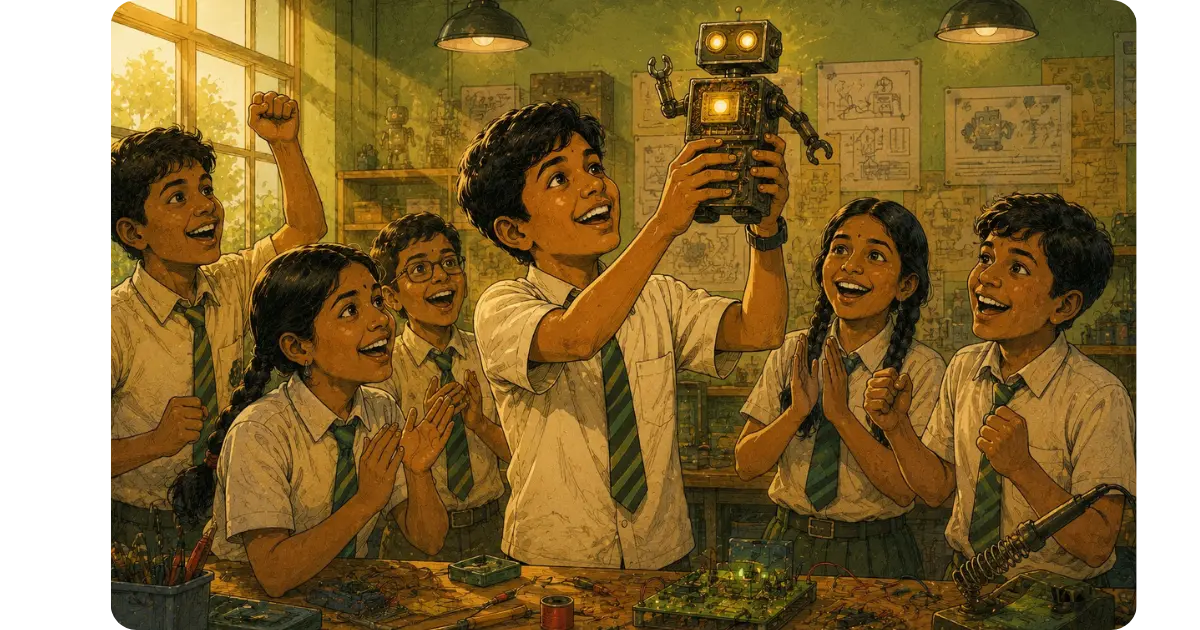
There is a particular kind of focus that comes over a child when they are building something that might actually work. Not filling in a worksheet, not reciting a definition — but assembling components, testing a circuit, arguing with a classmate about why the sensor is not firing the way it should.
Robotics education India has moved from a privilege of elite private schools to a growing presence in government classrooms and community learning centres, and the difference it is making is measurable.
The shift is not just about cool technology. Robotics, artificial intelligence, and the Internet of Things (IoT) are tools for teaching children how to think — how to break a problem into components, hypothesise, test, fail, revise, and try again.
These are capabilities that the Indian economy of 2030 will need at scale. The question is whether the education system — and the CSR ecosystem that increasingly funds it — is building them fast enough.
The State of Robotics Education India Today
The Atal Innovation Mission, launched in 2016, has been the defining government initiative in this space. Through its Atal Tinkering Labs (ATL) programme, the government has established more than 10,000 labs in schools across India, engaging over 1.1 crore students as of 2025.
The government has disbursed ₹1,391.84 crore directly to schools for this purpose. Maharashtra leads with 1,033 labs, followed by Tamil Nadu (975), Uttar Pradesh (955), Karnataka (798), and Andhra Pradesh (713). Crucially, more than 60% of these labs are in government and rural schools — not just well-funded private institutions.
For organisations designing CSR programmes in education, this creates a clear alignment opportunity — corporate investment can complement and accelerate a government initiative that already has momentum and institutional backing.
The data on impact is encouraging. Studies show that 74.4% of schools with ATLs report growth in STEM subject interest, and 69.4% show improved academic performance outcomes.
More than 16 lakh innovation projects have been created by students in these labs. These are not just tinkering sessions — they are formative learning experiences that change how children see themselves in relation to science and technology.
What Hands-On Learning Actually Looks Like
The phrase “hands-on learning” is used often and defined rarely. In the context of robotics education India, it means children physically assembling a robot from components — connecting motors, sensors, microcontrollers, and power sources — and then writing the code that tells the assembled device what to do.
When it works, the satisfaction is immediate and visceral. When it does not work, the child is confronted with a concrete problem that requires systematic diagnosis.
This process builds skills that no textbook exercise can replicate. Spatial reasoning develops as children figure out how components relate physically. Logical reasoning grows through the debugging process.
Collaboration becomes necessary because most builds are too complex for one student to manage alone. Communication is exercised when teams present their projects to judges, teachers, or visiting corporate partners.
AI and IoT dimensions add further layers. Children who learn to collect data from sensors and use it to drive decision-making in a small system gain an intuitive understanding of how AI works — not through abstract definition, but through direct experience.
An IoT project where students build a smart plant-watering system that checks soil moisture before activating a pump is more than a robotics exercise: it is an entry point into environmental awareness and systems thinking.
Samabhavana’s Smile Hub initiative integrates these elements into an enriched community learning environment. You can explore the education work we do here.
NEP 2020 and the Policy Case for Robotics
The National Education Policy 2020 explicitly recognises the importance of computational thinking, coding, and maker-space learning as core educational experiences for children from Class 6 onward.
NEP 2020 envisions every school having access to a tinkering lab environment — a vision that Atal Tinkering Labs and CSR-funded robotics programmes are working to realise.
The policy also emphasises multi-disciplinary learning — the idea that science, mathematics, arts, and humanities should be taught as interconnected rather than siloed subjects.
Robotics is naturally multi-disciplinary: it draws on mathematics (geometry, algebra), physics (mechanics, electronics), computer science (programming logic), and design (aesthetics, user experience). A single robotics project can activate learning across four or five traditional subject areas simultaneously.
This aligns with what education researchers have long argued: that children learn more deeply when knowledge is applied to solve real problems rather than studied in abstract isolation. Robotics education India is one of the clearest practical expressions of this principle at scale.
CSR Investment in Robotics Education India
CSR investment in robotics education India is accelerating, driven by several converging factors. First, the technology sector — one of India’s largest and most profitable — has a natural affinity for STEM education CSR.
Companies in IT, manufacturing, and infrastructure understand that their long-term talent pipeline depends on a stronger STEM foundation in the school system.
Second, robotics programmes produce highly visible outputs — competitions, demonstrations, exhibitions — that make for compelling CSR impact communications. When a group of government school students presents a working robot at a district-level competition, it is a story that resonates with employees, customers, investors, and regulators alike.
Third, Schedule VII of the Companies Act 2013 qualifies expenditure on education and livelihood enhancement as CSR, giving companies clear legal backing for robotics lab investments.
For companies preparing BRSR disclosures, a well-documented robotics programme with learning outcome data provides exactly the kind of social impact evidence that ESG frameworks reward.
The most effective CSR-funded robotics programmes are not one-off lab installations. They include multi-year commitments, trained facilitators who guide student projects, structured curriculum, and linkage to competitions and external recognition.
Samabhavana works with corporate partners to design programmes that deliver these elements systematically. Visit our PSU and donor partners page to understand our partnership model.
The Facilitator Question
As with smart classrooms, the technology is only as powerful as the human being guiding its use. A robotics lab without a trained, enthusiastic facilitator is a room full of boxes.
The facilitator — whether a specially trained teacher, an NGO staff member, or a community educator — is the person who turns a child’s frustration with a broken circuit into a learning moment rather than a reason to disengage.
Facilitator training for robotics education requires specific investment. It is not enough for a teacher to know how to assemble a robot; they need to know how to create the psychological safety for students to fail productively, how to scaffold complexity as skills develop, and how to link the hands-on work to the broader curriculum the child is expected to master. This is a specialised skill set, and it needs to be built deliberately.
Samabhavana’s approach integrates facilitator development into every robotics education programme — ensuring that the human infrastructure matches the physical infrastructure.
Inclusion and Equity in Robotics Education
One of the most important questions in robotics education India is who gets access. Historically, the answer has been children in private schools and urban areas.
Gender is a particular concern. Girls in many school environments are informally steered away from STEM. Robotics programmes that actively recruit girls, provide role models, and create a culture of inclusion can be powerful counters to this pattern.
The ATL programme reports that 96% of its labs are in co-educational or all-girls schools, a design choice that makes girls’ participation structurally possible. CSR programmes should build on this by explicitly tracking and reporting on girls’ participation and achievement.
Diversity and inclusion considerations matter in education just as they matter in workplaces. Samabhavana’s commitment to these values is reflected across all our programme areas, including education. Learn more about our diversity and inclusivity work.
FAQ
Q1: What is robotics education India and why does it matter?
Robotics education India refers to programmes that teach children to build and programme robots, using this as a vehicle for developing STEM skills, logical reasoning, collaboration, and creativity. It matters because these capabilities are foundational for India’s future workforce and are currently under-developed in the traditional curriculum.
Q2: How does robotics relate to AI and IoT education?
Robotics, AI, and IoT are naturally interconnected. Children learning to programme robots often use AI principles (decision trees, sensor-based logic) and IoT concepts (connecting devices to exchange data). These experiences give children an intuitive, practical understanding of technologies that will define the future economy.
Q3: Can companies fund robotics education through CSR?
Yes. Schedule VII of the Companies Act 2013 includes the promotion of education and livelihood enhancement as qualifying CSR activities. Robotics lab installations in government schools are an eligible, high-visibility use of CSR funds with measurable student impact.
Q4: What is the Smile Hub initiative by Samabhavana?
Smile Hub is Samabhavana’s enriched community learning environment that integrates STEM, robotics, digital literacy, and experiential learning for children in underserved communities. It is designed to complement school learning with hands-on, curiosity-driven exploration.
Q5: How can a company set up a robotics CSR programme with Samabhavana?
Samabhavana designs end-to-end robotics education CSR programmes — from site selection and lab setup to facilitator training, curriculum delivery, and impact reporting. Contact us to discuss a programme tailored to your CSR goals and geography.
CONCLUSION
When a child builds a robot that does what they programmed it to do, something changes in how they understand their own capability. That moment — small, specific, and entirely theirs — is what robotics education India at its best produces, at scale, in classrooms that have never had access to this kind of learning before.
For companies thinking seriously about their education CSR strategy, robotics education India is one of the most powerful investments available within Schedule VII. The technology is accessible. The evidence is strong. The policy support is in place.
Contact Samabhavana to explore how we can build a robotics education programme together — one that delivers measurable outcomes, supports your BRSR disclosures, and leaves a lasting mark on children’s lives.