
Learning With Robots: When Children Build Something With Their Own Hands
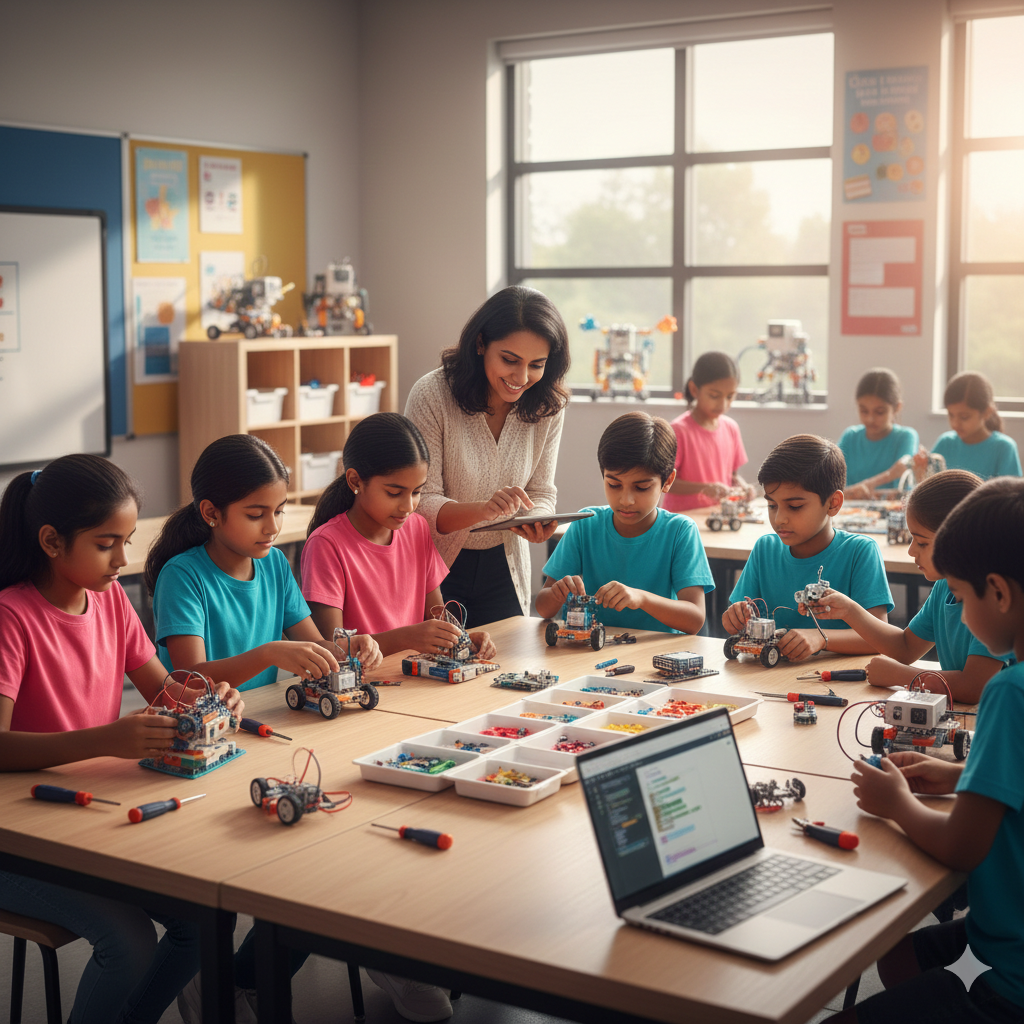
In many Indian classrooms, learning still follows a familiar pattern where teachers explain, students copy notes, exams are written, and marks determine success. While this traditional method has helped generations of students, it does not always support children who learn best through experience rather than memorization. Robotics in education quietly changes this pattern by transforming learning from passive listening into active participation. At Samabhavana, we believe robotics is not about turning every child into an engineer. It is about giving children the opportunity to build, experiment, fail, and try again. When a child constructs something with their own hands, learning becomes real, personal, and deeply meaningful.
Why Robotics Makes Learning Experiential
Robotics transforms abstract textbook concepts into tangible experiences. Instead of merely reading about circuits, motion, sensors, or programming logic, children physically assemble wires, connect motors, and test components. When they see a robot move because of something they built, theory turns into reality. This hands-on learning aligns strongly with the vision of India’s National Education Policy (NEP) 2020, which emphasizes experiential and skill-based education to promote critical thinking and innovation (Source: https://www.education.gov.in/en/nep-2020). Robotics naturally supports this approach because it encourages children to think, test, and discover rather than simply memorize.
The Moment That Builds Confidence
In a typical robotics session, children gather around a table with motors, wheels, sensors, and controllers placed in front of them. At first, everything appears confusing. There are hesitant hands and uncertain expressions. Gradually, under guidance, connections begin to form. Wires are attached correctly. A motor spins. The robot moves forward. That moment changes everything. For many students, especially first-generation learners, it is the first time they see something they built actually function. The joy and pride they feel in that instant remain far longer than any exam score. It builds confidence in a natural and powerful way.
Learning Without the Fear of Being Wrong
Traditional classrooms often emphasize correct answers, leaving little space for mistakes. Robotics, however, treats mistakes as part of the learning process. If a robot does not move, students check the wiring. If it turns in the wrong direction, they revisit the logic. Instead of fearing failure, children learn to troubleshoot and improve. This strengthens resilience, patience, and problem-solving abilities. According to UNESCO’s research on digital learning, hands-on technology education significantly improves student engagement and self-confidence (Source: https://www.unesco.org/en/education/digital-learning). Robotics classrooms demonstrate this clearly, as even quiet students begin to participate actively.
Connecting Subjects Through Robotics
One of the most powerful aspects of robotics education is its ability to connect multiple subjects seamlessly. Mathematics becomes practical when students calculate distance, timing, or angles for movement. Science becomes alive when children understand how sensors detect light or obstacles. Logical thinking develops when students program step-by-step instructions for their robot. Even communication skills improve as students explain their projects and collaborate with peers. At Samabhavana, our educational initiatives aim to create such interdisciplinary and experiential learning environments that nurture both academic and life skills. You can learn more about our work at https://samabhavana.in/.
Making Education Relevant to Real Life
Robotics also encourages children to think about real-world challenges around them. A robot that measures water levels can spark discussions about flood management. A line-following robot can lead to conversations about traffic systems. Automation projects may inspire ideas related to agriculture, waste management, or safety in local communities. When children see how technology connects to their daily lives, learning feels relevant rather than distant. Education becomes something they can apply, not just study.
An Equal Opportunity for Every Child
In India, exposure and access often define opportunity. However, when children from different backgrounds are given robotics kits and supportive guidance, they display equal curiosity and creativity. The difference lies not in ability but in access. The World Economic Forum’s Future of Jobs Report highlights that creativity, problem-solving, and technological literacy are essential skills for the future (Source: https://www.weforum.org/reports/the-future-of-jobs-report). Robotics education helps cultivate these skills early, ensuring children are better prepared for a rapidly changing world.
Teachers as Facilitators of Innovation
Introducing robotics does not replace teachers; it empowers them. With proper training and support, educators use robotics as a tool to simplify complex concepts and energize classrooms. Lessons become spaces of inquiry rather than repetition. Teachers observe increased engagement, improved teamwork, and deeper understanding among students. When implemented thoughtfully, robotics strengthens teaching rather than competing with it.
More Than Technology: Building Life Skills
Beyond technical knowledge, robotics nurtures essential life skills. It teaches patience when a design fails, teamwork when students collaborate, and respect for diverse ideas during group discussions. Children learn to listen, adapt, and persist. These qualities extend far beyond technology and prepare them for real-world challenges.
Conclusion: Building Confidence One Robot at a Time
Bringing robotics into classrooms is not about following trends or adopting the latest gadgets. It is about rethinking how children learn. It shifts education from memorization to exploration and from passive instruction to active discovery. When children build something with their own hands, they are not just assembling mechanical parts. They are building confidence, curiosity, and belief in their own abilities. As India moves toward a future shaped by innovation and technology, robotics offers a practical, inclusive, and inspiring starting point. At Samabhavana, we remain committed to creating learning spaces where every child has the opportunity to explore, build, and grow.
👉 Discover more about our mission and programs at https://samabhavana.in/