
POCSO Awareness CSR Program: A Guide for Indian Corporates
Introduction
Every day in India, 182 cases of child sexual abuse are reported. That is the figure from the National Crime Records Bureau — and it represents only the cases that are actually reported. The real number, according to the Ministry of Women and Child Development, is far higher. An alarming 50% of India’s children experience some form of sexual abuse — and the vast majority of it happens in silence, in spaces adults were supposed to make safe.
The Protection of Children from Sexual Offences Act — commonly known as the POCSO Act — was enacted in 2012 by the Government of India precisely to address this reality. It is comprehensive, gender-neutral, and unambiguous: any person who becomes aware of child sexual abuse has a legal obligation to report it. Failure to do so is a punishable offence.
For India’s corporate sector, this creates both a legal responsibility and a powerful CSR opportunity. A well-designed POCSO awareness CSR program does something that most CSR initiatives cannot — it protects the most vulnerable members of society, builds institutional accountability within the communities where companies operate, and delivers measurable social impact that is directly aligned with Schedule VII of the Companies Act 2013.
This guide walks CSR managers through everything they need to know — what a POCSO awareness CSR program involves, why it matters for your company, how it fits within your CSR mandate, and how to choose the right NGO partner to design and deliver it.
What Is the POCSO Act and Why Does It Matter for Corporates?
The Protection of Children from Sexual Offences Act, 2012, is India’s primary legislation for protecting children under the age of 18 from sexual assault, sexual harassment, and exploitation. It is one of the most significant child protection laws in the world — and one of the most misunderstood.
Here is what every corporate CSR team needs to know about it:
POCSO is gender neutral. Unlike many earlier child protection statutes, the POCSO Act recognises that boys as well as girls can be victims of sexual abuse. It protects all children under 18, regardless of gender.
POCSO imposes mandatory reporting on all adults. Under the Act, any person who has knowledge — actual or suspected — of a child sexual offence is legally required to report it to the police or Special Juvenile Police Unit. Failure to report is punishable with six months of imprisonment, a fine, or both. This is not a discretionary obligation. It applies to teachers, parents, NGO workers, corporate employees, and every adult in between.
POCSO places the burden of proof on the accused. In a significant departure from standard legal practice, the POCSO Act requires the accused to prove their innocence — not the child to prove the abuse occurred. This provision reflects the legislature’s understanding of the power imbalance in child sexual abuse cases.
POCSO applies to organisations, not just individuals. Any institution that works with or around children — schools, NGOs, corporate offices with on-site childcare, sports academies, community centres — has formal obligations under the Act. For companies running CSR programmes in schools or communities, this is directly relevant.
The gap between what the POCSO Act requires and what most adults — including corporate employees — actually know about it is enormous. A POCSO awareness CSR program exists to close that gap.
What a POCSO Awareness CSR Program Actually Involves
A POCSO awareness CSR program is a structured intervention — delivered by a qualified NGO partner — that builds awareness, knowledge, and response capability around child sexual abuse prevention and the legal framework of the POCSO Act.
It is not a one-time lecture. The most effective programmes are layered, context-specific, and delivered across multiple stakeholder groups simultaneously.
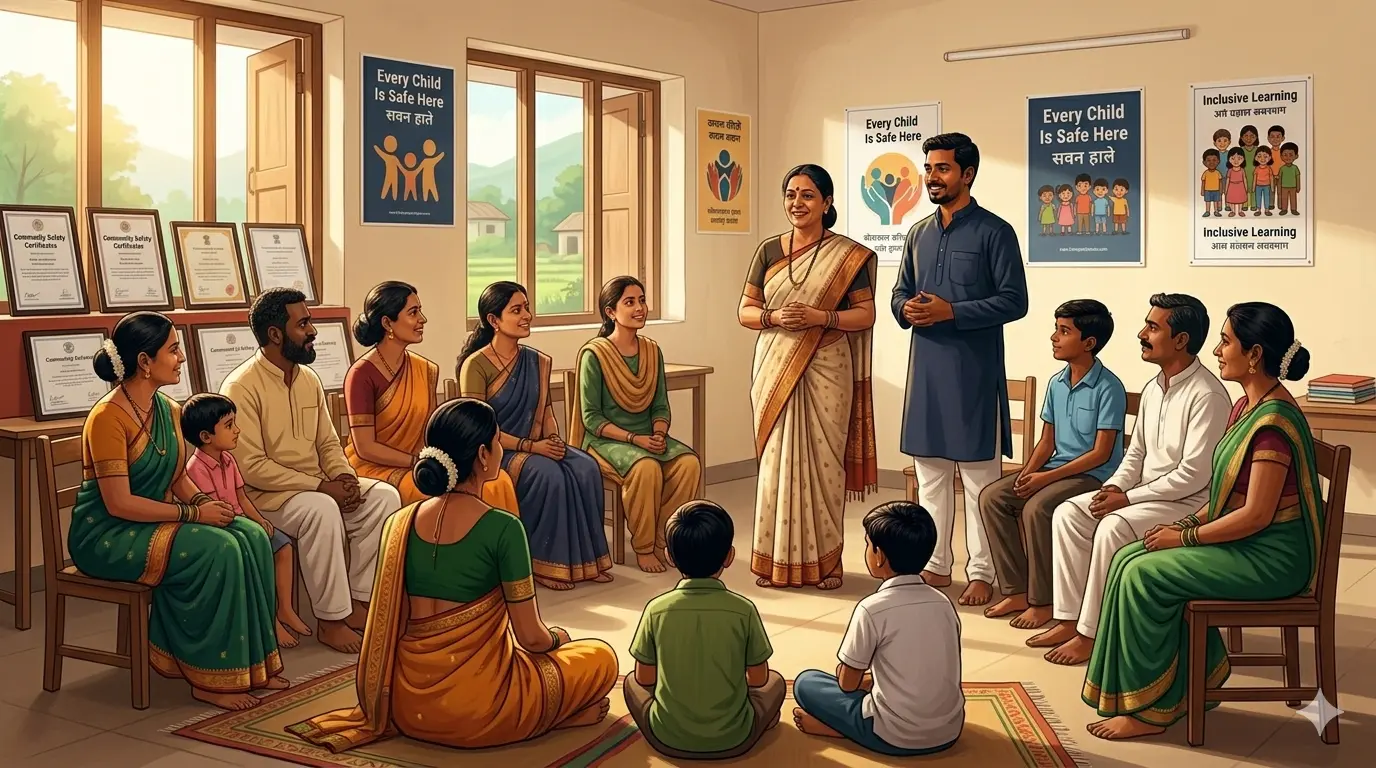
Community-level awareness: Sessions for parents, caregivers, and community leaders covering what constitutes child sexual abuse, how to recognise warning signs, how to create safe environments for children, and the legal obligations of any adult who becomes aware of abuse. These sessions use age-appropriate, culturally sensitive language — often delivered in regional languages — to ensure the content reaches people meaningfully rather than staying abstract.
School and institution-level training: Teachers and school staff are often the first adults a child confides in after experiencing abuse. Training for educators covers recognising behavioural changes that signal trauma — sudden decline in academic performance, withdrawal, fear of specific adults — and the exact steps to take when a child discloses abuse, including how to file a First Information Report without re-traumatising the child in the process. Also see – Teacher Training CSR Programme
Corporate employee sensitisation: For companies whose CSR programmes involve direct engagement with children — in schools, communities, or residential settings — training their own employees and volunteers on POCSO obligations, mandatory reporting, and appropriate boundaries is not optional. It is essential for the company’s legal standing and its ethical credibility.
Child-centred safety education: The most forward-thinking POCSO awareness CSR programmes also include age-appropriate safety education delivered directly to children — teaching concepts of body autonomy, consent, and the difference between safe and unsafe touch in language that children can understand and act on.
Samabhavana has been delivering POCSO and child protection awareness programmes as part of its broader community development and diversity and inclusion work for over 25 years. Our approach combines legal accuracy with community sensitivity — ensuring that awareness translates into real behaviour change, not just compliance documentation.
How POCSO Awareness CSR Programs Align with Schedule VII
For CSR managers working within the compliance framework of Section 135 of the Companies Act 2013, POCSO awareness CSR programs sit clearly within Schedule VII’s permissible categories — specifically under the promotion of education, healthcare, and measures for reducing inequalities.
Child protection is fundamentally an education and health intervention. It addresses a form of harm that directly impacts children’s physical health, mental wellbeing, educational participation, and long-term development. POCSO awareness programmes that are delivered through schools, community centres, and NGO networks fall squarely within the spirit and letter of what Schedule VII intends companies to invest in.
There is also a specific alignment with the government’s national priorities. The POCSO Act represents a landmark piece of legislation — and the government has consistently encouraged civil society, NGOs, and corporates to strengthen its implementation through awareness and training. A POCSO awareness CSR program is not peripheral to national development goals. It is central to them.
For PSU CSR teams in particular, POCSO awareness programmes offer a specific advantage: they are verifiable, community-oriented, and directly traceable to a statutory framework — exactly the kind of CSR expenditure that withstands CAG audit scrutiny most robustly.
Why Your Company Cannot Afford to Ignore POCSO Awareness
Some CSR managers hesitate to invest in POCSO awareness programmes because the topic feels sensitive or difficult to communicate to leadership. This hesitation is understandable — but it is increasingly difficult to justify.
The legal risk is real. If a company runs a CSR programme in a school or community setting and one of its volunteers or employees fails to report a case of child sexual abuse — because they were never trained on the mandatory reporting obligation — the company faces genuine legal exposure under the POCSO Act. Ignorance of the law is not a defence.
The reputational risk is even greater. In an era of growing ESG scrutiny and social media accountability, a company whose CSR programme was associated with a child safety failure — however inadvertently — faces reputational consequences that no amount of subsequent investment can easily undo.
The business case is compelling. Research consistently shows that 77% of global consumers prefer brands with credible, visible CSR commitments. Child safety is one of the issues that resonates most universally — across demographics, geographies, and political positions. A well-documented POCSO awareness CSR program strengthens your ESG narrative, your annual disclosure, and your employer brand simultaneously.
The community need is undeniable. With 182 POCSO cases reported every day — and a vastly larger number going unreported — the communities where your company operates, where your employees live, and where your CSR programmes are delivered are communities where this issue is present. Addressing it is not going beyond your mandate. It is fulfilling it.
Five Components of an Effective POCSO Awareness CSR Program
Not all POCSO awareness programmes deliver equally. Here are the five components that distinguish a programme that creates real, lasting change from one that generates documentation without impact:
1. Community needs assessment before design. The most effective programmes begin with a genuine understanding of the community context — what existing knowledge exists, what cultural sensitivities need to be navigated, what language the content needs to be delivered in, and which stakeholder groups are most critical to reach first.
2. Multi-stakeholder delivery. A programme that trains only teachers, or only parents, misses most of its potential impact. Effective POCSO awareness CSR programmes reach children, parents, educators, community leaders, and corporate employees — because child safety is a whole-community responsibility.
3. Qualified, trained facilitators. The quality of awareness delivery depends entirely on the quality of the facilitators delivering it. Look for NGO partners whose trainers have documented expertise in child protection law, trauma-informed communication, and community facilitation — not just generic training credentials.
4. Monitoring and impact documentation. A strong programme establishes baseline data — what participants know before the training — and measures change after it. This gives your company defensible impact evidence for CSR-2 reporting, ESG disclosures, and board presentations.
5. Follow-through and institutional embedding. The most impactful POCSO awareness CSR programmes do not end with a workshop. They help institutions — schools, NGOs, community organisations — establish Child Protection Committees, safety policies, and internal reporting mechanisms that function independently of the corporate CSR funding that created them. This is what sustainability in child protection actually looks like.
Samabhavana’s Approach to POCSO Awareness as a CSR Programme
Samabhavana has been working on child protection, gender equity, and community safety for over 25 years. Our POCSO awareness programmes are part of a broader commitment to creating safe, equitable, and rights-respecting environments in every community we work in.
We deliver POCSO awareness CSR programmes that combine legal accuracy, cultural sensitivity, and community-centred facilitation — ensuring that awareness reaches the adults and children who need it most, in language they understand, with follow-through that lasts beyond the programme period.
Our programmes are delivered across schools, community centres, NGO networks, and corporate settings — and they are fully documented for MCA compliance, including beneficiary data, session records, pre and post awareness assessments, and impact reports.
As an NGO registered with Niti Aayog, holding valid 80G, 12A, and CSR1 certifications, with published audit reports and a formal capability statement available on our website, Samabhavana provides corporate partners with the compliance confidence and community credibility that a sensitive programme like POCSO awareness demands.
The Invisible Victims: Why POCSO Awareness Must Address Male Children
One of the most persistently overlooked dimensions of child sexual abuse in India is its impact on boys. The Ministry of Women and Child Development’s own Study on Child Abuse: India 2007 — the most comprehensive national study of its kind — found that 52.94% of children who reported sexual abuse were boys. More boys than girls.
Yet public discourse, awareness campaigns, and institutional responses to child sexual abuse remain overwhelmingly focused on girl children. The POCSO Act was deliberately designed to be gender-neutral — it protects all children under 18, regardless of sex — but the awareness ecosystem around it has not kept pace with that intention.
Male children who experience sexual abuse face an additional and compounding barrier: a deep cultural silence that tells them what happened to them either didn’t happen, doesn’t count, or is something to be ashamed of rather than reported. This silence is not incidental — it is produced by the absence of awareness.
A POCSO awareness CSR programme that does not explicitly address male child victimisation is not only incomplete — it is actively leaving the majority of victims without a framework to understand, report, or recover from what they have experienced.
How to Choose the Right NGO Partner for Your POCSO Awareness CSR Program
The choice of NGO partner for a POCSO awareness CSR program is more consequential than for most other CSR initiatives — because the subject matter is sensitive, the legal stakes are real, and the community trust required to deliver effective awareness is not something that can be manufactured quickly.
When evaluating potential NGO partners, look for:
Documented experience in child protection, gender, and community safety — not just general social development work. Ask for examples of previous POCSO or child protection programmes with impact data.
Qualified facilitators with verifiable credentials in child protection law, trauma-informed practice, and community facilitation. Ask to review facilitator profiles and training methodologies.
Full regulatory compliance — CSR1 registration, 80G and 12A certifications, published audit reports. A credible NGO partner will make all of these available without hesitation.
A monitoring and evaluation framework that generates the documentation your company needs for CSR-2 filing, ESG reporting, and board disclosure.
Cultural and linguistic capability in the geographies where your programme will be delivered. POCSO awareness is only effective when it reaches people in language and context they can relate to.
Frequently Asked Questions
Q1. Does a POCSO awareness CSR program qualify under Schedule VII of the Companies Act?
Yes. POCSO awareness programmes fall under Schedule VII categories covering promotion of education, healthcare, and measures for reducing inequalities. Child sexual abuse prevention is directly relevant to children’s health, educational participation, and long-term development — all of which are core Schedule VII priorities.
Q2. Is POCSO compliance mandatory for all companies, not just schools?
Yes. The POCSO Act imposes mandatory reporting obligations on all adults — including corporate employees and volunteers who work with or around children as part of CSR programmes. Companies running education or community CSR initiatives have a specific obligation to ensure their teams understand and comply with the Act.
Q3. Who should attend a POCSO awareness training programme?
Teachers, school staff, parents, caregivers, NGO workers, counsellors, corporate employees involved in community CSR programmes, and anyone who works directly or indirectly with children. Training should also be adapted for delivery to children themselves in age-appropriate formats.
Q4. How long does a POCSO awareness CSR programme typically run?
Programme duration varies based on scope and geography. A community-level programme covering multiple schools and stakeholder groups typically runs for 3–12 months. A corporate employee sensitisation programme can be delivered in a structured full-day workshop format. Your NGO partner should recommend a duration that matches your impact goals.
Q5. What impact metrics should we track for a POCSO awareness CSR programme?
Key metrics include number of adults trained, number of children reached, pre and post awareness assessment scores, number of Child Protection Committees established, number of institutions adopting formal child safety policies, and any documented changes in reporting behaviour. For CSR obligations above Rs 10 crore, a mandatory third-party impact assessment is required by MCA.
Q6. How does a POCSO awareness programme differ from POSH training?
POSH — Prevention of Sexual Harassment — applies to workplace sexual harassment of adult employees and is governed by the Sexual Harassment of Women at Workplace Act, 2013. POCSO — Protection of Children from Sexual Offences — applies to sexual abuse of children under 18 and is governed by the POCSO Act, 2012. Both are important compliance and awareness areas, and both fall within the scope of Samabhavana’s training programmes.
Q7. Can a POCSO awareness CSR programme be delivered in rural areas?
Yes — and rural delivery is where the need is often greatest. Effective rural POCSO awareness programmes use regional language content, community-trusted facilitators, and culturally sensitive communication methods. NGO partners with established rural community networks — like Samabhavana, with 25 years of grassroots engagement across Maharashtra and beyond — are best placed to deliver meaningful awareness in these contexts.
Conclusion
Child safety is not a peripheral CSR concern. It is one of the most fundamental responsibilities any organisation can choose to take seriously.
Every company whose CSR programmes touch schools, communities, or children — and that includes a significant proportion of India’s corporate CSR spenders — has both a legal obligation and a moral imperative to invest in POCSO awareness. The POCSO Act has been on the books since 2012. The gap between what it requires and what most communities and institutions actually know about it remains vast.
A well-designed POCSO awareness CSR program closes that gap — one school, one community, one workshop at a time. It protects children. It builds institutional accountability. And it positions your company as an organisation that takes child safety seriously — not just as a compliance exercise, but as a genuine commitment to the communities it serves.
Samabhavana has been delivering child protection and community safety programmes for over 25 years. If your company is ready to design a POCSO awareness CSR program that creates real, documented, lasting impact — we are ready to help.
📞 022-45658306 📧 info@samabhavana.in 🌐 samabhavana.in