
How to Set Up a STEM Education CSR Programme in Government Schools | Samabhavana
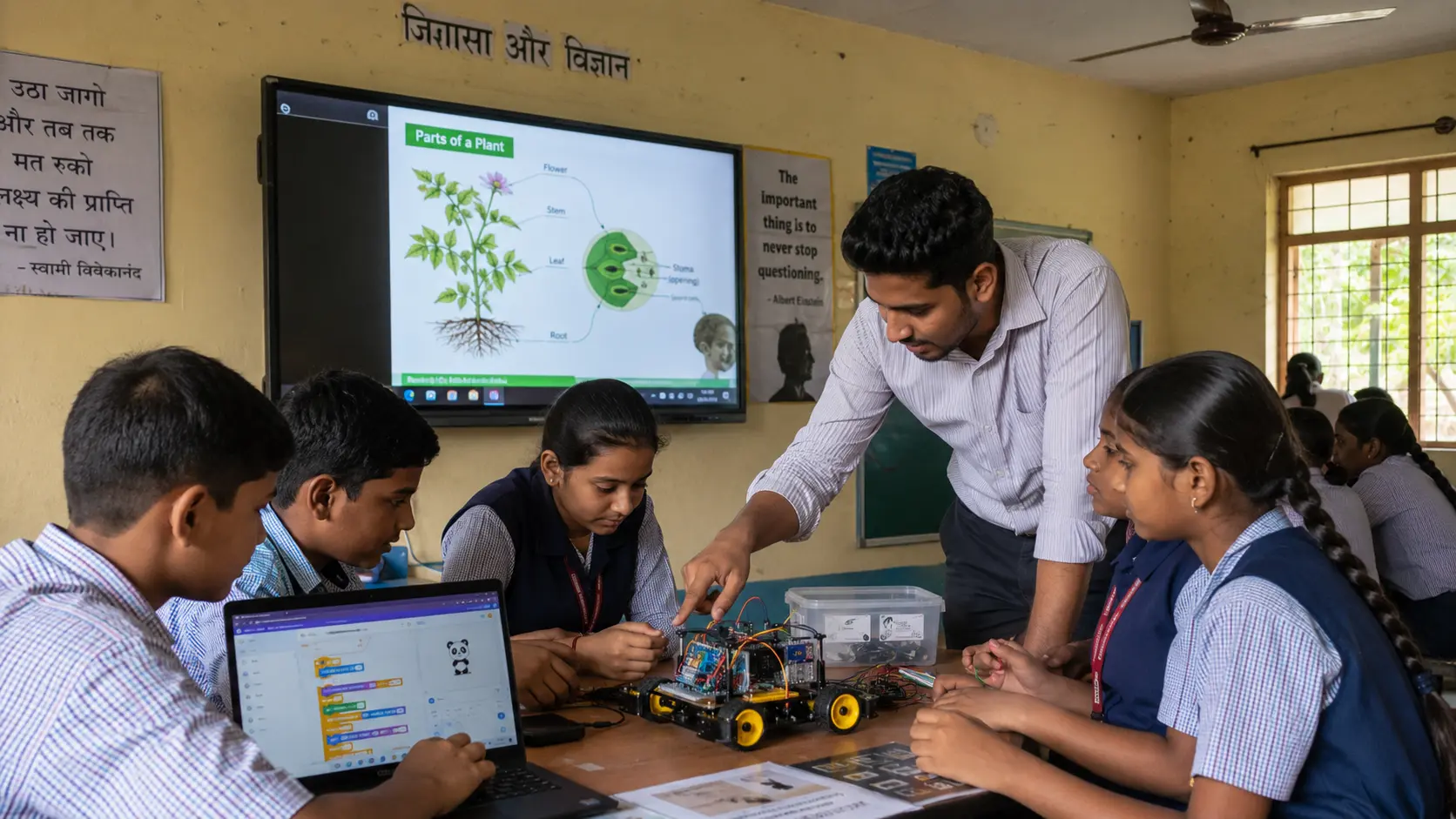
Setting up a STEM education CSR programme in government schools is one of the most impactful things a company can do with its CSR budget — and one of the most mismanaged. The gap between a well-executed STEM programme and an expensive equipment donation that produces no outcomes comes down almost entirely to how the programme is designed and who implements it.
This step-by-step guide is written for CSR managers who are either planning their first STEM programme or looking to improve on a previous attempt.
Before You Begin: Two Things to Get Clear On
Most CSR managers begin their STEM programme planning by looking at equipment catalogues or NGO brochures. That is the wrong starting point. Before any of that, get clarity on two things:
- What do you want students to know or be able to do when this programme ends? A clear learning outcome — even a simple one — will shape every other decision.
- What is your CSR geography and how many schools are you realistically able to cover in year one? Spreading budget too thin across too many schools produces shallow impact everywhere. Concentration produces depth.
With these two anchors in place, the rest of the planning follows a logical sequence.
The 6-Step Process
Identify and Shortlist Government Schools
Work with your District Education Officer (DEO) or municipal education authority to identify government schools in your CSR geography. Selection criteria should include: student enrolment size (larger schools give more beneficiary impact per rupee), existing infrastructure (a room that can house equipment securely), and school management willingness to participate (a resistant principal will undermine any programme).
For companies with a STEM focus, prioritise schools with strong Science enrolment in Grades 8–12.
Choose Your Modules Based on Grade Profile
A STEM education programme is not one-size-fits-all. The right modules depend on the grades you are targeting. For primary schools (Grades 1–5): STEM models, Smart Digital Classroom, and Computer Literacy are the right entry points. For middle and secondary schools (Grades 6–10): add Robotics, Coding, and IoT.
For senior secondary (Grades 11–12): AI, IoT, and Astronomy are appropriate. SMILE HUB’s 9-module structure covers all three levels — and can be implemented in full or in select combinations based on your school’s grade profile.
Vet the Implementing NGO Thoroughly
The implementing NGO is the most important variable in your programme’s success. Equipment can be replaced. A bad NGO relationship cannot be easily unwound mid-year. Before signing any agreement, verify: CSR-1 registration on the MCA21 portal (mandatory since 2021), 80G and 12A certificates, Niti Aayog registration, geographic presence in your specific CSR district — not just a metro office, track record of multi-year programme implementation (not one-off events), and sample impact reports from previous programmes.
Ask specifically: what happens to programme delivery if your assigned trainer leaves?
Design for Impact — Not for the Inauguration Photo
The inauguration photo is not the outcome. The outcome is what students can demonstrate six months after the lab is running. Two decisions at the design stage determine this: whether a dedicated trainer is included (non-negotiable for sustained impact), and whether teacher training is treated as a programme priority (a trained teacher multiplies impact after the programme formally ends).
Do not cut these to save budget. They are the programme.
Set a Realistic Timeline and Phasing Plan
A single-school SMILE HUB installation from project sign-off to operational takes 45–60 days — covering procurement, logistics, installation, trainer deployment, and teacher orientation. Multi-school rollouts are phased over 90–120 days.
Build this into your CSR planning calendar. Q3 and Q4 (October–March) are the most active deployment months — do not plan for a March 31 inauguration without signing off in January.
Impact measurement typically begins showing in month 3–4 of operations.
Define the Reporting Framework Before You Start
The most common CSR reporting failure is trying to reconstruct impact data after the programme has run. Define upfront what you will report: student reach by grade and gender, session hours delivered, learning outcome assessment scores (pre and post), teacher training sessions completed, and equipment utilisation rate.
A credible implementing NGO will have this framework built into their programme management system.
For a detailed look at what a well-run technology education CSR programme looks like on the ground, read our post on Inside a Robotics CSR Project in Rural Schools — it covers the realities of implementation that brochures rarely mention.
The Smart Digital Classroom Question
Many companies ask whether they should add a Smart Digital Classroom component to their STEM programme or treat it as a separate CSR initiative. Our recommendation: integrate it from day one.
A Smart Digital Classroom upgrades every subject across every grade — meaning your CSR investment impacts the entire school population, not just the students in the STEM lab.
- Our post on The Power of Smart Digital Classroom CSR Programs explains how digital classroom integration works alongside a STEM programme.
What a SMILE HUB Setup Covers (That Most Programmes Don’t)
- Government and school liaison — Samabhavana handles all MoU documentation with the school and education authority.
- Custom curriculum mapping to NCERT/SCERT standards for the specific grades in each school.
- Dedicated on-site trainer who conducts daily student sessions and monthly teacher training.
- Equipment maintenance and replacement support throughout the programme period.
- Quarterly impact reports with student outcome data, ready for BRSR and CSR-2 filing.
For the compliance documentation your company needs for a government school STEM programme, see our guide: How Teacher Training CSR Programmes Transform Classrooms.
Common Mistakes to Avoid – how to set up STEM education CSR programme India
- Selecting schools based on convenience rather than community need — this weakens your Schedule VII justification.
- Splitting budget across too many schools in year one — depth of impact in 2 schools is more valuable than presence in 10.
- Choosing an NGO based on lowest cost rather than implementation track record.
- Planning for a financial-year-end installation — the effective programme period shrinks to weeks, not months.
- Measuring success in equipment delivered rather than learning outcomes achieved.
| Bring SMILE HUB to Your CSR Geography Samabhavana handles every step in this guide — from school selection and government liaison to installation, trainer deployment, and documentation. 25+ years. 1000+ SMILE Hubs. Pan India. |
Contact us: info@samabhavana.in
Call: 022-45658306 | samabhavana.in/smile-hub.html
Related Reading: Inside a Robotics CSR Project | Smart Digital Classroom CSR | Teacher Training CSR