
How SMILE HUB Qualifies Under Schedule VII Item II And What Documents Your Company Needs
Before any CSR commitment is made, the compliance question must be answered first.
For STEM education programmes, the question is almost always the same: does this qualify under Schedule VII of the Companies Act 2013, and what documentation does our company need to demonstrate that it does?
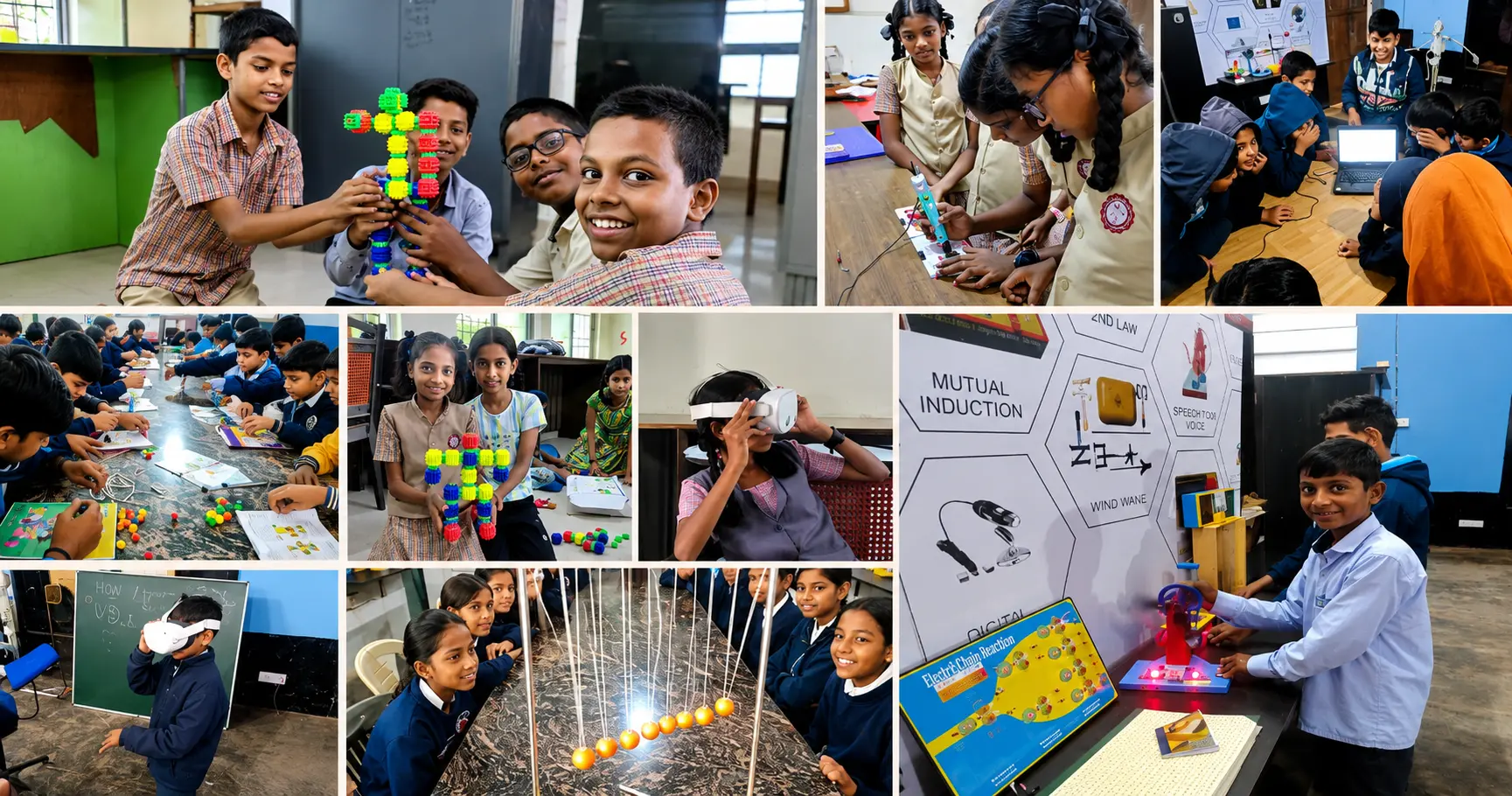
This guide answers both questions specifically for SMILE HUB — Samabhavana’s 9-module STEM education CSR programme.
What Schedule VII Item II Actually Says
Schedule VII of the Companies Act 2013 lists the categories of activities that qualify as eligible CSR expenditure. Item II is the education clause, and it covers two distinct categories that are relevant to SMILE HUB:
| “Promoting education, including special education and employment enhancing vocational skills especially among children, women, elderly, and the differently abled and livelihood enhancement projects.” — Schedule VII, Item (ii), Companies Act 2013 |
This single clause covers two separate qualifying routes for SMILE HUB:
- Promoting education — for STEM modules targeting students in government schools (Grades 1–12). This is the primary qualification route for SMILE HUB’s STEM, Astronomy, Smart Digital Classroom, and Computer Literacy modules.
- Employment-enhancing vocational skills — for Robotics, AI, IoT, and Coding modules targeting students at the Class 8–12 level, where the skills being developed are directly linked to future employment in technology sectors.
Both routes are valid. Many SMILE HUB programmes will qualify under both simultaneously.
The NEP-2020 Alignment Advantage
Beyond the Schedule VII clause, SMILE HUB’s alignment with the National Education Policy 2020 strengthens the compliance case in a way that is increasingly valuable for CSR-2 filings and BRSR disclosures.
NEP-2020 mandates the integration of Technology, Coding, Artificial Intelligence, and Computational thinking into school education across India. SMILE HUB is designed specifically to deliver on these NEP-2020 mandates in government schools that lack the internal capacity to implement them independently.
A CSR programme that is explicitly aligned to a National Education Policy — with documented curriculum mapping — is a significantly stronger compliance position than one that simply donates equipment.
This is a distinction we explore in detail in our post on AI and IoT Education CSR in India, which covers the policy context and implementation requirements for technology education CSR.
Does SMILE HUB Qualify for PSU Companies? – SMILE HUB Schedule VII Compliance
Yes — and the compliance standard for PSU CSR is higher, not lower. PSU CSR programmes are subject to CAG scrutiny, RTI queries, and in some cases parliamentary review.
As we outlined in our guide on CSR for PSU Companies in India, PSU CSR managers need an implementing agency that can provide documentation that holds up under audit — not just a programme that delivers activities.
SMILE HUB’s compliance infrastructure is built to meet this standard. Every programme includes beneficiary data, session logs, pre- and post-assessment scores, teacher training records, equipment utilisation data, and financial audit trail documentation — structured for CAG-audit-ready reporting.
BRSR Alignment: Which Principal Applies?
For companies filing a Business Responsibility and Sustainability Report (BRSR), SMILE HUB programmes are reportable under Principal 8: Inclusive Growth and Equitable Development.
Specifically:
- Indicator 8.1: Social impact assessments — SMILE HUB programmes include pre/post learning outcome assessments that satisfy this requirement.
- Indicator 8.2: Rehabilitation and resettlement — not applicable for education programmes.
- Indicator 8.3: CSR details — SMILE HUB’s structured quarterly reports provide all the programme-level data required for the BRSR CSR disclosure section.
For companies that have adopted the BRSR Core (mandatory for the top 150 listed entities from FY2023-24), SMILE HUB’s outcome documentation is designed to meet the higher assurance standard required.
What Documents Your Company Needs
From Samabhavana (Implementing Agency) – SMILE HUB Schedule VII Compliance
- CSR-1 Registration Certificate (MCA21 portal) — mandatory since 2021 for any NGO receiving CSR funds
- 80G Tax Exemption Certificate
- 12A Income Tax Registration
- Niti Aayog / NGO Darpan Registration Certificate
- Maharashtra Charity Commissioner Registration
- Audited financial statements (last 3 years)
- Board resolution authorising CSR programme implementation
- Project proposal with defined beneficiaries, activities, and outcomes
From Your Company
- Board-approved CSR Policy mentioning education / STEM / NEP-2020 alignment
- CSR Committee resolution approving the programme and budget
- Signed Implementation Agreement with Samabhavana
- Transfer of funds to Samabhavana’s dedicated programme account
- Annual CSR-2 Form filed with MCA, citing the programme under Schedule VII Item II
For BRSR Disclosure – SMILE HUB Schedule VII Compliance
- Programme name, objectives, and target community
- Budget allocated vs. budget utilised
- Beneficiary count by grade, gender, and school
- Outcome indicators: learning assessment scores, teacher training sessions, session hours
- Third-party verification reference (available on request for large programmes)
One Important Clarification on Fund Transfer
Some companies ask whether they can transfer CSR funds directly to a school rather than through a registered implementing agency.
Legally, direct transfers to schools are permitted under the Companies Act, but they carry significant compliance risk: schools are not equipped to provide the structured impact documentation, CSR-1-backed receipts, or outcome reporting that CSR-2 filing requires.
The implementing agency model — where a registered NGO like Samabhavana holds the funds and manages the programme — is the approach that minimises compliance risk for the corporate partner.
A Note on the NEP-2020 and SOAR Programme Connection
The Government of India’s SOAR (Skilling for AI Readiness) programme, launched in 2025, introduces foundational AI and machine learning modules for Classes 6–12. SMILE HUB’s Robotics, AI, and IoT modules are directly aligned with the SOAR competency framework. CSR programmes that fund SOAR-aligned technology education can cite this alignment explicitly in their BRSR disclosures and CSR-2 filings — strengthening the government policy justification for the expenditure.
| Want a compliance-ready SMILE HUB proposal for your company? Samabhavana holds valid 80G, 12A, and CSR-1 certifications and is registered with Niti Aayog. We provide the full documentation package your CSR-2 filing, BRSR report, and internal audit require — as part of every programme. Contact us: info@samabhavana.in Call: 022-45658306 | samabhavana.in/smile-hub.html |
Related Reading: CSR for PSU Companies India | AI and IoT Education CSR India | The Role of NGOs in CSR