
How Much Does a STEM Education CSR Programme Cost?
A Budget Guide for CSR Managers
It is usually the first question a CSR manager asks — and for good reason. STEM education programmes range from modest single-school pilots to pan-India multi-year rollouts, and the cost difference between them can be tenfold or more. If you are planning to set up a STEM education programme as part of your company’s CSR mandate.
This guide gives you an honest breakdown of what drives the cost, what realistic budget ranges look like, and what to watch for in quotes that look too good.
Why There Is No Single Answer
STEM education CSR costs vary significantly based on four variables: the number of schools you are covering, the modules you choose to implement, whether the programme includes a dedicated trainer or is equipment-only, and the geographic spread of your CSR mandate. A single-school pilot in Mumbai looks nothing like a 20-school rollout across Jharkhand.
Getting clarity on these four variables before requesting quotes will save you significant time — and prevent you from comparing programmes that are not actually comparable.
The Two Models: Equipment-Only vs. Full Programme
The Equipment-Only Model
Some companies opt to procure and donate STEM equipment — Robotics kits, Science models, computers — to schools directly or through a vendor. The upfront cost is lower. A basic STEM model kit for a primary school can be sourced for ₹3–8 lakh. A robotics kit setup might run ₹8–15 lakh per school depending on the components. On paper, this looks like an efficient use of CSR budget.
The problem is well-documented: equipment without training, curriculum, and sustained support routinely sits unused within 6–12 months. A CSR report that shows ₹12 lakh of equipment donated with no documented student outcomes is not a compliance success — it is a governance risk.
As we outlined in our guide on Inside a Robotics CSR Project in Rural Schools, the trainer and the pedagogy are what make the equipment work.
The Full Programme Model (SMILE HUB) – STEM Education CSR Programme
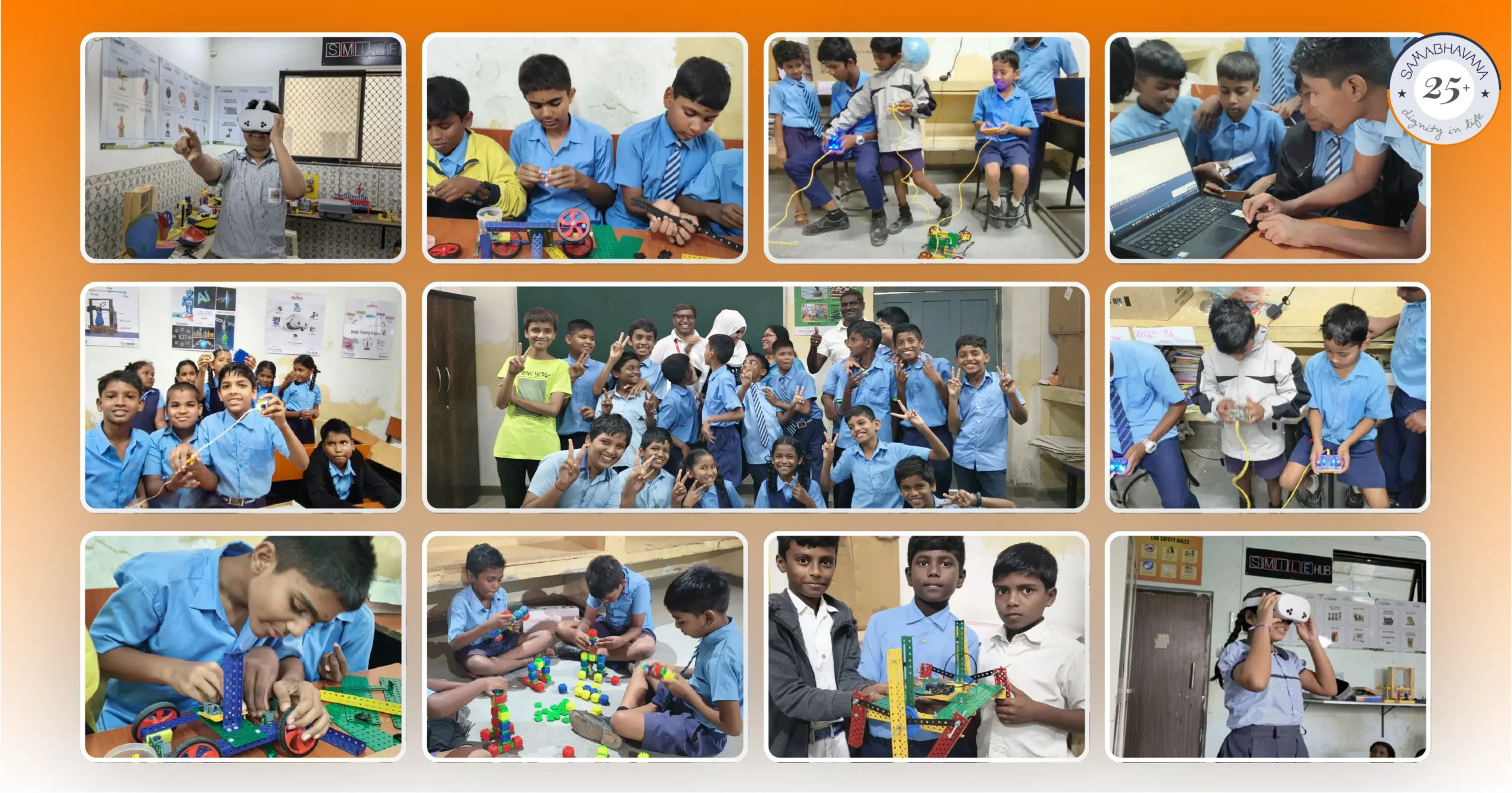
A full STEM Education CSR programme — like Samabhavana’s SMILE HUB — Integrates Hardware, Curriculum, A Dedicated On-Site Trainer, Teacher Orientation, Quarterly Impact Reporting, and BRSR Documentation into a Single Implementation Package.
This is the model that produces measurable, auditable outcomes. It costs more upfront. But it is the only model that delivers on what Schedule VII Item II actually requires:
A Structured Education Initiative with Documented Beneficiary Outcomes.
Realistic Budget Ranges for STEM Education CSR Programme in India
| Scope | Budget Range | What It Covers |
| Single school, equipment only | ₹10–12 lakh | STEM models, robotics kit. No trainer, no curriculum. |
| Single school, full programme | ₹35–45 lakh | Equipment + trainer + curriculum + quarterly reports. |
| 3–5 schools, full programme | ₹1.3 crore – ₹1.5 crore | Multi-school rollout with phased trainer deployment. |
| 10–20 schools, pan-India | ₹5 crore – ₹7 crore+ | Full SMILE HUB suite, all 9 modules, dedicated staff. |
| Multi-year, anchor partnership | ₹40 lakh per school (Full Programme) | Sustained impact, BRSR-ready, named corporate partner. |
Note: These ranges are indicative. Actual costs depend on module selection, geography, trainer deployment model, and programme duration. Samabhavana provides detailed scope-based proposals — not catalogue pricing.
What Drives Cost Up — and What Cheap Quotes Leave Out
When you receive a quote that seems significantly lower than the ranges above, it is worth asking specifically what is included. The most common omissions in low-cost STEM CSR quotes:
- No dedicated trainer — the school teacher is expected to run the programme with minimal support. This is the single biggest predictor of programme failure.
- No teacher training — equipment is delivered without teacher orientation, meaning it sits in a cupboard.
- No impact reporting — outcomes are measured only in headcount (number of students reached), not in learning outcomes.
- No curriculum mapping — the programme is not aligned to NCERT/SCERT standards, making it difficult to justify under Schedule VII.
- No BRSR documentation — the implementing agency cannot produce the structured data your sustainability report needs.
If you are looking to understand how a well-structured education CSR programme is delivered from design to documentation, our blog on AI and IoT Education CSR in India covers the full implementation framework in detail.
The Real Cost Question: What Does Non-Compliance Cost?
CSR managers sometimes calculate the cost of a STEM programme and conclude that a lower-cost, equipment-only approach saves money. This is true in year one.
In year two or three, when an internal audit finds no documented beneficiary outcomes, or when a BRSR disclosure requires learning outcome data that doesn’t exist.
The cost of remediation — or the cost of reputational damage — typically exceeds what a full-programme approach would have cost from the start.
For PSU companies in particular, where CAG audits and RTI queries apply, the documentation standard is non-negotiable.
Our guide on CSR for PSU Companies in India explains the specific compliance requirements that PSU CSR managers need to plan for.
How Samabhavana Structures SMILE HUB Programme Costs
Every SMILE HUB proposal from Samabhavana is scope-based and transparent. We break down costs into four categories: Hardware and Equipment, Trainer Deployment and Training Operations, Curriculum and Materials, and Programme Management and Reporting.
We do not offer catalogue pricing because no two CSR geographies or school contexts are identical.
What every SMILE HUB programme includes regardless of scope: NCERT/SCERT-mapped curriculum, a dedicated On-Site Trainer, Quarterly Impact Reports with Student Outcome Data, Teacher Training, Equipment Maintenance Support, and full BRSR and CSR-2 Documentation.
Key Questions to Ask Any STEM CSR Programme Provider
- Is a dedicated trainer included, or is the school expected to manage the programme independently?
- Does the curriculum map to NCERT/SCERT standards for the specific grades?
- What impact metrics are tracked — outputs (kits delivered) or outcomes (learning levels)?
- Can you provide sample impact reports from previous programmes?
- What documentation is provided for CSR-2 filing and BRSR reporting?
- What is your NGO’s CSR-1 registration number on the MCA21 portal?
| Ready to discuss SMILE HUB for your CSR geography? Samabhavana has implemented 1000+ SMILE Hubs across India over 25 years. We’ll help you design the right programme scope, budget, and timeline — and handle all the documentation for your BRSR and CSR-2 filing. Contact us: info@samabhavana.in Call: 022-45658306 | samabhavana.in/smile-hub.html |
Related Reading: Inside a Robotics CSR Project | AI and IoT Education CSR India | CSR for PSU Companies India