
Sky Lessons: What Astronomy Teaches Children About Patience, Hope, and Their Own Potential
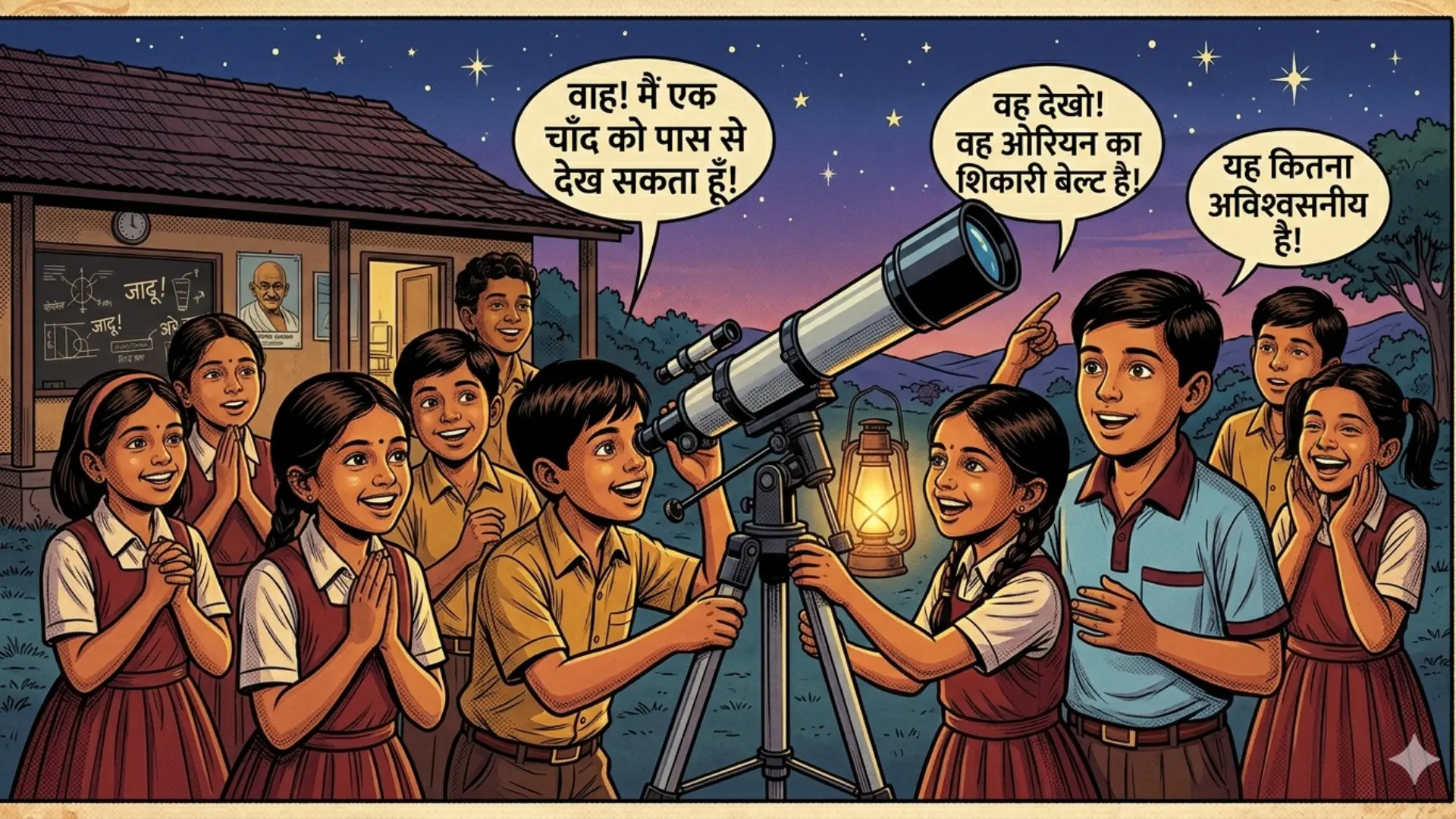
Introduction: The Night India Looked Up Together | Astronomy Education for Children India
On 23 August 2023, India became only the fourth country in history to land a spacecraft on the moon — and the first to land near the lunar south pole.
As Chandrayaan-3’s Vikram lander touched down, millions of Indians watched. Many of them were children. And in that moment, something that had lived in textbooks — the solar system, orbits, space science — became immediate, real, and Indian.
India’s relationship with the sky has always been deep. From ancient astronomical observatories in Jaipur and Delhi to ISRO’s modern achievements, the cosmos has long been part of the country’s cultural and intellectual identity. And yet, for most children studying in government schools across India, astronomy remains an abstract chapter in a science textbook — something to memorise, not experience.
At Samabhavana, through the Smile Hub Programme, we believe that every child deserves the chance to actually look up. Not just to learn facts about the solar system, but to sit with the scale of the universe, to understand patterns that have unfolded over billions of years, and to take from that experience something far more durable than exam answers: patience, perspective, and hope.
This is what astronomy education does when it is done right.
India’s Astronomy Education Gap
India produces some of the world’s finest astrophysicists and space scientists. ISRO is a global benchmark for cost-effective space exploration. And yet, a 2024 baseline survey published on arXiv found that astronomy education in India remains deeply uneven — concentrated in urban, English-medium institutions and largely absent in the government school system that educates the majority of Indian children.
The numbers are telling:
- India has over 1.5 million government schools educating more than 120 million children
- NEP 2020 explicitly mandates “scientific temper” as a core educational outcome — yet dedicated astronomy or space science programmes are available in a fraction of schools
- HDFC Bank Parivartan expanded STEM astronomy education to 47,000 students in 2026 — significant, but a small fraction of the children who need access (Makers Muse, 2026)
- Organisations like SPACE India and the Space Education Foundation have pioneered astronomy education for children — but the reach gap to underserved communities remains enormous
The children most likely to become inspired by India’s space achievements are the least likely to receive structured astronomy education. This is an equity problem, a STEM pipeline problem, and a CSR opportunity.
Why Astronomy Is Different from Every Other Subject
Most school subjects demand quick recall. Astronomy invites something rarer: sustained observation.
When children learn about the phases of the moon, they cannot simply memorise a diagram and move on. They have to watch. Night after night, week after week, the moon changes — and the pattern only reveals itself to those patient enough to notice it.
This is the first and most important lesson astronomy teaches: the universe does not rush, and neither should you.
In a world of instant notifications, 30-second videos, and same-day answers, this is a radical and necessary counterweight. Children who practice observation develop attention spans that carry into every area of their lives.
The ability to watch something slowly unfold — without anxiety, without needing an immediate result — is a cognitive and emotional skill that formal education rarely teaches directly.
At Samabhavana’s Smile Hub centres, educators consistently observe that astronomy sessions produce something unusual: stillness. Children who are often restless in conventional lessons become focused, quiet, and genuinely absorbed when engaging with the night sky.
What the Sky Actually Teaches | Astronomy Education for Children India
Patience. Earth takes one year to orbit the sun. Saturn takes 29 years. Some stars visible tonight have been burning for billions of years. These facts aren’t just scientific trivia — they are reminders that meaningful things develop slowly. For children navigating academic pressure and social anxiety, this perspective is quietly powerful.
Perspective. When children understand that the light from the nearest star beyond our sun takes more than four years to reach us — that the star itself may no longer exist — the problems of a difficult school day or a hard week begin to feel more manageable. Astronomy doesn’t minimise a child’s struggles. It contextualises them within something vast enough to hold them.
Pattern recognition. The sky is the original data set. Seasons, tides, eclipses, planetary positions — all follow patterns that human beings learned to read long before formal science existed. Children who learn to notice patterns in the sky develop the same cognitive habit in mathematics, language, and problem-solving.
Consistency. The sun rises every morning. The moon follows its phases reliably. The constellations return to the same positions each year. For children whose home environments may be unpredictable or stressful, the regularity of the sky offers something that anxiety-filled classrooms often cannot: the reassurance that some things can be trusted to behave as expected.
Curiosity without competition. There are no wrong answers when a child asks why Saturn has rings, or whether other planets have oceans, or whether anyone lives in another galaxy. Astronomy is the rare subject where questions are more celebrated than answers — and where “nobody knows yet” is a legitimate and exciting response. This creates a learning environment that is psychologically safe for children who have been trained by conventional schooling to fear being wrong.
India’s Cultural Connection: Science Meets Heritage
Astronomy education in India carries an additional dimension that no other country quite replicates.
The subcontinent has one of the world’s oldest traditions of astronomical observation. The Jantar Mantar observatories built by Maharaja Jai Singh II in the early 18th century remain among the most sophisticated pre-telescopic instruments ever constructed. Indian astronomers calculated the length of the solar year with extraordinary precision centuries before modern technology.
Folk traditions across India’s regions are woven with references to stars, planets, and celestial events — in festivals, in agriculture, in navigation, in the stories grandparents tell. When children learn that Diwali’s timing is connected to lunar cycles, or that Magha (the Aquarius constellation) features in classical Sanskrit literature, the boundary between science and heritage dissolves.
At Smile Hub centres, Samabhavana’s approach to astronomy deliberately incorporates India’s cultural astronomical heritage alongside modern space science. Children learn about Chandrayaan and Mangalyaan in the same sessions where they discuss ancient Indian astronomical traditions. Science becomes something that belongs to them — not a foreign import, but a living part of their own culture.
This integration matters for learning outcomes. Research on culturally responsive pedagogy consistently shows that children engage more deeply with content they can connect to their own identity and community. When astronomy feels like their subject — Indian, local, historically rooted — children invest in it differently.
The CSR Case for Astronomy Education | Astronomy Education for Children India
Under Schedule VII of the Companies Act, 2013, science education and STEM promotion in schools are eligible CSR activities. Astronomy education specifically sits at the intersection of multiple Schedule VII themes: education, skill development, and the promotion of scientific temper — a constitutional value under Article 51A(h) of the Indian Constitution.
For corporate CSR teams, astronomy education in underserved schools offers three distinct strategic advantages:
Distinctive visibility. Computer labs and school buildings are common CSR investments. A programme that brings telescopes, space models, and planetarium sessions to children who have never experienced them is visible, memorable, and stories well — in CSR reports, media coverage, and employee engagement.
ISRO alignment. India’s space programme is a point of national pride. CSR investments in astronomy education tap directly into that cultural moment — aligning corporate identity with India’s broader space aspirations in a way that resonates with employees, communities, and media.
Long-term STEM pipeline. India will need hundreds of thousands of space scientists, engineers, and researchers over the next three decades as ISRO, DRDO, and the private space sector expand. CSR investments in early astronomy education contribute to that pipeline from the bottom up — starting with the children least likely to find their way into STEM without intervention.
Samabhavana’s Smile Hub astronomy module is designed to deliver all of these outcomes, with full impact documentation and Schedule VII compliance support.
🔗 Explore Samabhavana’s Education programmes: Education
🔗 See the full Smile Hub technology curriculum: Smart Digital Class
🔗 Partner with us for CSR: Donors & Partners
What Smile Hub’s Astronomy Module Delivers
Samabhavana’s astronomy education is not a one-off event. It is a structured module within the broader Smile Hub curriculum, delivered over multiple sessions with progressive depth:
- Solar system exploration — hands-on scale models, orbital mechanics, and planetary comparison that make abstract facts tangible
- Sky observation sessions — guided observation of the moon, visible planets, and key constellations using simple equipment accessible in any school setting
- India’s space story — age-appropriate exploration of ISRO’s missions, Indian contributions to astronomy, and career pathways in space science
- Cultural astronomy — connecting celestial events to Indian festivals, folklore, and ancient observation traditions
- Inquiry-led discussion — open-ended questions designed to develop scientific thinking, not just factual recall
Every cohort is assessed at baseline and endline for knowledge gain, curiosity indicators, and engagement levels. CSR partners receive structured impact reports documenting both learning outcomes and programme reach.
Frequently Asked Questions
1. Can astronomy be taught without expensive equipment? Yes. The most meaningful astronomy education requires very little hardware — the naked eye, a clear sky, and a thoughtful facilitator are sufficient for most foundational learning. Scale models, printed star charts, and basic moon-phase observational diaries are low-cost tools that produce high-impact learning. At Smile Hub, we design for resource constraints without compromising on depth.
2. At what age should children start astronomy education? Children as young as 6–7 can engage meaningfully with basic concepts like day and night, the moon’s phases, and the planets. From age 10 onwards, more complex ideas — orbital mechanics, stellar distances, India’s space programme — become accessible. Early exposure builds the curiosity and vocabulary that make secondary science education significantly more effective.
3. Is astronomy education eligible under Schedule VII CSR? Yes. Astronomy and space science education in schools qualifies under the education and STEM promotion provisions of Schedule VII of the Companies Act, 2013.
It also aligns with Article 51A(h) of the Indian Constitution — the duty to develop scientific temper — making it politically resonant for PSU CSR teams reporting to government stakeholders.
4. How does astronomy support children’s mental health and emotional development? Research in nature-based and inquiry-based learning consistently links astronomy education to improved emotional regulation, reduced anxiety, and stronger sense of perspective in children.
The non-competitive, observation-based nature of astronomy creates a psychologically safe environment that benefits children who struggle in conventional high-pressure academic settings.
5. What makes Samabhavana’s approach to astronomy education different? We integrate India’s cultural and historical astronomy heritage with modern space science — making it relevant and personally meaningful to children from diverse backgrounds.
We design for low-resource settings. And we embed astronomy within a broader STEM curriculum (Smile Hub) that includes robotics, AI basics, and digital literacy, so children experience science as interconnected, not siloed.
6. How can our company fund astronomy education through CSR? Samabhavana partners with corporate CSR teams to design, fund, and implement astronomy education modules in government schools in or near their operational areas.
We handle programme design, educator training, material development, delivery, impact measurement, and MCA compliance documentation. Get in touch at info@samabhavana.in to discuss your specific geography and goals.
Conclusion: The Sky Has Always Been India’s Classroom
Long before textbooks, before formal schools, before ISRO — the sky was how India learned.
It taught farmers when to plant. It gave sailors direction. It helped astronomers build calendars and philosophers contemplate time. The sky was the first shared curriculum.
When a child from a government school in a Mumbai suburb or a village in Vidarbha first sees Saturn’s rings through a telescope — when they understand that the light from that distant planet has been travelling toward them for over an hour — something changes. The universe becomes real. Science becomes personal. And the future becomes imaginable in ways it wasn’t a moment before.
This is what Samabhavana’s Smile Hub astronomy programme is built to create. Not just scientific knowledge — though that matters. But the deeper experience of a child discovering that the cosmos includes them too. Astronomy Education for Children India
Samabhavana is a Mumbai-based NGO with 25+ years of experience in CSR implementation across education, health, skill development, and community development.
Our Smile Hub programme brings astronomy, robotics, AI, and digital literacy to children in underserved schools across India. If your organisation is looking to fund STEM education through CSR, connect with us.