
Looking Up: How Astronomy Education CSR Gives Children a Bigger World
There is a moment — it happens reliably, across cultures and geographies — when a child looks through a telescope for the first time and sees the rings of Saturn. Not in a textbook diagram, not on a screen, but actually sees them: faint, precise, impossibly real.
The effect is difficult to describe and impossible to forget. Astronomy education CSR brings this experience to children in government schools and underserved communities who would otherwise never encounter it — and in doing so, it opens something that extends far beyond a science lesson.
India has a particular relationship with the cosmos. ISRO’s achievements — from Chandrayaan-3’s historic soft landing on the Moon’s south pole in 2023, to the Aditya-L1 solar mission, to the ambitions of Gaganyaan — have given the country a renewed sense that space is not just a domain for the powerful and the wealthy, but a frontier that belongs to India.
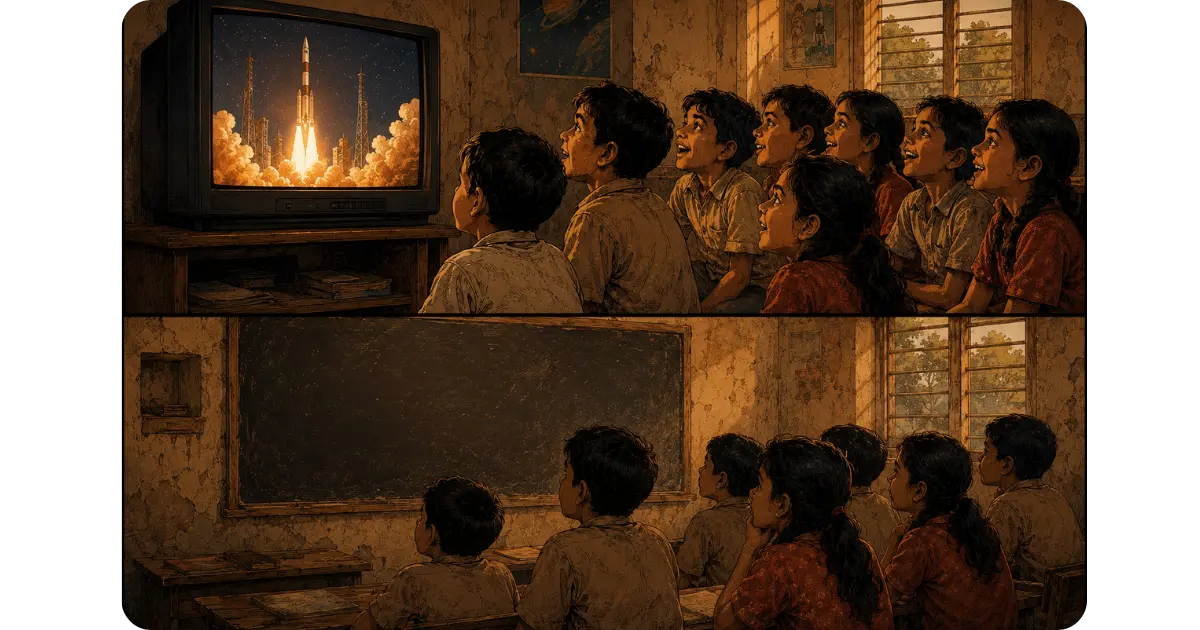
When a child in a village school in Rajasthan sees ISRO scientists celebrating a successful lunar mission on a classroom screen, something shifts in what they believe is possible for people like them. Astronomy education in schools is the bridge between that inspiration and a child’s own sense of potential.
The Science of Wonder: What Astronomy Teaches
Astronomy is not a subject that can be taught in isolation. It draws on mathematics, physics, geography, history, and culture simultaneously — making it one of the most naturally multi-disciplinary subjects in the school curriculum.
When children learn about the scale of the solar system, they are practising mathematical reasoning. When they track the movement of stars across seasons, they are learning about the Earth’s rotation and orbit.
When they explore cultural astronomy — the ways in which Indian civilisations mapped the stars, named the nakshatras, and used celestial observation to develop the calendar and navigate the seas — they are connecting science to history, culture, and identity.
This multi-disciplinary richness makes astronomy an unusually effective vehicle for inquiry-based learning. A child who wants to know why Jupiter has so many moons will need mathematics, physics, and persistence. A child who wants to know how the ancient astronomers of Ujjain built the Jantar Mantar will need history, geometry, and spatial reasoning. The subject does not allow passive reception — it demands active curiosity.
For children who have struggled to find a way into the sciences through textbook instruction, astronomy can be a revelatory entry point. It begins with observation — something every child can do — and builds from there toward deeper understanding. The barrier to entry is lower than in many other STEM subjects, yet the ceiling is as high as anyone wants to take it.
ISRO and the Inspiration Ecosystem
ISRO runs the START (Space Science and Technology Awareness Training) programme for post-graduate and final-year undergraduate students, and the Antriksh Jigyasa portal for online space science learning.
These initiatives create an ecosystem of space inspiration that CSR-funded school astronomy programmes can connect to — giving children a pathway from a stargazing session in their school courtyard to the possibility of a career in India’s space sector.
When a Samabhavana Smile Hub astronomy programme brings a telescope to a school in a semi-urban area of Maharashtra, it is not just providing a science activity. It is connecting children to this larger ecosystem of inspiration — letting them see themselves as part of India’s space story, not just distant spectators of it.
Why Astronomy Education CSR Works
Astronomy education CSR works for several reasons that are specific to the format and the context. First, the experience of looking through a telescope is intrinsically memorable. Most school education asks children to absorb information; astronomy asks them to see something that they have never seen before and will not forget. That quality of experience is the foundation of lasting curiosity.
Second, astronomy is accessible. You do not need expensive lab equipment to run a meaningful astronomy session. A telescope, a clear sky, a knowledgeable facilitator, and a group of children who have never looked at the moon’s craters up close is enough to create a profound learning experience.
Astronomy makes scientific wonder accessible at relatively low cost — an important consideration for NGOs and CSR programmes working at scale across many schools.
Third, astronomy has strong cultural resonance in India. The country’s astronomical heritage — the Vedic calendar, the Panchangam, the observatory traditions, the mathematical contributions of Aryabhatta — means that school astronomy can be taught as both modern science and cultural heritage. This dual framing builds engagement across diverse communities and gives the subject a grounding that feels meaningful, not merely technical.
Astronomy education CSR qualifies under Schedule VII of the Companies Act 2013 as promotion of education and, where delivered in government schools serving disadvantaged communities, as a livelihood enabler — since STEM education directly affects employability in an economy where technology skills are increasingly central to income.
Samabhavana’s Smile Hub: Astronomy as Community Experience
Samabhavana’s Smile Hub initiative integrates astronomy into a broader community learning experience. Regular stargazing sessions bring children — and often their parents and siblings — together for guided observation, storytelling about the cosmos, and discussion of India’s space achievements.
These sessions are designed to be social as well as educational: they create community around learning, building the kind of collective curiosity that sustains scientific interest beyond a single event.
The facilitators who run Smile Hub astronomy sessions are trained not just in astronomy content but in facilitation techniques that work with the specific age groups, learning contexts, and cultural backgrounds of the communities they serve.
They know how to connect Saturn’s rings to a child’s sense of wonder, how to link Chandrayaan-3 to a class discussion about Indian achievements, and how to handle the genuine questions — “How big is the universe?”, “Is there life on other planets?” — that astronomy reliably produces.
For corporate partners, Smile Hub offers a well-designed, community-rooted platform for education CSR investment that produces visible, memorable outcomes. Children and communities remember astronomy experiences. They talk about them. They inspire other children to attend. The ripple effect of a well-run stargazing programme extends well beyond the children who participated on the night.
Learn more about Samabhavana’s education work, including Smile Hub, on our education page.
Cultural Astronomy and the Indian Tradition
India’s astronomical heritage is one of the richest in the world and one of the least known to school-age children. The Jantar Mantar observatories of Jaipur, Delhi, Mathura, Varanasi, and Ujjain — built by Maharaja Jai Singh II in the eighteenth century — are UNESCO World Heritage Sites that represent one of the most sophisticated pre-telescopic astronomical traditions anywhere.
The Aryabhatiyam, written in the fifth century CE, accurately calculated the earth’s rotation and laid the foundation for Indian mathematics and astronomy for a millennium. The Indian National Calendar is derived directly from this tradition.
Astronomy education programmes that incorporate these cultural dimensions are not just teaching science — they are reconnecting children to a heritage of intellectual achievement that belongs to them.
For many children in communities where self-confidence and aspiration are in short supply, the discovery that people from their civilisation were mapping the stars while much of the world was in what Europe called the Dark Ages can be genuinely transformative.
This is the depth of what astronomy education CSR at its best can do — not just teach the mechanics of the solar system, but expand a child’s sense of who they are and what they come from.
CSR Partner Engagement
For corporate partners interested in astronomy education CSR, Samabhavana offers programme designs that range from single-school telescope installations with facilitator training to multi-school, multi-year Smile Hub partnerships with regular programming and impact reporting.
We work with CSR teams to align the programme with their sector focus, geography, and BRSR reporting requirements.
Astronomy CSR is also an effective employee engagement vehicle: corporate volunteers who participate in a Smile Hub stargazing session alongside community children consistently report it as one of the most meaningful volunteer experiences they have had. It creates connection between employees and community in a way that feels genuine rather than performative.
Explore CSR partnership opportunities on our PSU and donor partners page, or contact us directly to discuss a programme.
FAQ – Astronomy Education CSR
Q1: What is astronomy education CSR and how does it work in India?
Astronomy education CSR involves corporate-funded programmes that bring stargazing experiences, telescopes, astronomy workshops, and space science learning to school children — particularly in government schools and underserved communities. It operates under Schedule VII of the Companies Act 2013 as education CSR.
Q2: How does ISRO inspire school astronomy programmes?
ISRO’s missions — including the Chandrayaan-3 Moon landing and Gaganyaan — have made space a source of national inspiration. ISRO’s own programmes, including YUVIKA (for Class 9 students) and START (for undergraduates), create a broader ecosystem that school-level astronomy CSR can connect to, giving children a sense of belonging to India’s space story.
Q3: Is astronomy education eligible under Schedule VII CSR?
Yes. Astronomy education delivered in school or community settings qualifies under Schedule VII as the promotion of education. Where delivered in government schools serving underprivileged communities, it also supports livelihood enablement through STEM skills development.
Q4: What is the Smile Hub programme?
Smile Hub is Samabhavana’s enriched community learning platform that integrates astronomy, STEM, digital literacy, and cultural education for children in underserved communities. It combines telescope-based stargazing sessions with storytelling, Indian astronomical heritage, and ISRO-inspired learning.
Q5: Why is cultural astronomy important in Indian school education?
India has one of the world’s richest astronomical heritages — from Aryabhatta’s fifth-century calculations to the Jantar Mantar observatories. Incorporating cultural astronomy into school programmes connects children to this heritage, builds cultural pride, and creates a bridge between ancient and modern science.
Q6: How can companies support astronomy education through CSR?
Companies can fund telescope installations, trained facilitators, curriculum materials, and multi-year Smile Hub programmes. Samabhavana handles programme design, implementation, and impact reporting.
Contact us to design an astronomy education CSR programme for your communities.
CONCLUSION – Astronomy Education CSR
When a child looks through a telescope and sees the rings of Saturn for the first time, something changes that no worksheet or textbook can produce.
Astronomy education CSR is one of the most imaginative investments available within India’s Schedule VII framework — and one of the most memorable. It builds curiosity, connects children to India’s space heritage, and opens doors to STEM careers through an experience that lasts a lifetime.
Contact Samabhavana to bring a Smile Hub Astronomy Programme to your CSR communities. Let your investment be the night a child looked up — and decided to reach higher.