
First Time Seeing the Moon Through a Telescope: How Astronomy Inspires Children
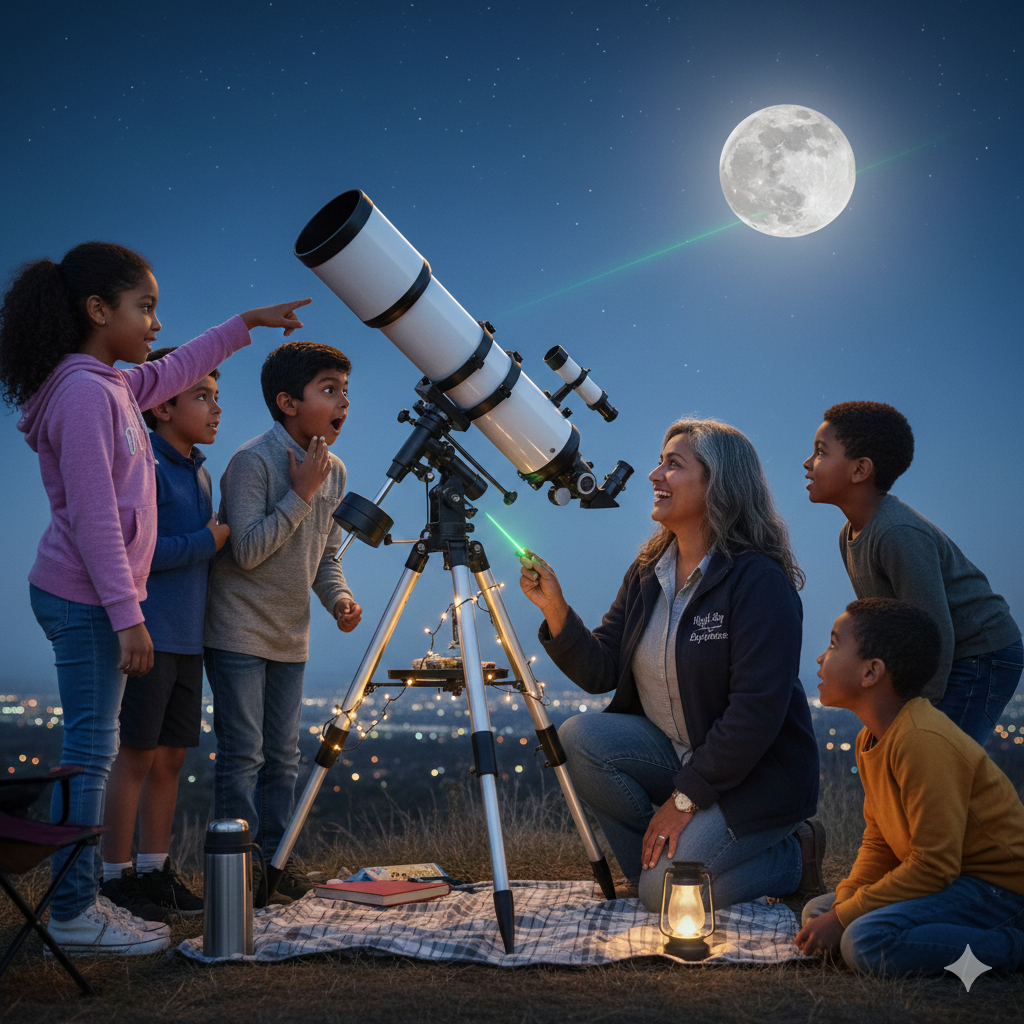
The moon is familiar to most children. They see it while traveling at night, from rooftops, through windows, or during power cuts. It appears calm, smooth, and constant.
But everything changes the first time a child sees the moon through a telescope.
Suddenly, the smooth white circle reveals craters, shadows, textures, and depth. What once seemed flat becomes detailed and alive. In that moment, something shifts—not just in what the child sees, but in how they think.
This first telescope experience often becomes unforgettable, especially in classrooms where astronomy is introduced through simple, hands-on learning.
The Emotional Impact of Seeing the Moon Up Close
When children wait for their turn at the telescope, emotions are mixed:
- Excitement
- Curiosity
- Nervousness
- Impatience
There is often a brief hesitation before they lean in to look through the lens.
Then comes the reaction.
Sometimes a gasp.
Sometimes laughter.
Sometimes silence.
Many step back and say, “It’s not flat!”
That realization stays with them forever.
Textbooks can explain lunar craters. Diagrams can show surface features. But nothing compares to the emotional impact of direct observation.
According to NASA’s Moon exploration resources, hands-on astronomy experiences significantly improve scientific curiosity and engagement in children.
Source: https://moon.nasa.gov/
Why Practical Astronomy Learning Is So Powerful
Moving Beyond Textbooks
In many classrooms, science is often taught through memorization. But astronomy changes the approach.
When children see the moon through a telescope:
- Learning becomes discovery
- Observation replaces memorization
- Questions replace passive listening
They are not just learning about the moon—they are experiencing it.
At organizations like Samabhavana, experiential learning plays a vital role in child development. Initiatives focus on creating opportunities where children engage directly with science, curiosity, and exploration.
Learn more about educational initiatives at Samabhavana
How Astronomy Improves Focus and Attention
Teachers often observe something surprising during telescope sessions.
Even students who struggle with concentration become fully attentive.
Astronomy slows children down.
They must:
- Wait patiently
- Observe carefully
- Focus deeply
- Think critically
In today’s fast-paced digital world, this kind of slow, mindful learning is rare and valuable.
According to research highlighted by UNESCO’s science education programs, inquiry-based learning strengthens long-term understanding and critical thinking skills.
(Source: https://www.unesco.org/en/education/science-technology)
Building Confidence Through Scientific Equipment
For many Indian children—especially those from homes with limited exposure to scientific tools—using a telescope may be their first hands-on experience with real equipment.
Holding it.
Adjusting it.
Looking through it correctly.
These small actions build confidence.
Children begin to understand that science is not distant or exclusive.
It is accessible.
It belongs to them too.
This sense of inclusion is powerful in making education feel personal rather than intimidating.
Encouraging Questions Beyond the Curriculum
Astronomy naturally inspires deeper questions:
- Why does the moon have craters?
- Why do shadows shift?
- Why does the moon change shape?
- How far away is it?
These are not exam-driven questions.
They are curiosity-driven questions.
And curiosity is the foundation of scientific thinking.
When teachers guide discussions gently—without rushing to give every answer—children learn something more important than facts.
They learn how to think.
Astronomy and Emotional Development in Children
The first telescope experience often triggers strong emotional responses:
- Awe
- Wonder
- Humility
- Inspiration
Some children feel small in comparison to the universe.
Others feel excited to be part of something vast.
These reflections foster both intellectual and emotional growth.
Children begin to understand concepts like:
- Scale
- Distance
- Time
- Movement
Learning that lunar craters formed millions of years ago or that the moon follows consistent patterns introduces perspective and patience.
Astronomy as a Balance in High-Pressure Classrooms
In many Indian classrooms, academic pressure can be intense.
Astronomy offers a refreshing counterbalance:
- No immediate tests
- No right or wrong emotional reaction
- No pressure to memorize instantly
Learning happens through discussion and observation.
This relaxed environment often strengthens the bond between teachers and students. During telescope sessions, the teacher becomes a fellow observer—not just an instructor.
Developing Life Skills Through Astronomy
When children observe the moon carefully, they develop more than scientific knowledge.
They build:
- Observation skills
- Patience
- Critical thinking
- Curiosity
- Open-mindedness
Astronomy teaches children that some answers require calm attention and time.
These lessons extend far beyond science. They influence how children approach challenges, academics, and life itself.
Inclusion and Shared Wonder
One of the most beautiful aspects of astronomy sessions is unity.
Regardless of background, language, or academic performance, every child responds with the same curiosity when they see the moon clearly for the first time.
Wonder is universal.
That shared experience strengthens inclusion in classrooms and learning spaces.
At organizations like Samabhavana, creating inclusive educational experiences helps children feel connected, valued, and capable.
The Power of Simple Infrastructure
Importantly, inspiring astronomy learning does not require advanced laboratories.
All it takes is:
- A simple telescope
- Clear guidance
- A safe space for discussion
- Encouragement to ask questions
Experience matters more than complexity.
For children who do not consider themselves “science-oriented,” astronomy can be transformative. It shows them that science is not only formulas and exams—it is also wonder and discovery.
Conclusion: More Than Just Looking at the Moon
When a child sees the moon through a telescope for the first time, they are not just learning about space.
They are learning:
- To observe deeply
- To question thoughtfully
- To stay curious
- To think independently
Astronomy reminds children that the familiar can become extraordinary when viewed closely.
And often, all it takes to begin that journey is one glance at the moon.