
From Classrooms to Code: How AI and IoT Education CSR Is Shaping India's Future
INTRODUCTION
India is in the middle of the most significant shift in its educational history since the introduction of the National Education Policy-2020. The government has committed to embedding artificial intelligence into the school curriculum from Grade 3 by the 2026–27 academic year.
The Ministry of Skill Development launched SOAR — Skilling for AI Readiness — in 2025. The Union Budget 2025–26 earmarked ₹500 crore to establish a Centre of Excellence in Artificial Intelligence for Education. The signal is unambiguous: AI and IoT competency is no longer a premium add-on for elite private schools. It is being positioned as a foundational skill for every Indian child.
Yet between national policy and ground-level reality sits a gap that government alone cannot close. Public schools in underserved communities lack the hardware, trained teachers, and pedagogical frameworks to deliver technology education meaningfully. That gap is precisely where corporate CSR — when implemented well — can make a structural difference.
This is not about donating tablets or installing a computer lab and declaring success. AI and IoT education CSR done right is about building the ecosystems — teacher training, curriculum design, hands-on experiential learning, and sustained community engagement — that turn technology access into technology literacy.
This article explains what effective AI and IoT education CSR in India looks like, how it qualifies under Schedule VII, what implementation requires, and what every CSR manager must demand before committing to a technology education programme.
THE NATIONAL CONTEXT — WHY THIS MOMENT MATTERS
India’s policy momentum on AI in education is real and rapid. The SOAR (Skilling for AI Readiness) programme, launched by the Ministry of Skill Development and Entrepreneurship in July 2025, introduces foundational AI and machine learning concepts through three targeted 15-hour modules for students in Classes 6 to 12, plus a 45-hour upskilling module for teachers.
This is one of the most structured government-led AI skilling initiatives India has seen at the school level.
Simultaneously, the National Curriculum Framework for School Education 2023 has laid a pedagogical foundation for integrating technology — including AI, computational thinking, and data literacy — into mainstream school education. When AI becomes a curriculum subject from Grade 3 in 2026–27, the schools that have already built AI and IoT infrastructure and sustainable trained teachers through CSR partnerships will be significantly ahead.
HOW AI AND IOT EDUCATION QUALIFIES UNDER SCHEDULE VII
Before a CSR manager commits a budget, the compliance question must be answered: does AI and IoT education qualify under Schedule VII of the Companies Act, 2013?
The answer is YES!! — on multiple counts.
Schedule VII Item (ii) covers “promoting education.” This includes not just traditional literacy and numeracy but any education initiative that enhances the knowledge, skills, and capabilities of students. AI and IoT education programmes at schools clearly fall within this category, provided the intervention targets students in underserved or underrepresented communities.
Schedule VII Item (ii) also covers “promoting vocational skills especially among children, women, elderly, and the differently abled and livelihood enhancement projects.” AI and IoT training for older students — particularly at the Class 8–12 level — that builds employable skills in technology sectors qualifies as vocational skill development CSR.
For companies whose CSR mandate focuses on education technology, digital access, or future skills, AI and IoT education programmes offer a compelling Schedule VII alignment that also connects to India’s national development agenda.
One important compliance note: the programme must be clearly structured as an education or skilling intervention with defined beneficiaries, documented learning outcomes along with a sustainable process, and a qualified implementing NGO with valid CSR-1 registration +80G + 12A.
Donating hardware without a programmatic framework is equipment procurement — not CSR.
WHAT AI AND IOT EDUCATION CSR ACTUALLY LOOKS LIKE
Not all AI and IoT education CSR looks the same. Based on Sambhavana’s 25+ years of programme implementation PAN India models exist — each with different requirements, risks, and outcomes.
The lab setup model. A company donates AI and IoT equipment — robotics kits, sensors, microcontrollers, computers — to a school or community centre. The lab is inaugurated, photographs are taken, and the company’s CSR obligation for that year is partly addressed. The problem with this model in isolation is well-documented: without sustained teacher training, curriculum design, and sustained maintenance, equipment sits unused within months. Hardware is not a programme. It is an input.
The teacher training model. A more sustainable approach focuses upstream — training teachers in AI, coding, and IoT concepts before placing technology in classrooms. A teacher who understands computational thinking can create AI-adjacent learning experiences even without expensive equipment. This model creates a multiplier effect: one trained teacher reaches hundreds of students over years. Its weakness is speed. It requires time, qualified trainers, and sustained engagement to produce classroom change.
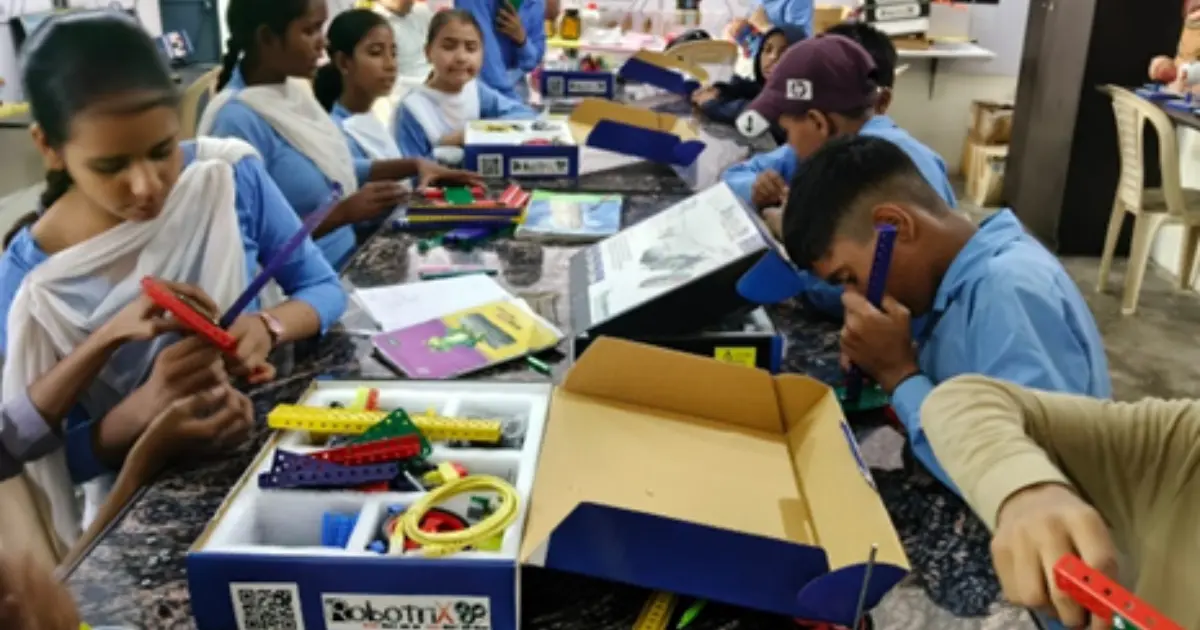
The experiential learning model. The most effective AI and IoT education CSR programmes integrate all three components: appropriate hardware, trained teachers, structured curriculum, and ongoing assessment of student learning outcomes. This is the model Samabhavana designs. It is also the most demanding to implement — it requires an implementing NGO with pedagogy expertise, not just a vendor relationship with technology suppliers. The outcomes, when done right, are measurable and sustained.
THE 5 THINGS CSR MANAGERS MUST GET RIGHT
1. Curriculum before hardware. The single most common failure in technology education CSR is procurement-led thinking — choosing equipment first and building a programme around it. The correct sequence is the reverse: define the learning outcomes you want for students, identify the pedagogical approaches that will achieve them, and then select the technology tools that support that training.
A ₹50,000 robotics kit in the hands of a teacher with no curriculum framework produces very little. The same kit integrated into a well-designed sustained experiential learning programme produces documented, measurable outcomes.
2. Teacher training as the foundation. Teachers are the most important variable in any education programme — including technology education. An AI lab with an unprepared teacher is a room of equipment. An AI lab with a trained, confident teacher is a transformation engine. CSR programmes that skip teacher training to save time or budget are investing in the wrong place.
3. Age-appropriate curriculum design. AI and IoT education is not one-size-fits-all. What is appropriate for a Class 3 student — basic computational thinking, pattern recognition, simple cause-and-effect logic using visual programming.
It is fundamentally different from what a Class 10 student can engage with: data literacy, machine learning concepts, IoT sensor design, basic Python. An effective programme must be designed for the developmental stage of the learner, not for the convenience of the implementer.
4. Outcomes, not outputs. The CSR report should not measure how many kits were distributed. It should measure how many students can demonstrate a defined AI or IoT competency — design a simple sensor circuit, write a basic algorithm, explain how a recommendation system works, complete a robotics challenge.
Outcome measurement requires pre- and post-assessments, documented student work, and a qualified evaluator. This is not optional for credible AI and IoT education CSR.
5. A multi-year commitment. Technology education does not deliver its impact in a single financial year. Year one builds physical and pedagogical infrastructure — lab setup, teacher training, curriculum piloting.
Year two begins delivering measurable student outcomes at scale. Year three allows refinement, peer learning between schools, and genuine community ownership. Corporate CSR managers who approach technology education with a one-year budget are setting up a programme that will peak before it produces its best outcomes.
The conversation with your implementing NGO should begin with a three-year commitment framing.
WHY IMPLEMENTATION EXPERIENCE MATTERS MORE THAN EQUIPMENT
India does not lack technology vendors willing to sell AI and IoT equipment to CSR programmes. It lacks experienced NGOs who can design, execute, and document an AI and IoT education programme that would survive scrutiny from the corporate’s internal audit team, a third-party impact assessor, or, for PSU partners, a CAG review.
The distinction matters because technology education programmes are uniquely vulnerable to a specific failure mode: impressive-looking inputs (smart labs, branded equipment, inaugurated facilities) that produce no documented learning outcomes. A CSR manager who cannot show that students learned something — not just that students received something — has a compliance gap, a reputational gap, and a genuine impact gap.
What separates a credible AI and IoT education programme from a procurement exercise is the implementing organisation’s ability to design learning, not just deliver equipment. This requires training expertise, community relationships, teacher support structures, assessment frameworks, and the institutional memory to know what works in low-resource Indian classroom environments.
That institutional knowledge is not something any organisation can acquire quickly.
HOW SAMABHAVANA DELIVERS AI AND IOT EDUCATION CSR
Samabhavana has been implementing education CSR programmes since 2014 — well before STEM education and technology integration became standard CSR vocabulary.
Our education programmes span primary learning foundations, experiential science education, and increasingly, digital and technology literacy initiatives designed for underserved communities across Mumbai and Maharashtra.
Our approach to AI and IoT education programmes is built on three commitments.
First, curriculum design precedes procurement — we define learning outcomes and design the teaching framework before recommending any technology investment to our corporate partners.
Second, teacher development is treated as a programme priority equal in importance to student outcomes, because we know that untrained teachers cannot unlock what capable students are ready to learn hence we provide a dedicated trainer.
Third, we document outcomes in a format that supports our corporate partners’ CSR-2 filing, ESG reporting, and impact assessment requirements.
Our corporate and PSU partners — including NHPC, SBI Life Insurance, GAIL, BSES Rajdhani, IRCON International, Suzuki Motorcycles, Michelin, Tata Hitachi, SBI Foundation, Murata Electronics (India) Pvt Ltd and Worley — operate under significant public and regulatory scrutiny.
They require implementation standards that match their own compliance frameworks. That is the standard Samabhavana is built to meet.
We hold valid 80G, 12A, and CSR-1 certifications and are registered with Niti Aayog. We also run PRISM India — India’s first public-private-civil society CSR dialogue platform — which gives us continuous insight into emerging corporate priorities and policy developments across India’s CSR ecosystem.
FREQUENTLY ASKED QUESTIONS
Q1. Does AI and IoT education CSR qualify under Schedule VII of the Companies Act? Yes. AI and IoT education programmes qualify under Schedule VII Item (ii), which covers promoting education and promoting vocational skills.
For programmes targeting students in underserved communities, the education qualification is the most direct path. For programmes targeting older students (Class 8–12) with employable technology skills, the vocational skills route is also valid.
The programme must be implemented by a registered NGO with valid CSR-1 certification and must include documented learning outcomes to meet compliance standards.
Q2. What is the minimum budget for a meaningful AI and IoT education CSR programme? This depends on the scope — number of schools, number of students, programme duration, and whether teacher training is included.
A single-school, one-year pilot programme with hardware, curriculum, and teacher training can be designed for ₹15–40 lakh. Multi-school, multi-year programmes that build genuine competency at scale typically require ₹40 lakh and above annually.
The more important question is not the minimum budget but whether the budget is sufficient to include teacher training and outcome measurement — without these two components, no programme size produces credible impact.
Q3. How does AI and IoT education CSR align with the government’s NEP 2020 and SOAR programme? The alignment is direct. NEP 2020 mandates technology integration across school education.
The SOAR programme specifically targets AI and machine learning literacy for Class 6–12 students and their teachers.
CSR-funded AI and IoT education programmes that follow SOAR’s foundational competency framework are both pedagogically sound and aligned with national education policy — which strengthens the programme’s credibility with regulators, impact assessors, and the communities it serves.
Q4. Can PSU companies fund AI and IoT education CSR? Yes. PSU companies with CSR obligations under the Companies Act are increasingly directing funds toward technology education as part of their community development mandates.
The documentation and accountability standards for PSU CSR are typically higher than for private companies — requiring CAG-audit-ready expenditure records and structured outcome reporting.
PSU partners should confirm that their implementing NGO has experience with this level of documentation scrutiny before committing funds.
Q5. What does a good AI and IoT education impact report include? A credible impact report for an AI and IoT education programme includes: baseline student assessment data (what competency levels were measured before the programme), programme activity log (sessions conducted, teachers trained, topics covered)
End-line student assessment (what competency levels were measured after the programme), student work samples or project documentation (evidence of applied learning), teacher feedback and confidence scores, and beneficiary demographic data.
It should not consist solely of photographs of equipment or headcount figures without learning outcome data.
Q6. How does Samabhavana approach AI and IoT education differently from a technology vendor? Technology vendors sell equipment. Samabhavana designs learning programmes. The distinction is fundamental.
We begin with the question: what do we want students to know and be able to do when this programme ends?
We then design the teacher training, curriculum sequencing, and learning activities that will produce those outcomes supported with a dedicated trainer — and select technology tools that support that learning design.
The equipment is a means, not the end. This approach produces documented outcomes that survive scrutiny, satisfy compliance requirements, and create genuine value for the communities we work with.
CONCLUSION
India’s AI and IoT education moment is real. The policy is in place. The national investment is committed. The corporate appetite is growing. What remains is the harder work: turning intent into impact, at the community level, in classrooms where teachers are underprepared and infrastructure is limited.
That is implementation work. It is not glamorous, and it does not photograph as well as a lab inauguration. But it is the work that determines whether AI and IoT education CSR produces a generation of technology-literate young Indians — or a generation of schools with unused equipment and no documented outcomes.
Samabhavana has been doing the unglamorous implementation work for 25 years. We understand the gap between a well-funded CSR proposal and a programme that produces real learning, real documentation, and real community change.
If you are a CSR manager looking to invest in AI and IoT education that is credibly designed, compliantly executed, and rigorously documented — we would welcome the conversation.
📩 info@samabhavana.in 📞 022-45658306 🌐 samabhavana.in/education.html
Samabhavana is registered with Niti Aayog and holds valid 80G, 12A, and CSR1 certifications. All CSR programmes are fully documented for MCA compliance, CSR-2 filing support, and ESG/BRSR reporting.