Author: admin_blogs

  • Digital Literacy for Children in India: How Early Computer Skills Change Everything

    Digital Literacy for Children in India: How Early Computer Skills Change Everything

    Introduction: India’s Quiet Digital Divide

    Only 24.7% of Indians aged 15 and above are computer literate.

    That figure, from National Survey Data, sits alongside another uncomfortable reality: even as India positions itself as a Global Technology Leader, nearly 36% of schools still lack computers, and only 26% of students in rural areas have any form of digital access for learning.

    The children most likely to miss out on digital education are the ones who need it most โ€” those in government schools, in peri-urban communities, in households where a smartphone is a luxury, not a given.

    This is not just an education problem. It is a workforce problem, a social equity problem, and increasingly, a CSR opportunity.

    At Samabhavana, through our Smile Hub Programme, we work with underserved schools across communities to give children what the system has not yet provided: a safe, structured, and genuinely engaging introduction to digital skills.

    What happens when children get that access consistently surprises everyone โ€” parents, teachers, and the children themselves?


    The Numbers India Cannot Ignore

    • 24.7% โ€” computer literacy rate among Indians aged 15+ (National Survey)
    • 64.7% of schools have computers; 63.5% have internet access โ€” leaving more than a third without (UDISE+ data)
    • Only 26% of students in rural India have smartphone access for learning (ORF, 2026)
    • India needs to add approximately 100 million Skilled Workers to its digital economy by 2030 (NASSCOM estimate)
    • Under NEP 2020, digital literacy is mandated as a core competency from Grade 6 onwards

    The children who enter adulthood without basic digital skills will face compounding disadvantage โ€” in employment, in accessing government services, in participating in a rapidly digitising economy.

    The window to change this begins in school. It begins early.


    From Fear to Curiosity: How Children First Meet Computers

    When children in underserved communities encounter computers for the first time, the initial reaction is often not excitement โ€” it is caution. They watch the screen carefully before clicking. They look to the teacher before touching the keyboard. Making a mistake feels high-stakes.

    This hesitation is rational. Many of these children have never owned a device. The computer is unfamiliar territory.

    What shifts the dynamic โ€” and shifts it quickly โ€” is environment. When children understand that the computer is a space for exploration, not evaluation, the caution evaporates. Usually within the first two or three sessions.

    At Samabhavana’s Smile Hub centres, this is the first and most deliberate design principle:

    • Make the learning environment psychologically safe.
    • No wrong answers.
    • No pressure to keep up.
    • Just the freedom to try.

    What happens next is what teachers consistently describe as the most rewarding part of their work.


    The Learning Curve: Faster Than Anyone Expects

    Children โ€” particularly younger children โ€” learn digital skills at a pace that consistently surprises adults working alongside them.

    The trajectory follows a recognizable arc:

    Week 1โ€“2: Typing their name. Learning to click, double-click, and scroll. Moving the mouse with intention. Small actions. Big confidence gains.

    Week 3โ€“6: Opening and saving files. Typing short sentences. Beginning to navigate menus independently. The computer stops being mysterious and starts being manageable.

    Month 2โ€“3: Creating. A story typed and formatted. A poster designed with images and text. A simple presentation built from scratch. At this stage, children are no longer using computers โ€” they are making things with them.

    Month 4 onwards: Teaching each other. This is the moment that defines digital confidence โ€” when a child turns to a classmate and says, “I’ll show you how to do that.”

    The reason children progress this quickly is structural. Unlike adults, who approach new technology with accumulated anxiety about making mistakes, children approach it with default curiosity.

    They click things to see what happens. They are not afraid of breaking something. This openness โ€” combined with the instant feedback that digital tools provide โ€” creates an accelerated learning loop.


    Project-Based Learning: From Consumer to Creator | Digital Literacy for Children in India

    The most significant shift in digital education happens when children move from being Consumers of Technology to Creators with Technology.

    This transition โ€” from typing names to building projects โ€” is not just about skill acquisition. It is a fundamental change in how children see themselves in relation to knowledge.

    A child who has designed a poster is no longer passive. They have made a decision about colour, about layout, about what information to include and how to present it. They have exercised judgment and produced something original. That experience does not stay in the computer room.

    At Smile Hub centers, project-based learning is built into the curriculum:

    • Language and literacy: Children type and format their own stories, building both writing fluency and keyboard confidence simultaneously.
    • Science and environment: Presentations on local ecosystems, water cycles, or community health topics โ€” researched, structured, and presented digitally.
    • Art and design: Posters, digital drawings, and creative compositions that combine visual thinking with technical skill.
    • Civic education: Children research and present on local government services, community issues, or national topics โ€” building both digital literacy and informed citizenship.

    These projects do multiple things at once. They build computer skills. They reinforce academic content. They develop planning, focus, and the ability to communicate ideas clearly. And they produce visible outcomes that children can share with pride โ€” with classmates, with parents, with the community.


    Why This Is a CSR Priority for Corporate India

    Under Schedule VII of the Companies Act, 2013, education and skill development are eligible CSR activities. Digital literacy for underserved children sits squarely within this mandate โ€” and it is one of the highest-leverage interventions available to corporate CSR teams.

    Here’s why:

    The multiplier effect is high. A child who becomes digitally confident in Class 5 carries those skills through their entire academic and professional life. The return on investment per rupee spent is disproportionately large compared to interventions that reach adults.

    The alignment with national priorities is explicit. NEP 2020, Digital India, and PM e-VIDYA all signal government intent to build a digitally literate generation. CSR investments in digital education for children align with stated national goals โ€” which matters for MCA compliance documentation and impact reporting.

    The need is acute in exactly the geographies PSUs and large corporates operate. Many corporate and PSU CSR mandates require spending in communities near operations โ€” often peri-urban or industrial areas where government school infrastructure exists but digital programming does not.

    The outcomes are measurable. Digital literacy can be assessed through structured assessments at baseline, midline, and endline. CSR partners receive clean, documented impact data โ€” the kind that holds up in CAG audits and ESG reports.

    Samabhavana’s Smile Hub programme is designed to meet all of these requirements. It delivers structured digital literacy programming with full impact documentation, aligned to Schedule VII, in the geographies where our CSR partners operate.

    🔗 Explore our Education initiatives: Samabhavana Education Programmes

    🔗 Learn about Smile Hub and our technology education approach: SMILE Hub

    🔗 Partner with us for CSR implementation: Donors & Partners


    What Smile Hub Actually Delivers

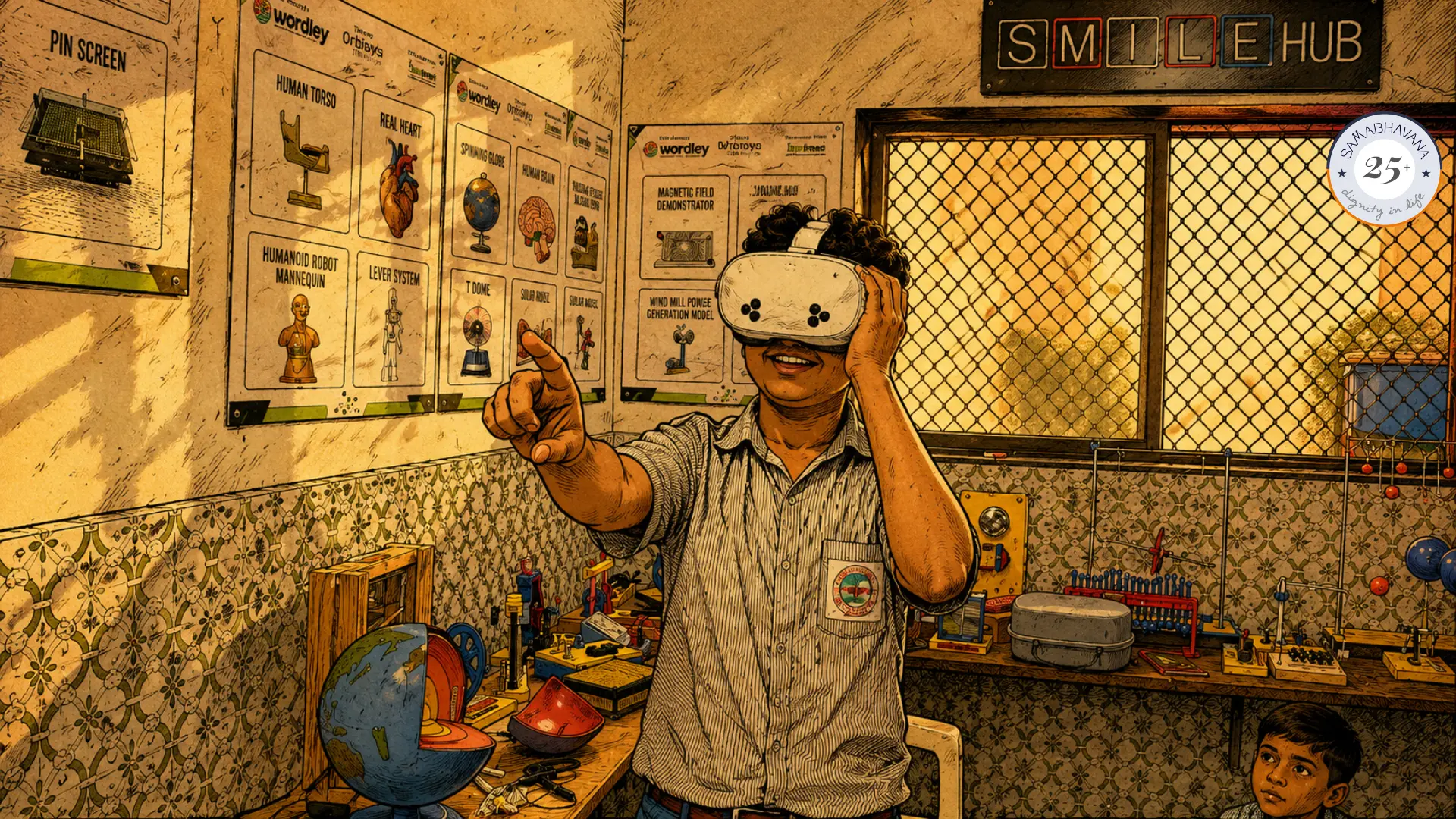
    The Smile Hub Programme is Samabhavana’s integrated technology education initiative for children in underserved schools. It combines digital literacy with hands-on STEM exposure โ€” robotics, astronomy, AI and IoT basics, and smart classroom technology โ€” delivered through trained educators in a structured curriculum.

    For the digital literacy component specifically, Smile Hub delivers:

    • Foundational computer skills: keyboard, mouse, file management, basic software navigation
    • Creative digital projects: word processing, presentations, digital art and design
    • Structured digital communication: typing, email basics, safe internet habits
    • Peer teaching culture: children who progress faster support classmates, building both confidence and community
    • Teacher capacity building: local educators are trained alongside children, creating sustainable in-school capability

    Progress is tracked through learner assessments at multiple points in the programme. CSR partners receive structured impact reports showing skill growth, confidence outcomes, and reach data โ€” aligned with MCA CSR reporting requirements.


    Frequently Asked Questions – Digital Literacy for Children in India

    1. At what age should children start learning computer skills?

    Research consistently shows that children can begin meaningful digital learning from ages 6โ€“8, starting with basic motor skills (mouse and keyboard) and progressing to creative projects by ages 10โ€“12. Starting early builds foundational confidence that accelerates learning at every subsequent stage.

    NEP 2020 mandates digital literacy introduction from Grade 6, but early exposure in primary school significantly improves outcomes at that stage.

    2. Does computer education in schools replace traditional learning?

    No โ€” and it shouldn’t. The most effective digital literacy programmes in schools integrate with existing curricula rather than replacing them.

    When children use digital tools to explore science topics, write stories, or present social studies content, they reinforce academic learning while building technical skills. The two reinforce each other.

    3. How does digital literacy CSR qualify under Schedule VII?

    Digital literacy for children falls under both “education” and “vocational skills” provisions of Schedule VII of the Companies Act, 2013. When delivered as part of a structured programme in underserved schools, it is clearly CSR-eligible.

    Samabhavana provides full documentation to support CSR-2 filing and MCA compliance for all partner companies.

    4. What’s the difference between having computers in a school and having a digital literacy programme?

    A significant one. Computers without a structured curriculum and trained facilitators rarely produce learning outcomes. Children need guided, progressive, project-based engagement โ€” not just access.

    The Smile Hub model is built on this distinction: the hardware is a starting point, not the solution.

    5. Can digital literacy programmes work in rural or low-connectivity areas?

    Yes. The foundational components of digital literacy โ€” keyboard skills, file management, creative applications, presentation building โ€” do not require internet access.

    Smile Hub centres are designed to function effectively even in areas with limited or no connectivity, using offline-capable tools and locally relevant content.

    6. How does Samabhavana measure the impact of Smile Hub?

    We conduct baseline, midline, and endline assessments for each cohort of learners, measuring skill acquisition, confidence levels, and project-completion rates.

    These outcomes are documented in structured impact reports provided to CSR partners, aligned with MCA reporting requirements and ESG disclosure frameworks.


    Conclusion: A Click Is Just the Beginning

    The first time a child types their name on a keyboard, it is a small act. The second time, it is less uncertain. By the tenth time, it is effortless โ€” and they have already moved on to something more ambitious.

    This is how digital confidence grows: not in leaps, but in small, consistent, accumulating steps. A name becomes a sentence. A sentence becomes a story.

    A story becomes a presentation. A presentation becomes the belief that technology is something you can use to make things โ€” not something that belongs to other, more fortunate people.

    India has the policy framework. It has the aspiration. What it still needs, in thousands of schools across the country, is the structured, consistent, supported implementation that turns that aspiration into actual learning.

    That is what Samabhavana’s Smile Hub programme does. One classroom, one cohort, one confident digital learner at a time.


    Samabhavana is a Mumbai-based NGO with 25+ years of experience implementing CSR programmes across education, health, skill development, and women empowerment.

    If your organisation is looking to invest in digital literacy for children through CSR, get in touch with us.
  • Sky Lessons: What Astronomy Teaches Children About Patience, Hope, and Their Own Potential

    Sky Lessons: What Astronomy Teaches Children About Patience, Hope, and Their Own Potential

    Introduction: The Night India Looked Up Together | Astronomy Education for Children India

    On 23 August 2023, India became only the fourth country in history to land a spacecraft on the moon โ€” and the first to land near the lunar south pole.

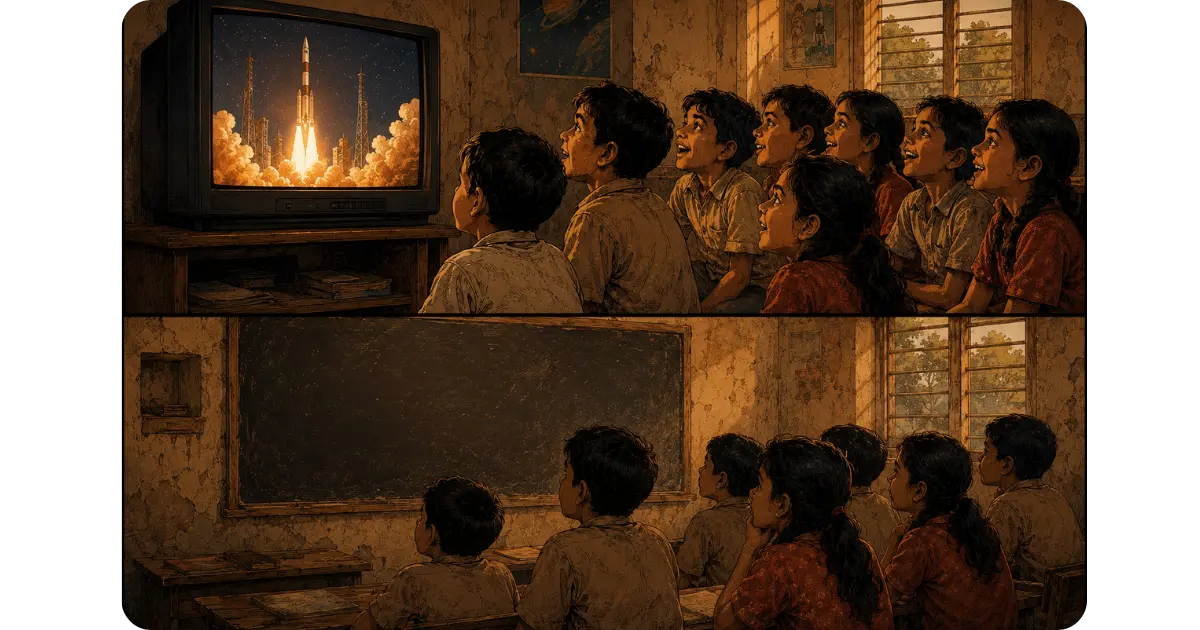
    As Chandrayaan-3’s Vikram lander touched down, millions of Indians watched. Many of them were children. And in that moment, something that had lived in textbooks โ€” the solar system, orbits, space science โ€” became immediate, real, and Indian.

    India’s relationship with the sky has always been deep. From ancient astronomical observatories in Jaipur and Delhi to ISRO’s modern achievements, the cosmos has long been part of the country’s cultural and intellectual identity. And yet, for most children studying in government schools across India, astronomy remains an abstract chapter in a science textbook โ€” something to memorise, not experience.

    At Samabhavana, through the Smile Hub Programme, we believe that every child deserves the chance to actually look up. Not just to learn facts about the solar system, but to sit with the scale of the universe, to understand patterns that have unfolded over billions of years, and to take from that experience something far more durable than exam answers: patience, perspective, and hope.

    This is what astronomy education does when it is done right.


    India’s Astronomy Education Gap

    India produces some of the world’s finest astrophysicists and space scientists. ISRO is a global benchmark for cost-effective space exploration. And yet, a 2024 baseline survey published on arXiv found that astronomy education in India remains deeply uneven โ€” concentrated in urban, English-medium institutions and largely absent in the government school system that educates the majority of Indian children.

    The numbers are telling:

    • India has over 1.5 million government schools educating more than 120 million children
    • NEP 2020 explicitly mandates “scientific temper” as a core educational outcome โ€” yet dedicated astronomy or space science programmes are available in a fraction of schools
    • HDFC Bank Parivartan expanded STEM astronomy education to 47,000 students in 2026 โ€” significant, but a small fraction of the children who need access (Makers Muse, 2026)
    • Organisations like SPACE India and the Space Education Foundation have pioneered astronomy education for children โ€” but the reach gap to underserved communities remains enormous

    The children most likely to become inspired by India’s space achievements are the least likely to receive structured astronomy education. This is an equity problem, a STEM pipeline problem, and a CSR opportunity.


    Why Astronomy Is Different from Every Other Subject

    Most school subjects demand quick recall. Astronomy invites something rarer: sustained observation.

    When children learn about the phases of the moon, they cannot simply memorise a diagram and move on. They have to watch. Night after night, week after week, the moon changes โ€” and the pattern only reveals itself to those patient enough to notice it.

    This is the first and most important lesson astronomy teaches: the universe does not rush, and neither should you.

    In a world of instant notifications, 30-second videos, and same-day answers, this is a radical and necessary counterweight. Children who practice observation develop attention spans that carry into every area of their lives.

    The ability to watch something slowly unfold โ€” without anxiety, without needing an immediate result โ€” is a cognitive and emotional skill that formal education rarely teaches directly.

    At Samabhavana’s Smile Hub centres, educators consistently observe that astronomy sessions produce something unusual: stillness. Children who are often restless in conventional lessons become focused, quiet, and genuinely absorbed when engaging with the night sky.


    What the Sky Actually Teaches | Astronomy Education for Children India

    Patience. Earth takes one year to orbit the sun. Saturn takes 29 years. Some stars visible tonight have been burning for billions of years. These facts aren’t just scientific trivia โ€” they are reminders that meaningful things develop slowly. For children navigating academic pressure and social anxiety, this perspective is quietly powerful.

    Perspective. When children understand that the light from the nearest star beyond our sun takes more than four years to reach us โ€” that the star itself may no longer exist โ€” the problems of a difficult school day or a hard week begin to feel more manageable. Astronomy doesn’t minimise a child’s struggles. It contextualises them within something vast enough to hold them.

    Pattern recognition. The sky is the original data set. Seasons, tides, eclipses, planetary positions โ€” all follow patterns that human beings learned to read long before formal science existed. Children who learn to notice patterns in the sky develop the same cognitive habit in mathematics, language, and problem-solving.

    Consistency. The sun rises every morning. The moon follows its phases reliably. The constellations return to the same positions each year. For children whose home environments may be unpredictable or stressful, the regularity of the sky offers something that anxiety-filled classrooms often cannot: the reassurance that some things can be trusted to behave as expected.

    Curiosity without competition. There are no wrong answers when a child asks why Saturn has rings, or whether other planets have oceans, or whether anyone lives in another galaxy. Astronomy is the rare subject where questions are more celebrated than answers โ€” and where “nobody knows yet” is a legitimate and exciting response. This creates a learning environment that is psychologically safe for children who have been trained by conventional schooling to fear being wrong.


    India’s Cultural Connection: Science Meets Heritage

    Astronomy education in India carries an additional dimension that no other country quite replicates.

    The subcontinent has one of the world’s oldest traditions of astronomical observation. The Jantar Mantar observatories built by Maharaja Jai Singh II in the early 18th century remain among the most sophisticated pre-telescopic instruments ever constructed. Indian astronomers calculated the length of the solar year with extraordinary precision centuries before modern technology.

    Folk traditions across India’s regions are woven with references to stars, planets, and celestial events โ€” in festivals, in agriculture, in navigation, in the stories grandparents tell. When children learn that Diwali’s timing is connected to lunar cycles, or that Magha (the Aquarius constellation) features in classical Sanskrit literature, the boundary between science and heritage dissolves.

    At Smile Hub centres, Samabhavana’s approach to astronomy deliberately incorporates India’s cultural astronomical heritage alongside modern space science. Children learn about Chandrayaan and Mangalyaan in the same sessions where they discuss ancient Indian astronomical traditions. Science becomes something that belongs to them โ€” not a foreign import, but a living part of their own culture.

    This integration matters for learning outcomes. Research on culturally responsive pedagogy consistently shows that children engage more deeply with content they can connect to their own identity and community. When astronomy feels like their subject โ€” Indian, local, historically rooted โ€” children invest in it differently.


    The CSR Case for Astronomy Education | Astronomy Education for Children India

    Under Schedule VII of the Companies Act, 2013, science education and STEM promotion in schools are eligible CSR activities. Astronomy education specifically sits at the intersection of multiple Schedule VII themes: education, skill development, and the promotion of scientific temper โ€” a constitutional value under Article 51A(h) of the Indian Constitution.

    For corporate CSR teams, astronomy education in underserved schools offers three distinct strategic advantages:

    Distinctive visibility. Computer labs and school buildings are common CSR investments. A programme that brings telescopes, space models, and planetarium sessions to children who have never experienced them is visible, memorable, and stories well โ€” in CSR reports, media coverage, and employee engagement.

    ISRO alignment. India’s space programme is a point of national pride. CSR investments in astronomy education tap directly into that cultural moment โ€” aligning corporate identity with India’s broader space aspirations in a way that resonates with employees, communities, and media.

    Long-term STEM pipeline. India will need hundreds of thousands of space scientists, engineers, and researchers over the next three decades as ISRO, DRDO, and the private space sector expand. CSR investments in early astronomy education contribute to that pipeline from the bottom up โ€” starting with the children least likely to find their way into STEM without intervention.

    Samabhavana’s Smile Hub astronomy module is designed to deliver all of these outcomes, with full impact documentation and Schedule VII compliance support.

    🔗 Explore Samabhavana’s Education programmes: Education 

    🔗 See the full Smile Hub technology curriculum: Smart Digital Class 

    🔗 Partner with us for CSR: Donors & Partners


    What Smile Hub’s Astronomy Module Delivers

    Samabhavana’s astronomy education is not a one-off event. It is a structured module within the broader Smile Hub curriculum, delivered over multiple sessions with progressive depth:

    • Solar system exploration โ€” hands-on scale models, orbital mechanics, and planetary comparison that make abstract facts tangible
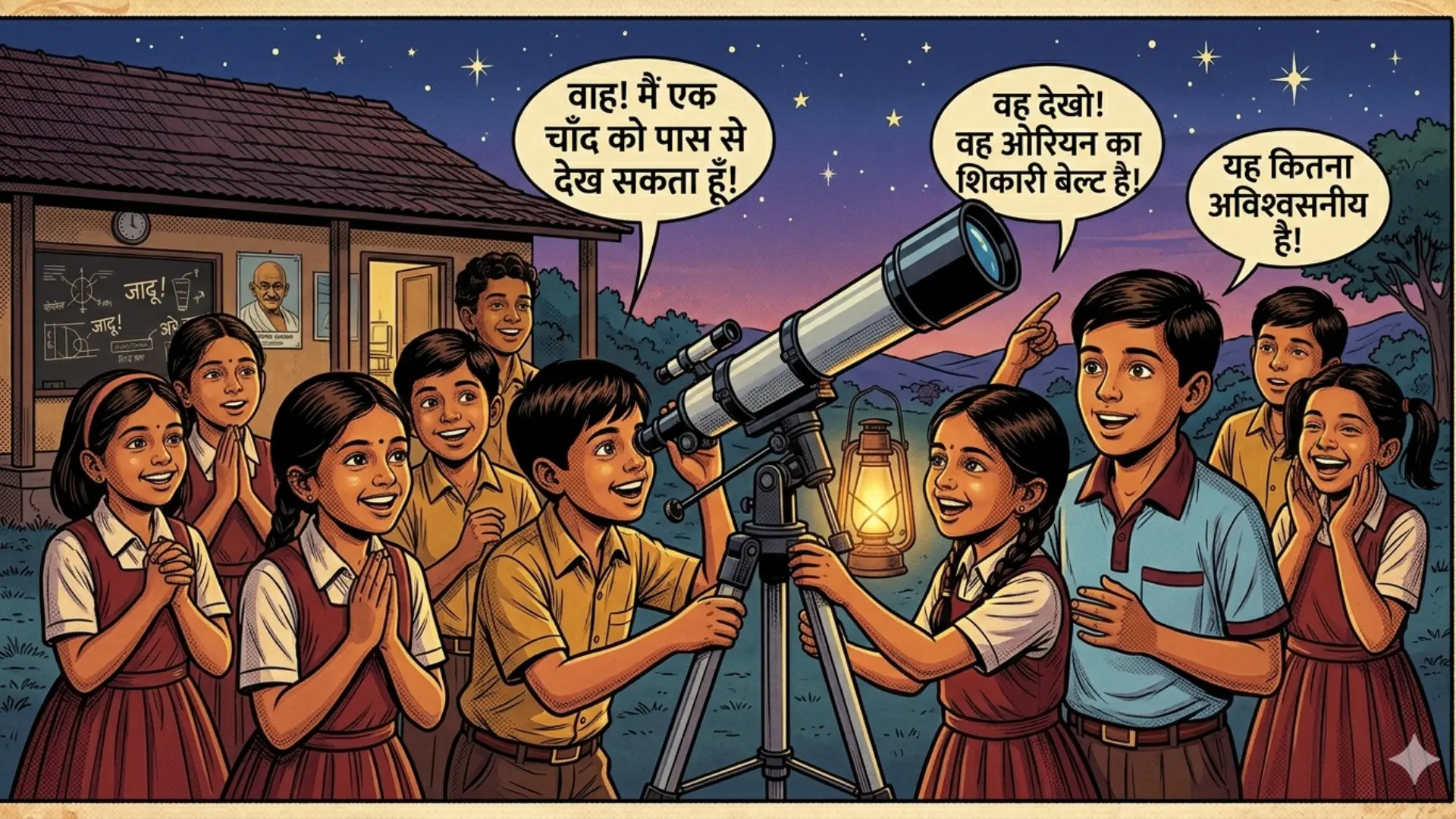
    • Sky observation sessions โ€” guided observation of the moon, visible planets, and key constellations using simple equipment accessible in any school setting
    • India’s space story โ€” age-appropriate exploration of ISRO’s missions, Indian contributions to astronomy, and career pathways in space science
    • Cultural astronomy โ€” connecting celestial events to Indian festivals, folklore, and ancient observation traditions
    • Inquiry-led discussion โ€” open-ended questions designed to develop scientific thinking, not just factual recall

    Every cohort is assessed at baseline and endline for knowledge gain, curiosity indicators, and engagement levels. CSR partners receive structured impact reports documenting both learning outcomes and programme reach.


    Frequently Asked Questions

    1. Can astronomy be taught without expensive equipment? Yes. The most meaningful astronomy education requires very little hardware โ€” the naked eye, a clear sky, and a thoughtful facilitator are sufficient for most foundational learning. Scale models, printed star charts, and basic moon-phase observational diaries are low-cost tools that produce high-impact learning. At Smile Hub, we design for resource constraints without compromising on depth.

    2. At what age should children start astronomy education? Children as young as 6โ€“7 can engage meaningfully with basic concepts like day and night, the moon’s phases, and the planets. From age 10 onwards, more complex ideas โ€” orbital mechanics, stellar distances, India’s space programme โ€” become accessible. Early exposure builds the curiosity and vocabulary that make secondary science education significantly more effective.

    3. Is astronomy education eligible under Schedule VII CSR? Yes. Astronomy and space science education in schools qualifies under the education and STEM promotion provisions of Schedule VII of the Companies Act, 2013.

    It also aligns with Article 51A(h) of the Indian Constitution โ€” the duty to develop scientific temper โ€” making it politically resonant for PSU CSR teams reporting to government stakeholders.

    4. How does astronomy support children’s mental health and emotional development? Research in nature-based and inquiry-based learning consistently links astronomy education to improved emotional regulation, reduced anxiety, and stronger sense of perspective in children.

    The non-competitive, observation-based nature of astronomy creates a psychologically safe environment that benefits children who struggle in conventional high-pressure academic settings.

    5. What makes Samabhavana’s approach to astronomy education different? We integrate India’s cultural and historical astronomy heritage with modern space science โ€” making it relevant and personally meaningful to children from diverse backgrounds.

    We design for low-resource settings. And we embed astronomy within a broader STEM curriculum (Smile Hub) that includes robotics, AI basics, and digital literacy, so children experience science as interconnected, not siloed.

    6. How can our company fund astronomy education through CSR? Samabhavana partners with corporate CSR teams to design, fund, and implement astronomy education modules in government schools in or near their operational areas.

    We handle programme design, educator training, material development, delivery, impact measurement, and MCA compliance documentation. Get in touch at info@samabhavana.in to discuss your specific geography and goals.


    Conclusion: The Sky Has Always Been India’s Classroom

    Long before textbooks, before formal schools, before ISRO โ€” the sky was how India learned.

    It taught farmers when to plant. It gave sailors direction. It helped astronomers build calendars and philosophers contemplate time. The sky was the first shared curriculum.

    When a child from a government school in a Mumbai suburb or a village in Vidarbha first sees Saturn’s rings through a telescope โ€” when they understand that the light from that distant planet has been travelling toward them for over an hour โ€” something changes. The universe becomes real. Science becomes personal. And the future becomes imaginable in ways it wasn’t a moment before.

    This is what Samabhavana’s Smile Hub astronomy programme is built to create. Not just scientific knowledge โ€” though that matters. But the deeper experience of a child discovering that the cosmos includes them too. Astronomy Education for Children India


    Samabhavana is a Mumbai-based NGO with 25+ years of experience in CSR implementation across education, health, skill development, and community development.

    Our Smile Hub programme brings astronomy, robotics, AI, and digital literacy to children in underserved schools across India. If your organisation is looking to fund STEM education through CSR, connect with us.

  • From Textbook to “I Was There”: How Virtual Reality Is Transforming Classrooms in India

    From Textbook to “I Was There”: How Virtual Reality Is Transforming Classrooms in India

    Introduction: The Moment Everything Changes | Virtual Reality Education India

    There is a particular moment that teachers across India describe when they introduce VR to students for the first time.

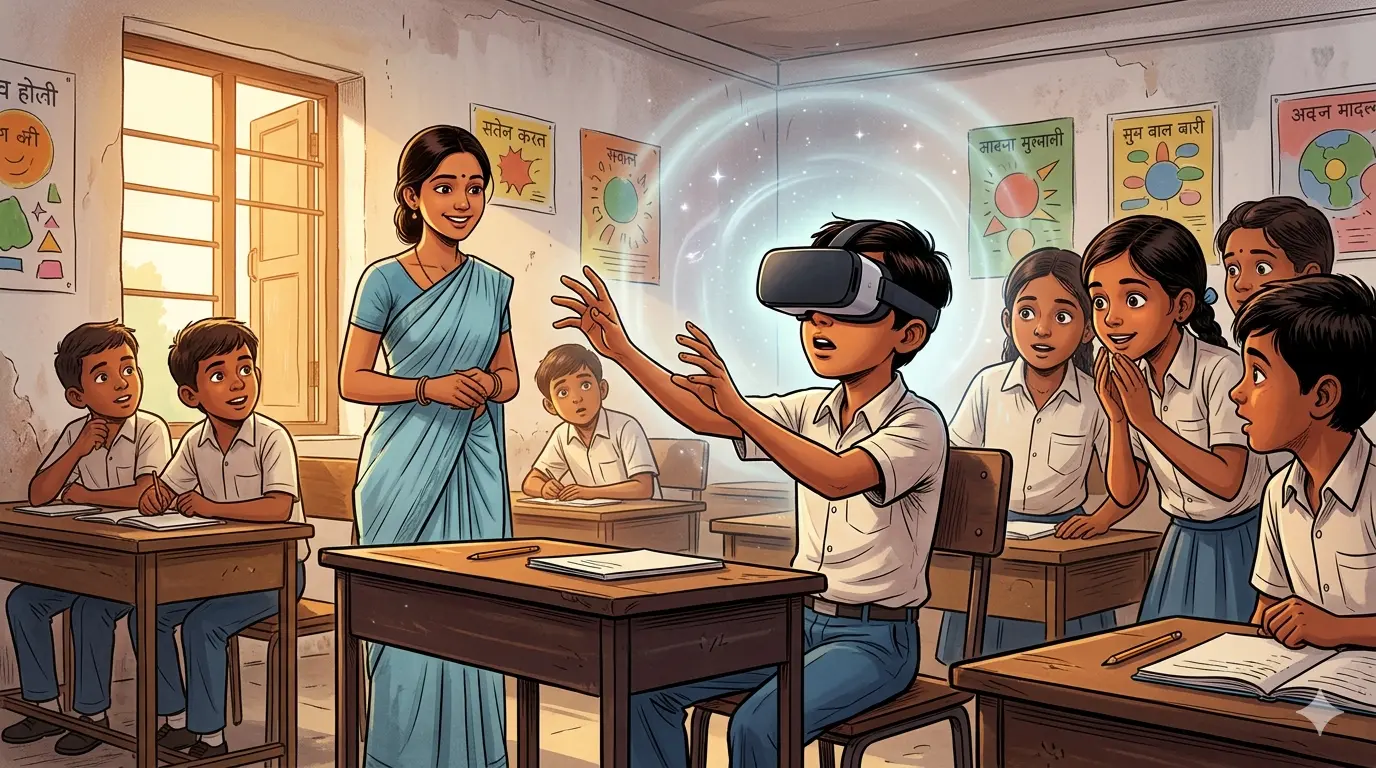
    A child puts on the headset. The room goes quiet. Then comes the turning โ€” the slow, instinctive rotation of the head as the child looks left, right, up, down, trying to take in the full 360 degrees of whatever world they have just entered.

    Sometimes it is the surface of the moon. Sometimes it is the inside of a human heart. Sometimes it is the Taj Mahal from three metres away.

    When the headset comes off, the expression is almost always the same: a kind of stunned delight.

    And then: “I felt like I was actually there.”

    That shift โ€” from reading about something to experiencing it โ€” is exactly what Virtual Reality (VR) brings to education. And for children in India’s government schools, where field trips are rare and laboratory access is limited, it may be one of the most significant educational tools of this decade.

    At Samabhavana, through the Smile Hub Programme, VR is not a futuristic experiment. It is a present-day classroom tool โ€” one we are already using to give children experiences that their circumstances would otherwise deny them.


    India’s VR Education Moment

    The adoption of VR in Indian education has moved faster than most people realise.

    In 2021, VR was present in just 7% of Indian high schools. By 2026, that figure has grown to nearly 38โ€“50% โ€” driven in large part by NEP 2020’s explicit push away from rote learning toward experience-based, competency-driven education.

    Government and institutional initiatives are accelerating this shift:

    • IIT Madras is developing a VR-based education model specifically designed for rural schools, focusing on subjects like social science, history, and science (PIB, Government of India)
    • IIT Guwahati launched Gyandhara in 2026 โ€” India’s first school-focused educational metaverse, beginning with PM SHRI schools
    • REC Limited, a PSU, signed a CSR agreement in May 2026 with IIT Delhi’s IHFC to fund a Green Innovator Immersive Learning Lab in Haryana schools โ€” bringing AR, VR, and 3D learning tools to government school students (India CSR, 2026)
    • Educational VR content is now available in 12 Indian languages, with plans to expand to all 22 scheduled languages

    India is not importing this technology passively. It is building it โ€” for its own schools, in its own languages, for its own children. The question is no longer whether VR belongs in Indian classrooms. It is how to ensure that every child, not just those in elite urban schools, gets access to it.


    The Exposure Gap VR Can Close

    For children studying in India’s government schools, the gap between curriculum and lived experience is often vast.

    The science textbook describes a rainforest ecosystem. But a child in a Nagpur suburb has never seen one. The history chapter covers the architecture of Hampi.

    But a child in a Mumbai chawl may never visit Karnataka. The biology lesson explains the human circulatory system. But there is no lab, no model, and no animation to make it real.

    Field trips are rare โ€” not because schools don’t value them, but because the logistical, financial, and safety barriers are enormous. Science labs, where they exist, are often understocked and oversupervised.

    Museums and cultural institutions are clustered in city centres, far from the communities where the need is greatest.

    VR collapses these barriers.

    With a single headset, a child can walk through the chambers of a 16th-century fort, observe the stages of photosynthesis from inside a leaf cell, witness the water cycle from the clouds, or float through the solar system to understand relative distances between planets.

    The experience is immediate, sensory, and โ€” crucially โ€” equal. Every child in the room has the same access to the same experience.

    This is VR’s most important contribution to Indian education: it is the great equaliser of exposure.


    Why Students Remember VR Experiences Longer | Virtual Reality Education India

    The retention advantage of immersive learning is well-documented. Studies in experiential education consistently show that immersive VR lessons improve information retention by over 30% compared to textbook-only instruction. (Prism Art Studio, 2026)

    The reason is rooted in how memory works.

    When we experience something โ€” when we are spatially present in a scene, when we look around and choose where to focus, when sensory input activates multiple pathways simultaneously โ€” the brain encodes that information differently and more durably than when we read a static page.

    Emotion is a key part of this. Traditional education has largely tried to separate emotion from learning โ€” to make the classroom neutral, calm, and objective. But the brain does not learn that way. Awe, surprise, curiosity, and delight are not distractions from learning. They are accelerants.

    When a child feels genuine wonder looking at the rings of Saturn in VR, that experience anchors the fact in memory in a way that “Saturn has rings made of ice and rock, see diagram 4.3” simply cannot.

    Teachers at Samabhavana’s Smile Hub centres observe this consistently: weeks after a VR session, children can describe in vivid detail what they saw, where they looked, and what surprised them. The experience creates a memory, not just a note.


    VR as an Inclusion Tool

    Beyond retention, VR creates a more equitable classroom in a specific and important way: it reduces the advantage that language and reading fluency currently confer.

    In a conventional classroom, a child who reads fluently processes the textbook faster, answers questions more confidently, and performs better in assessments.

    A child who struggles with language โ€” whether because of a learning difficulty, a multilingual home environment, or simply uneven prior schooling โ€” falls behind, not because they lack intelligence, but because the primary medium of learning disadvantages them.

    VR changes the medium | Virtual Reality Education India

    In an immersive experience, language is not the primary input. Spatial understanding, visual observation, and intuitive exploration take centre stage.

    Children who struggle in conventional lessons frequently surprise teachers in VR sessions โ€” engaging deeply, noticing details, asking questions that show sophisticated thinking.

    This matters enormously in India, where classrooms often contain children at dramatically different reading levels, from multiple language backgrounds, with highly varied prior educational exposure.

    VR doesn’t level the playing field โ€” it creates a different kind of playing field where more children can compete on equal terms.


    The Teacher’s Role Does Not Diminish โ€” It Deepens

    A concern sometimes raised about technology in classrooms is that it replaces teachers or makes their role redundant. With VR, the opposite is true.

    The most effective VR learning sessions follow a clear structure:

    • Pre-experience orientation โ€” the teacher contextualises what children are about to encounter and sets observation goals
    • The immersive experience โ€” typically 5โ€“12 minutes, focused on a specific concept or environment
    • Facilitated discussion โ€” the teacher draws out observations, corrects misconceptions, and deepens understanding
    • Reflection and connection โ€” students link the experience to the curriculum concept and to their own lives

    At every stage, the teacher is essential. VR without good facilitation becomes entertainment. VR with skilled facilitation becomes some of the most powerful teaching available.

    This is why Samabhavana’s approach to VR in the Smile Hub programme always includes educator training alongside the technology โ€” because the tool is only as good as the person wielding it.


    The CSR Case: VR in Government Schools | Virtual Reality Education India

    VR education CSR is an emerging and strategically valuable space for corporate partners. Here’s why it deserves serious consideration:

    Direct alignment with NEP 2020. The National Education Policy explicitly mandates experiential, inquiry-based learning. CSR investments in VR directly accelerate a national educational priority โ€” which matters for government stakeholder relations and compliance narrative.

    Schedule VII eligibility. VR-based learning programmes in schools qualify under the education and skill development provisions of Schedule VII of the Companies Act, 2013. Full documentation for CSR-2 reporting is available.

    Precedent from PSU leaders. In May 2026, REC Limited (a PSU) committed โ‚น1.40 crore to fund an immersive learning lab โ€” VR, AR, and 3D tools โ€” in Haryana government schools, in partnership with IIT Delhi. This demonstrates that VR education CSR is not just viable but actively being pursued by India’s most scrutinised CSR spenders.

    Strong visibility and storytelling. Few CSR investments produce more compelling content than a child in a government school experiencing VR for the first time.

    The story โ€” of access, of wonder, of a child who has never left their district suddenly standing at the foot of Everest โ€” is one that resonates far beyond the programme itself.

    Scalable impact measurement. Knowledge assessments before and after VR sessions, teacher observation reports, and student reflection exercises provide structured, MCA-compliant impact documentation.

    🔗 Explore Samabhavana’s Education programmes: Education

    🔗 Learn about the full Smile Hub STEM curriculum: Smart Digital Class

    🔗 Partner with us for CSR implementation: Donors & Partners


    Smile Hub’s VR Module: What It Delivers

    Within Samabhavana’s Smile Hub programme, VR is one component of a broader technology and STEM curriculum that includes digital literacy, robotics, astronomy, and AI basics.

    The VR module specifically delivers: Virtual Reality Education India

    • Curriculum-mapped immersive experiences โ€” VR content aligned to the school’s academic syllabus, not standalone novelty sessions
    • Educator-facilitated structured learning cycles โ€” pre-experience briefing, immersive session, and post-experience discussion in every class
    • Teacher training โ€” local educators are trained to facilitate VR sessions independently, building sustainable in-school capability
    • Multi-subject integration โ€” history, geography, science, environment, and civic education all covered through appropriate VR content
    • Impact documentation โ€” learning assessments, observation data, and session reports provided to CSR partners in MCA-compliant format

    Frequently Asked Questions

    1. Does VR in classrooms require expensive, high-end equipment?

    Not necessarily. Meaningful VR education can be delivered with entry-level standalone headsets, rotational sharing models (one headset serving multiple students per session), and offline-compatible content.

    Samabhavana designs Smile Hub VR modules for resource-constrained settings โ€” no permanent broadband connection or high-spec hardware required for core functionality.

    2. Is there evidence that VR actually improves learning outcomes?

    Yes. Studies consistently show retention improvements of 25โ€“35% for immersive learning versus textbook-only instruction. IIT Madras’s research on VR-based education for rural schools specifically focuses on outcome measurement.

    Within Smile Hub, pre- and post-session assessments allow direct measurement of knowledge gain from VR experiences.

    3. Can VR be used in government school settings?

    Yes, and it is increasingly being done so. REC Limited’s May 2026 CSR initiative, IIT Guwahati’s PM SHRI school metaverse project, and IIT Madras’s rural school VR research all demonstrate that government school VR implementation is not only possible but actively being scaled in India.

    4. Does VR work for children who struggle with reading or language?

    This is one of VR’s most important advantages. Because immersive learning is primarily visual and spatial โ€” not text-dependent โ€” it reduces the disadvantage that low reading fluency creates in conventional classrooms.

    Children who struggle with textbook learning frequently engage far more effectively in VR sessions.

    5. How is VR education funded through CSR?

    VR education programmes in schools qualify under Schedule VII’s education and skill development provisions. CSR partners can fund equipment, content development, educator training, and programme management.

    Samabhavana provides complete impact documentation for CSR-2 filing and annual CSR reporting.

    6. How does Samabhavana ensure VR is educationally effective and not just entertaining?

    Every Smile Hub VR session follows a structured facilitation model โ€” context-setting before, guided observation during, and discussion and reflection after.

    Educators are trained to lead this process. VR content is curriculum-mapped, not selected for novelty. And learning is assessed at baseline and endline to verify that the experience produced actual knowledge gain, not just engagement.


    Conclusion:

    Experience Is the New Texonomy, and digital literacy for children in underserved schools across India.

    To explore how your organisation can fund this work through CSR, get in touch with us.
  • STEM Education in India: Why It Belongs in Every Classroom โ€” Not Just Toppers

    STEM Education in India: Why It Belongs in Every Classroom โ€” Not Just Toppers

    Introduction: The Label That Limits

    For too long, STEM education in India has carried an invisible label: for bright students only.

    Walk into most Indian classrooms and you will find this belief quietly at work. The “topper” gets called to solve the equation on the board. The “average” student is guided toward arts or commerce. The child who struggles with marks is told โ€” directly or through silence โ€” that science and mathematics are not for them.

    This is not just wrong. It is damaging. And it is costing India the potential of millions of children who have been sorted out of STEM before they ever had a fair chance in it.

    At Samabhavana, through the Smile Hub Programme, we have seen what happens when that label is removed โ€” when a child who has been told they are “weak in science” is given a model to build, a problem to solve, or a robotics kit to program.

    What happens, consistently, is this: they discover they are not weak in science at all. They were just being taught in a way that didn’t reach them.

    STEM โ€” Science, Technology, Engineering, and Mathematics โ€” is not about speed, memorisation, or marks. It is about curiosity, observation, experimentation, and the willingness to try again when something fails. And those qualities exist in every child.


    The State of STEM Education in India: What the Numbers Show

    STEM education in India is at a pivotal moment. The infrastructure is growing rapidly, but access remains deeply uneven.

    In the CSR space, the impact is also measurable: corporate-funded STEM programmes have collectively reached 20 lakh+ students across 5,800+ schools and 400+ districts, supported by 30,000+ trained teachers. (India CSR, 2026)

    These are real achievements. But they also reveal the gap. India has over 1.5 million schools. The children in the hundreds of thousands of government schools that don’t yet have ATLs, STEM labs, or experiential learning programmes are still learning science from textbooks โ€” and being evaluated by whether they can memorise it.

    STEM education in India has the policy, the funding intent, and the corporate investment. What it still lacks, in too many classrooms, is the implementation that gets it to children who have been systematically excluded from it.


    Why Early Labels Are So Destructive

    In Indian classrooms, academic categorisation happens early โ€” and it sticks.

    By Class 5 or 6, many children have already absorbed a fixed belief about where they sit in the academic hierarchy. “Good at studies.” “Weak in maths.” “Not a science type.”

    These labels are not conclusions children reach about themselves through neutral observation. They are conclusions formed through comparison, grading, and the responses of adults around them.

    When a child repeatedly fails written tests in science, they do not conclude that written tests are a poor measure of scientific ability. They conclude that they are poor at science. The distinction matters enormously, because only one of those conclusions is true.

    The problem with how STEM is taught in many Indian schools is not the content โ€” it is the medium. When the primary delivery method is textbook reading and the primary assessment is written recall, the children who excel are those who learn well through reading and writing.

    Children who learn through doing, building, discussing, or visualising are systematically disadvantaged โ€” not because they lack aptitude, but because the classroom was never designed for how they learn.

    Hands-on STEM changes this. It creates multiple pathways to competence, and it surfaces intelligence that written exams leave invisible.


    What Happens When STEM Becomes Experiential

    The shift that occurs when children engage with hands-on STEM education is one that teachers describe with consistent surprise.

    A child who cannot recall Newton’s laws from a textbook will intuitively grasp the principle of inertia when a ball rolls off a table in a structured experiment. A student who freezes during maths assessments will estimate, calculate, and adjust confidently when building a model bridge under load.

    A girl who has been told she is “not good at science” may turn out to be the most precise observer in the room when given a specimen to examine.

    This is not exceptional. It is typical โ€” once the medium changes.

    Experiential learning works because it activates multiple cognitive pathways simultaneously. Doing, seeing, discussing, adjusting, and reflecting encode information far more durably than reading a static page. It also removes the performance anxiety that written assessment creates.

    When the goal is to make the experiment work rather than to produce the correct answer on paper, children engage differently โ€” more fully, more honestly, and more effectively.

    At Samabhavana’s Smile Hub centres, this is the foundation of how STEM is delivered. Activities are designed around curiosity and construction. Mistakes are built into the process.

    The question is not “did you get it right?” but “what did you observe, and what does that tell you?”


    STEM, Girls, and Marginalized Communities

    Inclusive STEM education in India has a specific and urgent gender dimension.

    Despite India’s growing presence in global technology and space science, women remain significantly underrepresented across STEM fields. An EY report published in January 2026, Breaking the Code: The Rise of Women in India’s STEM Landscape, documents both the progress made and the persistent barriers โ€” particularly for girls from lower-income, first-generation learner households. (EY, 2026)

    The barriers are not intellectual. They are social and structural. Girls in many communities receive subtle and not-so-subtle messages that STEM careers are not for them โ€” from families, from peer groups, and sometimes from the school environment itself. Early exposure to STEM in a genuinely inclusive, non-competitive setting disrupts this trajectory before it becomes entrenched.

    The same logic applies for children from marginalised communities, first-generation learners, and students with learning differences. Hands-on, experiential STEM creates a classroom where participation does not require reading fluency, prior educational advantage, or the kind of cultural capital that urban, upper-income households provide by default.

    Samabhavana’s Smile Hub programmes deliberately include girls, children from marginalised communities, and students who have been performing poorly in conventional academic settings โ€” because these are precisely the children for whom inclusive STEM education has the highest transformative potential.


    The CSR Case: Why STEM in Government Schools Deserves Corporate Investment

    STEM education in India โ€” specifically in government and low-resource schools โ€” is one of the most compelling CSR investments available under Schedule VII of the Companies Act, 2013. It qualifies under education, skill development, and promotion of scientific temper, providing multiple Schedule VII compliance pathways.

    The case for corporate investment is strong and multidimensional:

    India’s STEM workforce gap is real. NASSCOM estimates India needs to add over one million skilled technology workers annually to meet digital economy demand through 2030. The pipeline begins in school โ€” and it cannot be built from the top of the academic distribution alone.

    The multiplier effect is significant. One well-equipped STEM programme in a government school cluster reaches hundreds of children per year, for the duration of the programme. Teacher training components extend impact to every cohort those teachers subsequently teach.

    Government co-investment creates leverage. With PM SHRI schools, ATL infrastructure, and NEP implementation all creating public investment in STEM, corporate CSR supplements rather than duplicates โ€” extending the reach of government programmes into communities and schools that the flagship schemes haven’t yet reached.

    Impact measurement is structured and MCA-compliant. Pre- and post-assessments, teacher observation data, and participation records provide the documented outcome evidence that PSU CSR teams and corporate sustainability reports require.

    Samabhavana works with CSR partners to design and implement STEM education programmes aligned with Schedule VII requirements โ€” with full compliance documentation for CSR-2 filing and annual reporting.

    🔗 Explore Samabhavana’s Education programmes: Education 

    🔗 See the full Smile Hub STEM curriculum: Smart Digital Class 

    🔗 Partner with us for CSR implementation: Donors & Partners


    Samabhavana’s Smile Hub: STEM for Every Child

    The Smile Hub Programme at Samabhavana is built on a foundational conviction: that STEM education should reach every child โ€” not just those in well-resourced schools or those who score well in written examinations.

    Smile Hub delivers an integrated STEM curriculum that includes:

    • Robotics and engineering โ€” building, programming, and testing robots using age-appropriate kits, developing logical thinking and collaborative problem-solving
    • Astronomy and space science โ€” hands-on sky observation, solar system models, and India’s space story through ISRO
    • Digital literacy and AI basics โ€” practical computer skills, coding fundamentals, and an introduction to how artificial intelligence works
    • Virtual reality learning โ€” immersive, curriculum-mapped experiences that bring textbook concepts to life
    • Smart classroom technology โ€” interactive learning tools that make abstract concepts visible and engaging

    Every programme component is designed for low-resource settings, delivered by trained facilitators, and assessed at baseline and endline.

    CSR partners receive structured impact reports documenting knowledge gains, participation levels, and qualitative observations from educators.


    Frequently Asked Questions

    1. Is STEM education in India only for academically strong students?

    Absolutely not โ€” and this is the most important misconception to correct. STEM education in India’s most effective programmes is specifically designed to reach children who have struggled in conventional academic settings, because hands-on, experiential learning surfaces intelligence and aptitude that written-exam systems miss entirely.

    Curiosity and problem-solving ability are not correlated with exam scores.

    2. How does hands-on STEM improve learning outcomes?

    Experiential learning activates multiple cognitive pathways simultaneously โ€” doing, observing, adjusting, and reflecting. Research consistently shows that children retain and apply knowledge significantly better when they have engaged with it physically and practically.

    STEM activities also reduce the performance anxiety associated with written tests, allowing more children to participate fully.

    3. Is STEM CSR eligible under Schedule VII?

    Yes. STEM education programmes in schools qualify under the education and vocational skills provisions of Schedule VII of the Companies Act, 2013.

    They also align with the promotion of scientific temper โ€” a value enshrined in Article 51A(h) of the Indian Constitution โ€” providing an additional compliance narrative particularly relevant for PSU CSR teams.

    4. How can STEM education support girls’ advancement in India?

    Early, positive exposure to STEM in a supportive, non-competitive environment directly counters the social messaging that tells girls science and technology are not for them.

    Programmes that actively include and encourage girls โ€” particularly in communities where this messaging is strongest โ€” show measurable improvement in STEM confidence, participation, and aspiration.

    Samabhavana’s Smile Hub is designed with gender inclusion as a structural priority.

    5. Can STEM be taught effectively in schools without laboratories or infrastructure?

    Yes. The most important ingredient in effective STEM education is not equipment โ€” it is a pedagogical approach. Well-designed STEM activities using low-cost materials, structured observation exercises, and project-based challenges can produce genuine learning outcomes in any classroom.

    Smile Hub is specifically designed for resource-constrained government school settings.

    6. What does Samabhavana’s STEM programme deliver for CSR partners?

    Samabhavana provides CSR partners with programme design, educator training, material development and delivery, structured baseline and endline assessments, quarterly progress reports, and full MCA-compliant documentation for CSR-2 filing.

    Our programmes are designed to be delivered in or near your operational geography, with measurable outcomes reported across student, teacher, and school levels.


    Conclusion: STEM Education Belongs to Every Child in India

    STEM education in India is not a privilege. It is not a reward for academic performance. And it is not reserved for children who already know how to succeed in school.

    It belongs to the child who has been told they are weak in maths. It belongs to the girl who has been quietly guided away from science. It belongs to the first-generation learner in a government school who has never seen a working model, conducted an experiment, or been asked to solve a real problem.

    India’s ambitions โ€” in space, in technology, in manufacturing, in healthcare โ€” require a workforce that is not drawn from the top 10% of the academic distribution. They require thinkers and problem-solvers from every community, every background, every type of mind.

    STEM education in India that is inclusive, hands-on, and community-rooted is not a compromise on standards. It is the only version that actually builds India’s future.

    At Samabhavana, this belief drives everything we do.

    Every child has the capacity to observe, question, and create. When STEM education is designed to meet children where they are โ€” rather than where a textbook assumes they should be โ€” that capacity emerges consistently, and powerfully.


    Samabhavana is a Mumbai-based NGO with 25+ years of experience in CSR implementation across education, health, skill development, and community development.

    Our Smile Hub programme delivers inclusive STEM education across robotics, astronomy, digital literacy, AI basics, and VR in government schools.

    To explore how your organisation can fund this work through CSR, get in touch with us.
  • Smart Digital Class India: What Really Changes in Schools?

    Smart Digital Class India: What Really Changes in Schools?

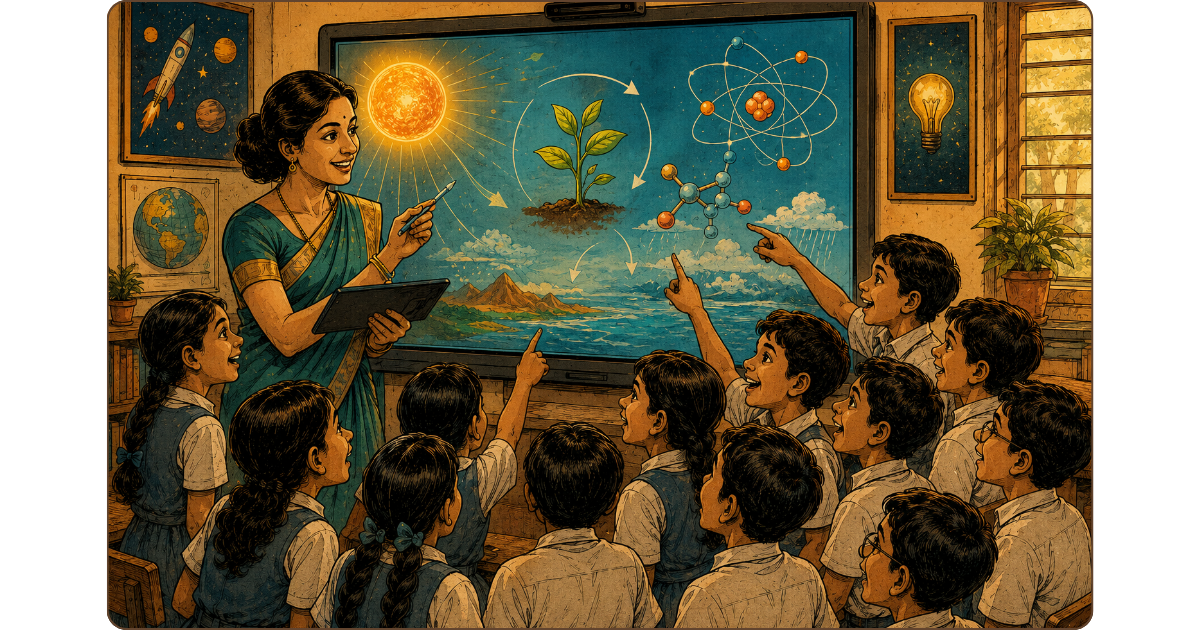
    Walk into a government school in rural Maharashtra or a municipal school on the outskirts of Delhi, and you might find something that would have seemed improbable a decade ago: a teacher guiding students through an animated science lesson on an interactive panel.

    A child in the back row raising her hand to answer a question she would have whispered to a friend just two years earlier. The idea of a smart digital class India is no longer an experiment โ€” it is becoming the baseline expectation for what learning can and should look like.

    But this shift is not just about hardware. Swapping a blackboard for a smartboard does not automatically change educational outcomes. The transformation is real when it is accompanied by trained teachers, reliable electricity, relevant content in regional languages, and a school environment where technology is used purposefully rather than decoratively. This is the conversation India needs to have โ€” and increasingly, it is having it.

    The Policy Foundation: NEP 2020

    The National Education Policy 2020 placed technology-enabled learning at the heart of India’s educational reform agenda. NEP 2020 envisions a shift from rote memorisation to experiential, inquiry-based learning โ€” and digital tools are seen as essential enablers of that shift, not ends in themselves.

    The policy calls for equipping all schools with ICT infrastructure, training teachers in digital pedagogy, and ensuring that content is available in regional languages and in accessible formats for children with different learning needs.

    What Makes a Smart Digital Class India Different?

    A smart digital class India, when properly implemented, offers several concrete shifts in the learning experience. Interactive panels replace static blackboards, allowing teachers to display animated diagrams, run simulations, and replay content for students who need reinforcement.

    Content aligned with the NCERT curriculum โ€” available in Hindi, English, and regional languages โ€” means that children are not navigating a language barrier on top of a subject-matter challenge.

    Assessment changes too. Digital tools allow teachers to quickly gauge comprehension through in-class quizzes, track which concepts are not landing, and adjust lessons accordingly. This is formative assessment in practice โ€” something that large, under-resourced classrooms have historically struggled to deliver.

    Perhaps most importantly, a well-implemented smart classroom can reignite curiosity. Children who have never seen the solar system animated, who have never watched a chemistry reaction play out step by step, respond to these stimuli with a kind of engagement that traditional instruction often cannot produce.

    Teachers who have worked in both environments consistently report that students ask more questions and stay more focused when learning is visual and interactive.

    The Teacher at the Centre – Smart Digital Class India

    Technology is only as effective as the person using it. This is the part of the smart classroom story that often goes untold. Across India, many schools have received smartboards and interactive panels that remain switched off because teachers were never trained to use them confidently. Equipment without capability development is wasted investment.

    Effective smart classroom implementation requires multi-day teacher training programmes, ongoing technical support, and school leadership that encourages experimentation. Teachers need to understand not just how to operate the technology, but how to redesign their pedagogy around it โ€” how to use the 45-minute class period differently when you have a tool that can show, not just tell.

    Samabhavana’s education programmes, detailed on our education page, have consistently prioritised teacher training alongside infrastructure deployment. In our experience, teacher capability development is the single biggest differentiator between a smart classroom that transforms learning and one that collects dust.

    The CSR Angle: Why Companies Are Funding Digital Education

    Under Schedule VII of the Companies Act 2013, expenditure on the promotion of education and livelihood enhancement qualifies as CSR spending. This has made smart classroom infrastructure one of the most popular CSR activities among Indian corporates.

    Education consistently ranks as the top recipient of CSR funds in India โ€” receiving approximately 37% of total CSR expenditure in FY 2023โ€“24, when overall CSR spending crossed โ‚น34,900 crore nationally.

    CSR-funded smart digital class India projects have particular value when they are targeted at government and municipal schools serving first-generation learners โ€” children whose parents may never have used a computer, let alone attended a school with a projector. The impact per rupee in these contexts is significantly higher than in already-well-resourced private schools.

    For companies looking to maximise Schedule VII compliance through education CSR, the key questions are: Which schools will benefit most? Who will train the teachers? How will outcomes be measured? These questions are what distinguish a genuine impact programme from a box-ticking exercise.

    To explore CSR partnerships in education, visit our PSU and donor partners page.

    Common Implementation Challenges

    Several recurring challenges can undermine even well-funded smart classroom projects. Unreliable power supply in rural schools means that technology-dependent lessons can be disrupted without warning. Poor internet connectivity limits the use of cloud-based content and video resources.

    Schools in areas with extreme heat or humidity face hardware maintenance challenges. And in schools where a single teacher handles multiple grades simultaneously, integrating digital tools into instruction requires creative adaptation.

    None of these challenges are insurmountable, but they require honest assessment upfront. The most successful smart classroom programmes conduct a thorough school-readiness audit before installation โ€” checking power, connectivity, space, and teacher capacity โ€” and then design implementation accordingly.

    Content localisation is another underappreciated factor. Digital content in English, covering examples drawn from urban middle-class life, has limited resonance with a child in a village school in Chhattisgarh.

    Content in the child’s mother tongue, with examples drawn from familiar environments, dramatically improves engagement and retention.

    Measuring the Difference

    How do you know if a smart classroom programme is working? The honest answer is that measurement in Indian school education remains weak. Learning outcomes data is patchy, attendance records are inconsistently maintained, and most corporate CSR reports focus on inputs โ€” number of schools covered, number of students reached โ€” rather than outputs, such as what those students actually learned.

    The shift toward outcome measurement is slowly happening. ASER (Annual Status of Education Report) data provides a useful national benchmark on foundational literacy and numeracy. Some NGOs running smart classroom programmes have developed pre- and post-assessment tools that capture learning gains.

    Samabhavana’s approach to education CSR includes built-in monitoring and evaluation โ€” tracking both usage rates and learning indicators over the project period.

    For companies preparing BRSR (Business Responsibility and Sustainability Reporting) submissions, outcome data from well-documented education programmes is increasingly valuable in demonstrating genuine social impact to investors and regulators.

    SEBI now requires the top 1,000 listed companies to file BRSR disclosures, and education CSR data โ€” when it is outcomes-focused and verifiable โ€” strengthens those submissions considerably.

    The Road Ahead

    India has roughly 1.5 million schools. Government data suggests fewer than 40% have functional computer facilities. PM SHRI covers 14,500. Atal Tinkering Labs, the government’s innovation-in-schools initiative, now operates in more than 10,000 schools, engaging over 1.1 crore students โ€” and the Union Budget 2025โ€“26 announced plans to expand to 50,000 more schools over the next five years. These are ambitious numbers, and meaningful progress is being made.

    But the gap between policy ambition and classroom reality remains large. Bridging it requires sustained investment, multi-year commitments rather than one-off donations, and genuine partnerships between government, corporates, civil society, and the schools themselves.

    Samabhavana has been working at this intersection for 25 years โ€” understanding both the ambition of the policy environment and the ground-level complexity of school transformation. That experience informs every initiative we design and implement, from site selection to teacher training to impact reporting. Learn more about our education programmes here.


    FAQ

    Q1: What is a smart digital class in India?

    A smart digital class in India is a classroom โ€” most commonly in a government or municipal school โ€” equipped with interactive panels, projectors, and NCERT-aligned digital content, backed by teacher training to use these tools effectively. The goal is to shift learning from passive listening to active, visual, inquiry-based engagement.

    Q2: How does a smart digital class India benefit government school students?

    Students in government schools often have limited access to learning resources outside the classroom. A smart digital class India gives them exposure to animated lessons, subject simulations, and multilingual content that helps bridge learning gaps and spark curiosity โ€” particularly valuable for first-generation learners.

    Q3: What is the PM SHRI scheme and how does it relate to smart classrooms?

    PM SHRI (Pradhan Mantri Schools for Rising India) is a centrally sponsored scheme with a โ‚น27,360 crore outlay (2022โ€“27) to upgrade 14,500 government schools into NEP 2020-aligned model institutions. Each upgraded school receives smart classrooms, ICT labs, and vocational infrastructure, with smart classrooms mandated for use at least twice a week per subject.

    Q4: Can CSR funds be used for smart classroom projects?

    Yes. Under Schedule VII of the Companies Act 2013, the promotion of education qualifies as a CSR activity. Smart classroom installations in government and municipal schools are among the most common education CSR investments, eligible for the mandatory 2% net profit spend.

    Q5: What makes a smart classroom programme succeed rather than fail?

    The key differentiator is teacher training. Schools that receive hardware without capability development rarely see meaningful change. Successful programmes also include school-readiness audits, localised digital content, ongoing technical support, and outcome measurement frameworks.

    Q6: How can companies partner with an NGO for smart classroom CSR?

    Companies should partner with experienced NGOs that have deep school networks, teacher training capacity, and documented impact track records. Samabhavana has 25 years of education programme experience across Maharashtra and beyond. Contact us to explore a partnership.


    CONCLUSION

    India’s classrooms are changing. The pace is uneven, the challenges are real, and the distance still to travel is considerable. But the direction is clear: smart, technology-enabled learning is becoming standard in the aspirations of policymakers, CSR heads, and parents alike.

    Every smart digital class India creates is a commitment to a child’s future โ€” and when designed and implemented thoughtfully, it is a commitment that delivers.

    If your company is exploring education CSR and wants to move beyond one-time donations toward sustained, measurable impact,

    Contact Samabhavana to learn how we design and deliver programmes that change what learning looks like in India’s most underserved classrooms.

  • Learning With Robots: When Children Build Something With Their Own Hands

    Learning With Robots: When Children Build Something With Their Own Hands

    Introduction

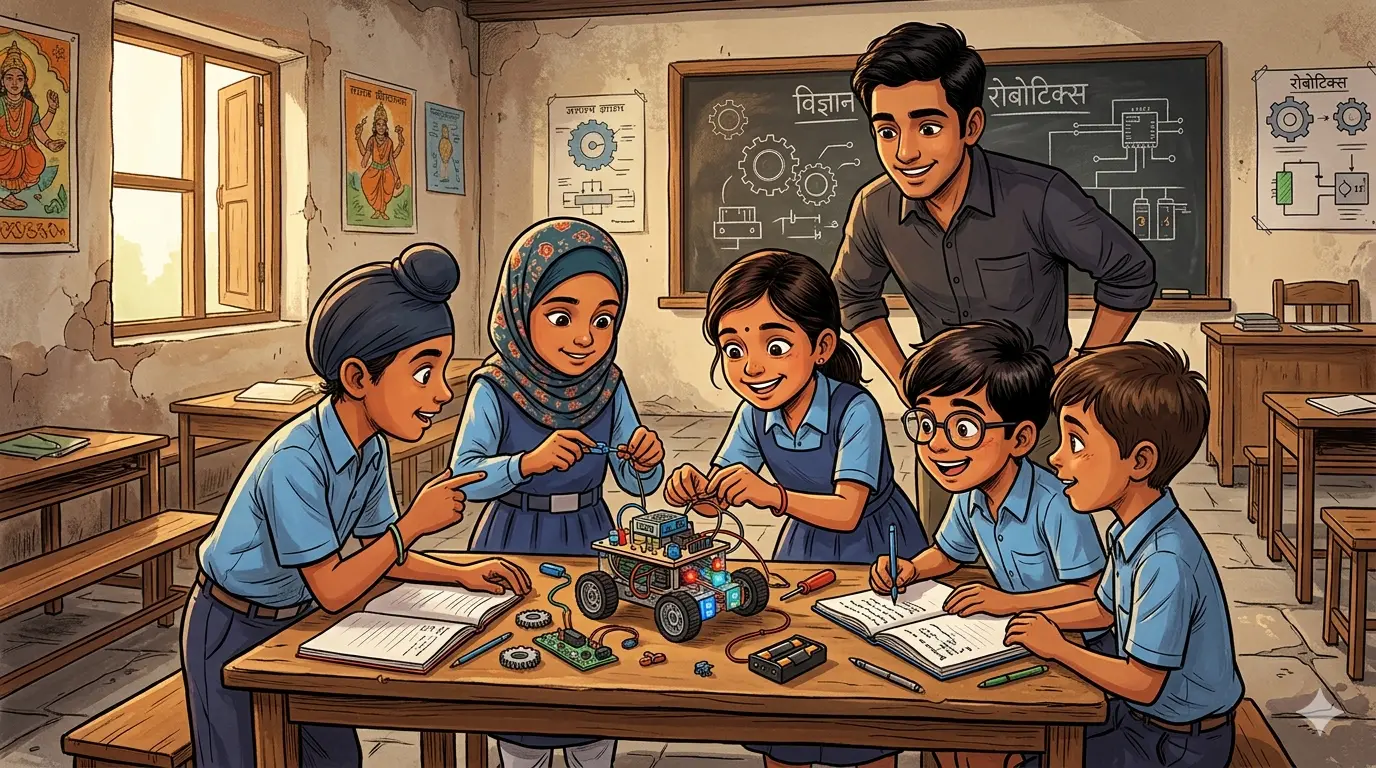
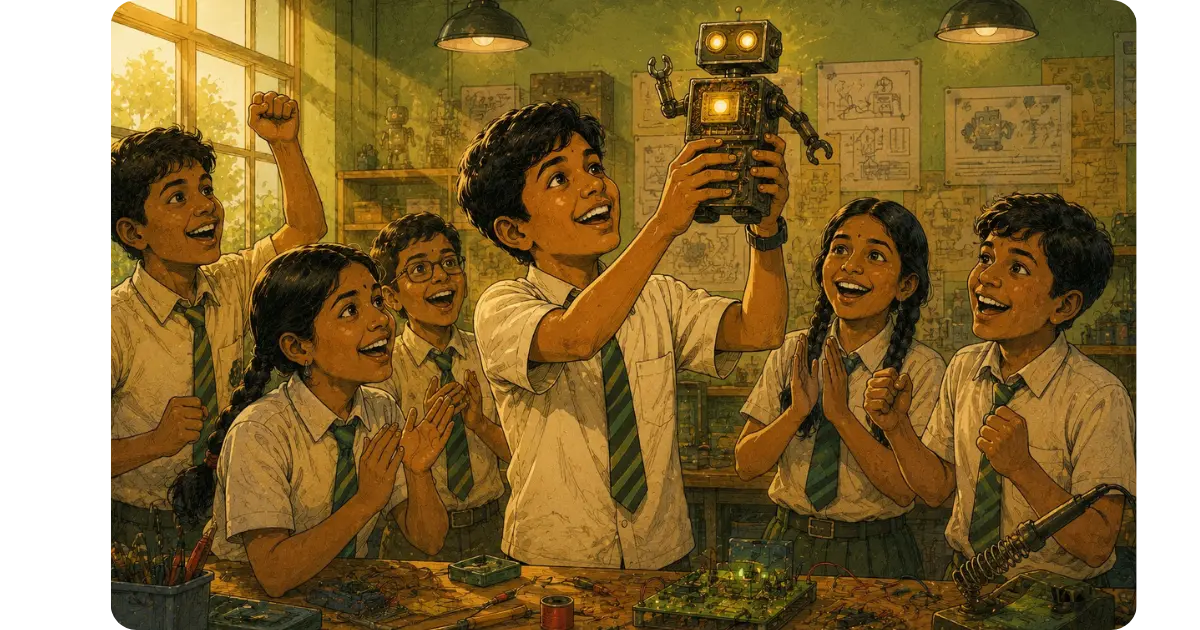
    There is a particular kind of focus that comes over a child when they are building something that might actually work. Not filling in a worksheet, not reciting a definition โ€” but assembling components, testing a circuit, arguing with a classmate about why the sensor is not firing the way it should.

    Robotics education India has moved from a privilege of elite private schools to a growing presence in government classrooms and community learning centres, and the difference it is making is measurable.

    The shift is not just about cool technology. Robotics, artificial intelligence, and the Internet of Things (IoT) are tools for teaching children how to think โ€” how to break a problem into components, hypothesise, test, fail, revise, and try again.

    These are capabilities that the Indian economy of 2030 will need at scale. The question is whether the education system โ€” and the CSR ecosystem that increasingly funds it โ€” is building them fast enough.

    The State of Robotics Education India Today

    The Atal Innovation Mission, launched in 2016, has been the defining government initiative in this space. Through its Atal Tinkering Labs (ATL) programme, the government has established more than 10,000 labs in schools across India, engaging over 1.1 crore students as of 2025.

    The government has disbursed โ‚น1,391.84 crore directly to schools for this purpose. Maharashtra leads with 1,033 labs, followed by Tamil Nadu (975), Uttar Pradesh (955), Karnataka (798), and Andhra Pradesh (713). Crucially, more than 60% of these labs are in government and rural schools โ€” not just well-funded private institutions.

    For organisations designing CSR programmes in education, this creates a clear alignment opportunity โ€” corporate investment can complement and accelerate a government initiative that already has momentum and institutional backing.

    The data on impact is encouraging. Studies show that 74.4% of schools with ATLs report growth in STEM subject interest, and 69.4% show improved academic performance outcomes.

    More than 16 lakh innovation projects have been created by students in these labs. These are not just tinkering sessions โ€” they are formative learning experiences that change how children see themselves in relation to science and technology.

    What Hands-On Learning Actually Looks Like

    The phrase “hands-on learning” is used often and defined rarely. In the context of robotics education India, it means children physically assembling a robot from components โ€” connecting motors, sensors, microcontrollers, and power sources โ€” and then writing the code that tells the assembled device what to do.

    When it works, the satisfaction is immediate and visceral. When it does not work, the child is confronted with a concrete problem that requires systematic diagnosis.

    This process builds skills that no textbook exercise can replicate. Spatial reasoning develops as children figure out how components relate physically. Logical reasoning grows through the debugging process.

    Collaboration becomes necessary because most builds are too complex for one student to manage alone. Communication is exercised when teams present their projects to judges, teachers, or visiting corporate partners.

    AI and IoT dimensions add further layers. Children who learn to collect data from sensors and use it to drive decision-making in a small system gain an intuitive understanding of how AI works โ€” not through abstract definition, but through direct experience.

    An IoT project where students build a smart plant-watering system that checks soil moisture before activating a pump is more than a robotics exercise: it is an entry point into environmental awareness and systems thinking.

    Samabhavana’s Smile Hub initiative integrates these elements into an enriched community learning environment. You can explore the education work we do here.

    NEP 2020 and the Policy Case for Robotics

    The National Education Policy 2020 explicitly recognises the importance of computational thinking, coding, and maker-space learning as core educational experiences for children from Class 6 onward.

    NEP 2020 envisions every school having access to a tinkering lab environment โ€” a vision that Atal Tinkering Labs and CSR-funded robotics programmes are working to realise.

    The policy also emphasises multi-disciplinary learning โ€” the idea that science, mathematics, arts, and humanities should be taught as interconnected rather than siloed subjects.

    Robotics is naturally multi-disciplinary: it draws on mathematics (geometry, algebra), physics (mechanics, electronics), computer science (programming logic), and design (aesthetics, user experience). A single robotics project can activate learning across four or five traditional subject areas simultaneously.

    This aligns with what education researchers have long argued: that children learn more deeply when knowledge is applied to solve real problems rather than studied in abstract isolation. Robotics education India is one of the clearest practical expressions of this principle at scale.

    CSR Investment in Robotics Education India

    CSR investment in robotics education India is accelerating, driven by several converging factors. First, the technology sector โ€” one of India’s largest and most profitable โ€” has a natural affinity for STEM education CSR.

    Companies in IT, manufacturing, and infrastructure understand that their long-term talent pipeline depends on a stronger STEM foundation in the school system.

    Second, robotics programmes produce highly visible outputs โ€” competitions, demonstrations, exhibitions โ€” that make for compelling CSR impact communications. When a group of government school students presents a working robot at a district-level competition, it is a story that resonates with employees, customers, investors, and regulators alike.

    Third, Schedule VII of the Companies Act 2013 qualifies expenditure on education and livelihood enhancement as CSR, giving companies clear legal backing for robotics lab investments.

    For companies preparing BRSR disclosures, a well-documented robotics programme with learning outcome data provides exactly the kind of social impact evidence that ESG frameworks reward.

    The most effective CSR-funded robotics programmes are not one-off lab installations. They include multi-year commitments, trained facilitators who guide student projects, structured curriculum, and linkage to competitions and external recognition.

    Samabhavana works with corporate partners to design programmes that deliver these elements systematically. Visit our PSU and donor partners page to understand our partnership model.

    The Facilitator Question

    As with smart classrooms, the technology is only as powerful as the human being guiding its use. A robotics lab without a trained, enthusiastic facilitator is a room full of boxes.

    The facilitator โ€” whether a specially trained teacher, an NGO staff member, or a community educator โ€” is the person who turns a child’s frustration with a broken circuit into a learning moment rather than a reason to disengage.

    Facilitator training for robotics education requires specific investment. It is not enough for a teacher to know how to assemble a robot; they need to know how to create the psychological safety for students to fail productively, how to scaffold complexity as skills develop, and how to link the hands-on work to the broader curriculum the child is expected to master. This is a specialised skill set, and it needs to be built deliberately.

    Samabhavana’s approach integrates facilitator development into every robotics education programme โ€” ensuring that the human infrastructure matches the physical infrastructure.

    Inclusion and Equity in Robotics Education

    One of the most important questions in robotics education India is who gets access. Historically, the answer has been children in private schools and urban areas. 

    Gender is a particular concern. Girls in many school environments are informally steered away from STEM. Robotics programmes that actively recruit girls, provide role models, and create a culture of inclusion can be powerful counters to this pattern.

    The ATL programme reports that 96% of its labs are in co-educational or all-girls schools, a design choice that makes girls’ participation structurally possible. CSR programmes should build on this by explicitly tracking and reporting on girls’ participation and achievement.

    Diversity and inclusion considerations matter in education just as they matter in workplaces. Samabhavana’s commitment to these values is reflected across all our programme areas, including education. Learn more about our diversity and inclusivity work.


    FAQ

    Q1: What is robotics education India and why does it matter?

    Robotics education India refers to programmes that teach children to build and programme robots, using this as a vehicle for developing STEM skills, logical reasoning, collaboration, and creativity. It matters because these capabilities are foundational for India’s future workforce and are currently under-developed in the traditional curriculum.

    Q2: How does robotics relate to AI and IoT education?

    Robotics, AI, and IoT are naturally interconnected. Children learning to programme robots often use AI principles (decision trees, sensor-based logic) and IoT concepts (connecting devices to exchange data). These experiences give children an intuitive, practical understanding of technologies that will define the future economy.

    Q3: Can companies fund robotics education through CSR?

    Yes. Schedule VII of the Companies Act 2013 includes the promotion of education and livelihood enhancement as qualifying CSR activities. Robotics lab installations in government schools are an eligible, high-visibility use of CSR funds with measurable student impact.

    Q4: What is the Smile Hub initiative by Samabhavana?

    Smile Hub is Samabhavana’s enriched community learning environment that integrates STEM, robotics, digital literacy, and experiential learning for children in underserved communities. It is designed to complement school learning with hands-on, curiosity-driven exploration.

    Q5: How can a company set up a robotics CSR programme with Samabhavana?

    Samabhavana designs end-to-end robotics education CSR programmes โ€” from site selection and lab setup to facilitator training, curriculum delivery, and impact reporting. Contact us to discuss a programme tailored to your CSR goals and geography.


    CONCLUSION

    When a child builds a robot that does what they programmed it to do, something changes in how they understand their own capability. That moment โ€” small, specific, and entirely theirs โ€” is what robotics education India at its best produces, at scale, in classrooms that have never had access to this kind of learning before.

    For companies thinking seriously about their education CSR strategy, robotics education India is one of the most powerful investments available within Schedule VII. The technology is accessible. The evidence is strong. The policy support is in place.


    Contact Samabhavana to explore how we can build a robotics education programme together โ€” one that delivers measurable outcomes, supports your BRSR disclosures, and leaves a lasting mark on children’s lives.

  • PRISM India: Where CSR Conversations Create Real Change

    PRISM India: Where CSR Conversations Create Real Change

    Introduction – CSR podcast India

    India’s CSR ecosystem is vast, diverse, and sometimes frustrating in its fragmentation. Thousands of companies are spending billions of rupees on projects across hundreds of sectors and geographies, yet the practitioners โ€” the CSR heads, the NGO implementers, the government officials who shape policy โ€” often operate in silos that limit learning and reduce collective impact.

    Into this landscape, PRISM India has carved a distinctive and necessary role. Among its many functions, PRISM India stands out as the country’s most enduring CSR podcast India platform โ€” a space where the conversations that shape India’s social investment agenda happen out loud, in public, and with rigour.

    PRISM โ€” the Public-Private-Civil Society Responsibility Interface for Sustainable and Meaningful engagement โ€” was founded in 2013 by Samabhavana, making it India’s first formal dialogue platform of its kind.

    More than a decade later, it remains the only platform that systematically brings together corporate CSR leadership, government ministries, PSU CSR teams, and civil society organisations in structured, on-record conversation. That is not a small distinction. It is the foundation of PRISM’s value.

    What PRISM India Actually Is

    Understanding PRISM India requires understanding the problem it was designed to solve. Before PRISM, there was no neutral, sustained forum where a Ministry of Corporate Affairs official, a CSR head from a large manufacturing company, and a field-level NGO implementer could sit together and examine why a given CSR intervention was or was not working.

    There were conferences, yes โ€” but conferences are episodic, often performative, and rarely produce the kind of sustained relationship that generates real change.

    PRISM is different in design and in practice. It is a year-round dialogue platform that operates through structured roundtables, policy consultations, and โ€” significantly โ€” a podcast format that extends these conversations to a much wider audience.

    The podcast component captures candid, substantive discussions between practitioners, policymakers, and civil society leaders, and makes them available to anyone working in or interested in India’s CSR and social impact space.

    Partners who have engaged with PRISM include some of India’s most prominent PSUs and corporates โ€” GAIL, BSES, IRCON, and Suzuki among them. These are not sponsorships in the conventional sense; they are substantive engagements where these organisations bring their CSR challenges and learnings to the table and contribute to a shared body of knowledge about what works.

    Why a CSR Podcast India Matters Now More Than Ever

    India’s mandatory CSR regime, established under Section 135 of the Companies Act 2013, has created a large and growing ecosystem of corporate spending. Total CSR expenditure crossed โ‚น34,900 crore in FY 2023โ€“24, with 61% of reporting companies exceeding their mandated 2% spend.

    The number of companies filing CSR reports is at a historic high. BRSR (Business Responsibility and Sustainability Reporting) is now mandatory for the top 1,000 listed companies, requiring detailed disclosure of ESG and social impact metrics.

    Yet quantity of spending does not automatically translate to quality of impact. India’s CSR ecosystem faces well-documented challenges: duplication of effort, poor outcomes measurement, short-term project cycles that cannot produce lasting change, and a persistent disconnect between what companies want to fund and what communities actually need. These are not new problems, but they are urgent ones as the scale of CSR spending grows.

    A CSR podcast India that brings serious practitioners together to examine these challenges serves a function that no report, conference, or annual CSR award can replicate. It creates a public record of thinking โ€” of what has been tried, what has worked, why something failed, what the next frontier looks like.

    For a CSR head joining a new organisation, a PRISM episode is a faster and more honest education than any consultant’s deck. For a government official designing a new Schedule VII category, hearing directly from the people implementing CSR at scale is irreplaceable input.

    The Voices on PRISM

    PRISM’s credibility comes from the quality and diversity of the voices it convenes. CSR heads from large Indian corporates and PSUs bring the perspective of organisations navigating mandatory compliance, stakeholder expectations, and the practical challenge of implementing social programmes at scale.

    Government officials bring the policy lens โ€” the regulatory context, the national priorities, the infrastructure of schemes and programmes that corporate CSR can align with or fill gaps around.

    Civil society voices are PRISM’s most distinctive contribution. NGOs and social enterprises often hold the most granular, honest knowledge of what happens on the ground when a CSR project meets a community. They know which assumptions funders make that do not hold, which metrics are easy to measure but do not capture what matters, and which interventions have a durable impact versus a brief one.

    Giving these voices equal standing in a multi-stakeholder dialogue is what makes PRISM unusual โ€” and unusually valuable.

    The podcast format amplifies this. A 45-minute conversation between a CSR director, a district collector, and a field programme manager can convey more nuance, more authentic learning, and more actionable insight than any formal publication.

    The CSR podcast India format reaches audiences that formal reports never do โ€” mid-level CSR managers, students of social work and public policy, journalists covering development, and the general public with an interest in how India’s corporate sector engages with social challenges.

    PRISM and Samabhavana’s Broader Mission

    PRISM is not a standalone initiative. It is the expression of Samabhavana’s belief that dialogue, knowledge exchange, and shared accountability are preconditions for effective CSR implementation.

    Samabhavana has been implementing CSR programmes for 25 years โ€” in education, health, skill development, women empowerment, and diversity and inclusion. That ground-level experience informs every PRISM conversation.

    The organisation brings to PRISM what very few conveners can: the credibility of being an implementer, not just a commentator.

    When Samabhavana facilitates a dialogue about what works in community health CSR, it is not drawing on secondary research alone โ€” it is drawing on years of programme delivery across Maharashtra and beyond. This combination of implementation depth and convening breadth is what makes PRISM’s conversations different.

    For corporate CSR teams looking to align their programmes with national priorities, understand the regulatory landscape, and learn from peers who have navigated similar challenges, PRISM is an invaluable resource.

    Explore the full PRISM platform at PRISM INDIA.

    The Topics PRISM Covers

    PRISM’s dialogue agenda tracks India’s most pressing social and policy challenges. Recent conversations have covered the integration of CSR with the government’s flagship schemes โ€” PM SHRI in education, Ayushman Bharat in health, PMKVY in skill development.

    The platform has addressed the challenge of measuring social impact rigorously in the context of mandatory BRSR disclosures, and has hosted discussions on the role of corporate CSR in supporting India’s mental health infrastructure โ€” a Schedule VII-eligible area that remains severely underfunded.

    PRISM has also been a forum for honest conversation about what CSR gets wrong. The tendency to fund what is visible rather than what is impactful. The preference for urban over rural implementation. The challenge of CSR committees approving projects that are strategically misaligned with national need. These are uncomfortable topics, but they are the conversations that improve the quality of CSR practice over time.

    For organisations working in specific sectors, Samabhavana’s programme pages provide further context on the areas where CSR investment can make the greatest difference: education, health, skill development, and women empowerment.

    The Future of PRISM: Scaling Dialogue for Greater Impact

    As India’s CSR ecosystem matures, PRISM’s role becomes more important, not less. The shift from compliance to strategic CSR โ€” driven by BRSR requirements, ESG investor scrutiny, and growing community expectations โ€” creates a greater need for the kind of candid, evidence-based dialogue that PRISM facilitates.

    Companies navigating this shift have a complex set of questions to answer:

    • Which implementing partners are genuinely capable?
    • Which Schedule VII categories offer the greatest impact leverage in specific geographies?
    • How do national policy shifts โ€” in education, in health insurance, in skills infrastructure โ€” change the optimal design of CSR programmes?

    PRISM is expanding its reach through the podcast format, making these conversations accessible to a much wider audience than can attend physical roundtables.

    CSR professionals in Tier 2 and Tier 3 cities, in PSUs in remote operational locations, in civil society organisations working in areas with limited connectivity to the Mumbai and Delhi CSR networks โ€” all of these audiences benefit from conversations that were previously confined to conference rooms.

    The democratisation of CSR knowledge is one of PRISM’s most significant contributions, and it is one that grows as the podcast audience grows.

    Samabhavana is also exploring how PRISM can serve as a platform for joint learning across the corporate-government interface. As BRSR reporting matures and the Ministry of Corporate Affairs continues to refine the CSR regulatory framework.

    PRISM’s ability to convene candid, on-record discussions between regulators and the regulated creates genuine public value โ€” informing policy with ground-level evidence and giving companies a channel to raise implementation challenges that the regulatory framework may not yet have addressed.


    FAQ – CSR podcast India

    Q1: What is the PRISM CSR podcast India?

    PRISM India is India’s first public-private-civil society CSR dialogue platform, founded by Samabhavana in 2013. Its podcast component captures substantive conversations between corporate CSR leaders, government officials, and civil society practitioners โ€” making practitioner knowledge accessible to India’s broader CSR community.

    Q2: Who participates in PRISM India dialogues?

    PRISM convenes corporate CSR heads, PSU leaders, government ministry officials, district administrators, and NGO practitioners. Key corporate and PSU partners have included GAIL, BSES, IRCON, and Suzuki, among others.

    Q3: How is PRISM different from a typical CSR conference?

    PRISM operates year-round through structured roundtables, policy consultations, and podcast recordings. Unlike episodic conferences, it builds sustained relationships and creates a public record of practitioner knowledge that can be referenced and built upon over time.

    Q4: What topics does the PRISM podcast cover?

    PRISM covers the full range of India’s CSR landscape โ€” education, health, skill development, women empowerment, mental health, rural development, and the regulatory framework of Schedule VII, mandatory reporting, and BRSR. It also addresses the harder questions about measurement, impact, and the gap between CSR intent and implementation outcomes.

    Q5: Why was PRISM founded in 2013?

    PRISM was founded by Samabhavana in response to the fragmentation of India’s emerging CSR ecosystem. The Companies Act 2013 was establishing mandatory CSR for the first time, and Samabhavana saw the need for a sustained, multi-stakeholder dialogue platform that could help translate regulatory obligation into genuine social impact.

    Q6: How can an organisation join PRISM India?

    Corporate CSR teams, PSUs, government bodies, and NGOs interested in participating in PRISM dialogues or the podcast can Get in touch through samabhavana.in/contact-us.html.

    Samabhavana welcomes partners who want to contribute to and learn from India’s most substantive CSR dialogue platform.


    CONCLUSION

    India’s CSR ecosystem needs more than good intentions and adequate budgets. It needs knowledge, honest conversation, and the kind of mutual accountability that only sustained dialogue can build.

    PRISM India has been providing exactly this since 2013 โ€” and its podcast continues to be the most accessible expression of that mission.

    Whether you are a CSR head trying to design a more impactful programme, a government official looking to understand how corporate investment aligns with national schemes, or a civil society practitioner wanting your field experience to shape the broader conversation, PRISM India has a place for you.

    Connect with Samabhavana to explore how you can participate in PRISM โ€” India’s defining CSR podcast India, where conversation becomes commitment, and commitment becomes change.


  • Mental Health and Corporate Responsibility: India’s Most Urgent Unmet Need

    Mental Health and Corporate Responsibility: India’s Most Urgent Unmet Need

    Introduction

    India is facing a mental health crisis that is enormous in scale, largely invisible in public discourse, and deeply underfunded. Approximately 197 million people โ€” about 14.3% of the population โ€” live with some form of mental disorder, ranging from depression and anxiety to severe conditions that require sustained psychiatric care. 

    Yet more than 80% of those who need treatment never receive it. The treatment gap is not a policy footnote; it is an ongoing human emergency that touches every community, every workplace, and every family in India. 

    Against this backdrop, mental health CSR India is still a fraction of what it needs to be โ€” but that is beginning to change.

    The barriers to treatment are well understood. India has approximately 0.3 psychiatrists per 100,000 people โ€” one of the lowest ratios in the world. Mental health infrastructure is concentrated in urban areas, with rural communities often having no accessible service at all. 

    Stigma remains powerful: the fear of being labelled “pagal” deters people from seeking help even when services are available.

    Public spending on mental health is less than 1% of the total health budget. These are not problems that the government can solve alone, and Schedule VII of the Companies Act 2013 provides corporate India with both the legal framework and the moral call to act.

    The Scale of the Challenge

    The numbers bear repeating because they are so frequently underestimated. Around 197 million Indians are living with mental health conditions. India accounts for nearly 15% of all disability-adjusted life years (DALYs) attributable to mental disorders globally.

    Depression and anxiety are among the leading causes of workplace absenteeism and reduced productivity. Suicide is the leading cause of death among young adults in India aged 15 to 29.

    These statistics represent real people โ€” employees who cannot focus at work, mothers unable to care for their children, young students whose academic trajectories are derailed by untreated anxiety. They also represent a significant economic cost.

    The World Health Organization has estimated that mental health conditions cost the global economy approximately $1 trillion annually in lost productivity. India’s share of that cost is substantial.

    The government has made efforts to respond. The National Mental Health Programme has been running for decades. The National Tele Mental Health Programme (Tele-MANAS), launched in 2022, provides 24/7 free tele-counselling and psychiatric support and had handled over 2.38 million calls by mid-2025. These are meaningful initiatives. 

    Mental Health CSR India: The Schedule VII Case

    Mental health qualifies for CSR funding under Schedule VII in two principal ways.

    • First, it falls under the promotion of healthcare โ€” explicitly listed in Schedule VII as an eligible CSR activity under the Companies Act 2013.
    • Second, where mental health programmes are delivered in the context of livelihood or women’s empowerment, they qualify under those heads as well.

     A mental health programme delivered to women in a self-help group network, for example, can simultaneously qualify under health and women’s empowerment โ€” a strong case for integration.

    The legal clarity on Schedule VII eligibility removes one barrier that previously caused CSR committees to hesitate. Mental health is not a peripheral or experimental CSR category โ€” it is a core health issue with explicit statutory backing. 

    What Mental Health CSR India Looks Like in Practice

    Mental health CSR India programmes take two broad forms: workplace wellness and community mental health. Both are important. Both are underinvested. And both produce measurable returns.

    Workplace mental health programmes address the mental wellbeing of a company’s own employees and, in many cases, their families. These programmes include Employee Assistance Programmes (EAPs) that provide confidential counselling services, mental health awareness campaigns that reduce stigma within the organisation, manager training to identify and sensitively respond to signs of distress in team members, and structured resilience-building initiatives. 

    The business case is direct: employees with good mental health are more productive, more engaged, and less likely to leave. Companies with strong workplace mental health programmes report lower absenteeism, higher retention, and stronger employee satisfaction scores.

    Community mental health programmes extend the reach of corporate investment beyond the company’s own workforce. These programmes fund counsellors in government schools, community mental health camps in underserved areas, training for frontline health workers (ASHAs, ANMs) to screen for mental health conditions and make referrals, and awareness campaigns in rural communities to reduce stigma.

    The impact here is harder to measure but is potentially transformative: a community that recognises mental health conditions and responds with support rather than shame is a community where treatment seeking increases and human suffering decreases.

    Samabhavana’s health programmes โ€” described in more detail on our health page โ€” take a holistic view of community wellbeing, integrating mental health support with physical health and social support structures.

    This integrated approach is more effective than stand-alone mental health interventions because mental health is inseparable from physical health, economic security, and social belonging.

    The Workplace Dimension

    Indian workplaces are under considerable mental health pressure. The acceleration of working hours, the blurring of work-life boundaries, and the persistent culture in many organisations of presenting strength rather than vulnerability create conditions where mental health deteriorates silently. 

    Research suggests that India’s workforce experiences among the highest stress levels in Asia, with significant proportions reporting burnout, anxiety, and sleep disturbance.

    The Mental Healthcare Act 2017 established a right to mental health care in India, and while its implementation has been uneven, it has created a normative expectation that employers have responsibilities in this area. 

    Progressive companies are moving beyond EAPs โ€” which are often underutilised because they feel clinical and confidential โ€” toward cultures of psychological safety where mental health is discussed openly and help-seeking is normalised.

    For CSR heads, the workplace mental health angle creates an interesting opportunity to fund programmes that serve both internal (employee) and external (community) populations โ€” maximising Schedule VII eligibility while building internal culture simultaneously.

    Samabhavana’s Approach – Mental Health CSR

    Samabhavana brings to mental health CSR the same characteristics that define its work across all programme areas: deep community relationships, trained field staff, multi-year programme design, and rigorous outcome tracking.

    We understand that mental health support cannot be delivered through a single awareness camp or a one-day workshop. It requires sustained presence, trusted relationships, and integration with the broader social support ecosystem of the community.

    We work with corporate partners to design mental health programmes that are honest about what they can and cannot achieve in a given timeline โ€” and that build toward sustainable impact rather than brief visibility. 

    Learn more about our approach to health programmes on our health page, and explore our work across related sectors including women empowerment and skill development.

    The Workplace Wellness Policy Landscape

    India’s regulatory environment is slowly catching up with the mental health crisis. The Mental Healthcare Act 2017 established a legal right to mental health care and placed obligations on establishments to ensure that employees with mental illness are not discriminated against. 

    The Occupational Safety, Health and Working Conditions Code 2020 extends welfare provisions to a broader workforce.

    While implementation of these frameworks remains uneven, the regulatory direction is clear:

    • Employer responsibility for employee mental wellbeing is becoming part of India’s formal legal framework, not just a progressive HR practice.
    • For CSR heads and HR leaders, this regulatory context reinforces the case for investment.

    Mental health programmes that create genuinely supportive workplace cultures and extend support to community populations are not just good social investments โ€” they are increasingly aligned with the direction of Indian law.

    Companies that build this capability now are ahead of a curve that will become steeper over the next decade.

    The Government of India’s National Mental Health Policy, last updated in 2014 and under revision, articulates a vision of universal mental health coverage โ€” a vision that the current public infrastructure cannot deliver without substantial private and civil society co-investment. 

    CSR-funded programmes that complement government services rather than duplicating them, that extend reach to populations the public system does not serve, represent exactly the kind of strategic co-investment that India’s mental health challenge requires.


     FAQ

    Q1: What is mental health CSR India and is it eligible under Schedule VII? 

    Mental health CSR India refers to corporate-funded programmes addressing mental health awareness, prevention, and treatment support in communities and workplaces. It is eligible under Schedule VII of the Companies Act 2013 as a healthcare CSR activity, making it a qualifying use of the mandatory 2% net profit CSR spend.

    Q2: How many people in India are affected by mental health conditions? 

    Approximately 197 million people โ€” around 14.3% of India’s population โ€” live with some form of mental disorder. More than 80% of those who need treatment do not receive it, due to a severe shortage of mental health professionals, poor infrastructure, and widespread stigma.

    Q3: What is the Tele-MANAS programme? 

    Tele-MANAS is India’s National Tele Mental Health Programme, launched in 2022, providing free 24/7 tele-counselling and psychiatric services through a national helpline. By mid-2025, it had handled over 2.38 million calls, making it one of India’s most impactful public mental health initiatives.

    Q4: What does a corporate mental health CSR programme include? 

    A comprehensive mental health CSR programme includes Employee Assistance Programmes (EAPs), manager sensitisation training, community mental health camps, training for frontline health workers to screen and refer, and awareness campaigns to reduce stigma. The most effective programmes address both internal (employee) and external (community) populations.

    Q5: Why is mental health under-represented in India’s CSR spend? 

    Mental health has historically been under-represented in CSR due to stigma, difficulty in measuring outcomes, and a lack of qualified NGO partners with credible delivery capability. These barriers are reducing as awareness grows, Schedule VII eligibility is well established, and the business case for employee mental health is documented.

    Q6: How can companies partner with Samabhavana on mental health CSR?

    Samabhavana designs and delivers community and workplace mental health programmes with multi-year frameworks, trained counsellors, frontline worker training, and robust outcome measurement. Contact us to discuss a programme aligned with your CSR goals.


    CONCLUSION

    India’s mental health crisis is not going away. With 197 million people affected and more than 80% untreated, the gap between need and provision is simply too large for government alone to close. 

    Corporate India โ€” through mental health CSR India programmes designed with care, backed by Schedule VII compliance, and delivered by experienced implementing organisations โ€” has both the means and the mandate to make a difference.

    This is not charity. It is investment in the people who drive India’s economy, the communities where employees live, and the social fabric that holds everything together.


    Contact Samabhavana to explore how your company can design a mental health CSR programme that creates real, lasting change โ€” for your workforce, for your community, and for your CSR impact record.

  • Looking Up: How Astronomy Education CSR Gives Children a Bigger World

    Looking Up: How Astronomy Education CSR Gives Children a Bigger World

    There is a moment โ€” it happens reliably, across cultures and geographies โ€” when a child looks through a telescope for the first time and sees the rings of Saturn. Not in a textbook diagram, not on a screen, but actually sees them: faint, precise, impossibly real.

    The effect is difficult to describe and impossible to forget. Astronomy education CSR brings this experience to children in government schools and underserved communities who would otherwise never encounter it โ€” and in doing so, it opens something that extends far beyond a science lesson.

    India has a particular relationship with the cosmos. ISRO’s achievements โ€” from Chandrayaan-3’s historic soft landing on the Moon’s south pole in 2023, to the Aditya-L1 solar mission, to the ambitions of Gaganyaan โ€” have given the country a renewed sense that space is not just a domain for the powerful and the wealthy, but a frontier that belongs to India.

    When a child in a village school in Rajasthan sees ISRO scientists celebrating a successful lunar mission on a classroom screen, something shifts in what they believe is possible for people like them. Astronomy education in schools is the bridge between that inspiration and a child’s own sense of potential.

    The Science of Wonder: What Astronomy Teaches

    Astronomy is not a subject that can be taught in isolation. It draws on mathematics, physics, geography, history, and culture simultaneously โ€” making it one of the most naturally multi-disciplinary subjects in the school curriculum.

    When children learn about the scale of the solar system, they are practising mathematical reasoning. When they track the movement of stars across seasons, they are learning about the Earth’s rotation and orbit.

    When they explore cultural astronomy โ€” the ways in which Indian civilisations mapped the stars, named the nakshatras, and used celestial observation to develop the calendar and navigate the seas โ€” they are connecting science to history, culture, and identity.

    This multi-disciplinary richness makes astronomy an unusually effective vehicle for inquiry-based learning. A child who wants to know why Jupiter has so many moons will need mathematics, physics, and persistence. A child who wants to know how the ancient astronomers of Ujjain built the Jantar Mantar will need history, geometry, and spatial reasoning. The subject does not allow passive reception โ€” it demands active curiosity.

    For children who have struggled to find a way into the sciences through textbook instruction, astronomy can be a revelatory entry point. It begins with observation โ€” something every child can do โ€” and builds from there toward deeper understanding. The barrier to entry is lower than in many other STEM subjects, yet the ceiling is as high as anyone wants to take it.

    ISRO and the Inspiration Ecosystem

    ISRO runs the START (Space Science and Technology Awareness Training) programme for post-graduate and final-year undergraduate students, and the Antriksh Jigyasa portal for online space science learning.

    These initiatives create an ecosystem of space inspiration that CSR-funded school astronomy programmes can connect to โ€” giving children a pathway from a stargazing session in their school courtyard to the possibility of a career in India’s space sector.

    When a Samabhavana Smile Hub astronomy programme brings a telescope to a school in a semi-urban area of Maharashtra, it is not just providing a science activity. It is connecting children to this larger ecosystem of inspiration โ€” letting them see themselves as part of India’s space story, not just distant spectators of it.

    Why Astronomy Education CSR Works

    Astronomy education CSR works for several reasons that are specific to the format and the context. First, the experience of looking through a telescope is intrinsically memorable. Most school education asks children to absorb information; astronomy asks them to see something that they have never seen before and will not forget. That quality of experience is the foundation of lasting curiosity.

    Second, astronomy is accessible. You do not need expensive lab equipment to run a meaningful astronomy session. A telescope, a clear sky, a knowledgeable facilitator, and a group of children who have never looked at the moon’s craters up close is enough to create a profound learning experience.

    Astronomy makes scientific wonder accessible at relatively low cost โ€” an important consideration for NGOs and CSR programmes working at scale across many schools.

    Third, astronomy has strong cultural resonance in India. The country’s astronomical heritage โ€” the Vedic calendar, the Panchangam, the observatory traditions, the mathematical contributions of Aryabhatta โ€” means that school astronomy can be taught as both modern science and cultural heritage. This dual framing builds engagement across diverse communities and gives the subject a grounding that feels meaningful, not merely technical.

    Astronomy education CSR qualifies under Schedule VII of the Companies Act 2013 as promotion of education and, where delivered in government schools serving disadvantaged communities, as a livelihood enabler โ€” since STEM education directly affects employability in an economy where technology skills are increasingly central to income.

    Samabhavana’s Smile Hub: Astronomy as Community Experience

    Samabhavana’s Smile Hub initiative integrates astronomy into a broader community learning experience. Regular stargazing sessions bring children โ€” and often their parents and siblings โ€” together for guided observation, storytelling about the cosmos, and discussion of India’s space achievements.

    These sessions are designed to be social as well as educational: they create community around learning, building the kind of collective curiosity that sustains scientific interest beyond a single event.

    The facilitators who run Smile Hub astronomy sessions are trained not just in astronomy content but in facilitation techniques that work with the specific age groups, learning contexts, and cultural backgrounds of the communities they serve.

    They know how to connect Saturn’s rings to a child’s sense of wonder, how to link Chandrayaan-3 to a class discussion about Indian achievements, and how to handle the genuine questions โ€” “How big is the universe?”, “Is there life on other planets?” โ€” that astronomy reliably produces.

    For corporate partners, Smile Hub offers a well-designed, community-rooted platform for education CSR investment that produces visible, memorable outcomes. Children and communities remember astronomy experiences. They talk about them. They inspire other children to attend. The ripple effect of a well-run stargazing programme extends well beyond the children who participated on the night.

    Learn more about Samabhavana’s education work, including Smile Hub, on our education page.

    Cultural Astronomy and the Indian Tradition

    India’s astronomical heritage is one of the richest in the world and one of the least known to school-age children. The Jantar Mantar observatories of Jaipur, Delhi, Mathura, Varanasi, and Ujjain โ€” built by Maharaja Jai Singh II in the eighteenth century โ€” are UNESCO World Heritage Sites that represent one of the most sophisticated pre-telescopic astronomical traditions anywhere.

    The Aryabhatiyam, written in the fifth century CE, accurately calculated the earth’s rotation and laid the foundation for Indian mathematics and astronomy for a millennium. The Indian National Calendar is derived directly from this tradition.

    Astronomy education programmes that incorporate these cultural dimensions are not just teaching science โ€” they are reconnecting children to a heritage of intellectual achievement that belongs to them.

    For many children in communities where self-confidence and aspiration are in short supply, the discovery that people from their civilisation were mapping the stars while much of the world was in what Europe called the Dark Ages can be genuinely transformative.

    This is the depth of what astronomy education CSR at its best can do โ€” not just teach the mechanics of the solar system, but expand a child’s sense of who they are and what they come from.

    CSR Partner Engagement

    For corporate partners interested in astronomy education CSR, Samabhavana offers programme designs that range from single-school telescope installations with facilitator training to multi-school, multi-year Smile Hub partnerships with regular programming and impact reporting.

    We work with CSR teams to align the programme with their sector focus, geography, and BRSR reporting requirements.

    Astronomy CSR is also an effective employee engagement vehicle: corporate volunteers who participate in a Smile Hub stargazing session alongside community children consistently report it as one of the most meaningful volunteer experiences they have had. It creates connection between employees and community in a way that feels genuine rather than performative.

    Explore CSR partnership opportunities on our PSU and donor partners page, or contact us directly to discuss a programme.


    FAQ – Astronomy Education CSR

    Q1: What is astronomy education CSR and how does it work in India?

    Astronomy education CSR involves corporate-funded programmes that bring stargazing experiences, telescopes, astronomy workshops, and space science learning to school children โ€” particularly in government schools and underserved communities. It operates under Schedule VII of the Companies Act 2013 as education CSR.

    Q2: How does ISRO inspire school astronomy programmes?

    ISRO’s missions โ€” including the Chandrayaan-3 Moon landing and Gaganyaan โ€” have made space a source of national inspiration. ISRO’s own programmes, including YUVIKA (for Class 9 students) and START (for undergraduates), create a broader ecosystem that school-level astronomy CSR can connect to, giving children a sense of belonging to India’s space story.

    Q3: Is astronomy education eligible under Schedule VII CSR?

    Yes. Astronomy education delivered in school or community settings qualifies under Schedule VII as the promotion of education. Where delivered in government schools serving underprivileged communities, it also supports livelihood enablement through STEM skills development.

    Q4: What is the Smile Hub programme?

    Smile Hub is Samabhavana’s enriched community learning platform that integrates astronomy, STEM, digital literacy, and cultural education for children in underserved communities. It combines telescope-based stargazing sessions with storytelling, Indian astronomical heritage, and ISRO-inspired learning.

    Q5: Why is cultural astronomy important in Indian school education?

    India has one of the world’s richest astronomical heritages โ€” from Aryabhatta’s fifth-century calculations to the Jantar Mantar observatories. Incorporating cultural astronomy into school programmes connects children to this heritage, builds cultural pride, and creates a bridge between ancient and modern science.

    Q6: How can companies support astronomy education through CSR?

    Companies can fund telescope installations, trained facilitators, curriculum materials, and multi-year Smile Hub programmes. Samabhavana handles programme design, implementation, and impact reporting.

    Contact us to design an astronomy education CSR programme for your communities.


    CONCLUSION – Astronomy Education CSR

    When a child looks through a telescope and sees the rings of Saturn for the first time, something changes that no worksheet or textbook can produce.

    Astronomy education CSR is one of the most imaginative investments available within India’s Schedule VII framework โ€” and one of the most memorable. It builds curiosity, connects children to India’s space heritage, and opens doors to STEM careers through an experience that lasts a lifetime.

    Contact Samabhavana to bring a Smile Hub Astronomy Programme to your CSR communities. Let your investment be the night a child looked up โ€” and decided to reach higher.

  • Why CSR Projects India Matter More Than Ever โ€” and How to Make Them Count

    Why CSR Projects India Matter More Than Ever โ€” and How to Make Them Count

    A decade ago, corporate social responsibility in India was a familiar concept wrapped in unfamiliar obligations. The Companies Act 2013 made India the first country in the world to legislate mandatory CSR spending, and the ecosystem that followed โ€” of compliance teams, implementing agencies, monitoring frameworks, and national databases โ€” has grown into one of the largest coordinated social investment systems anywhere.

    The number and scale of CSR projects India has funded since 2014 is extraordinary: more than โ‚น34,900 crore spent in FY 2023โ€“24 alone, touching education, health, environment, skill development, rural development, and dozens of other areas. The question is no longer whether Indian companies spend on CSR. The question is whether they spend wisely.

    The answer, too often, is: not as wisely as they could. India’s mandatory CSR regime has produced compliance behaviour โ€” companies meeting the 2% threshold, filing the required reports, selecting projects that are low-risk and visible. That is understandable. But it is not enough.

    The communities that CSR spending is meant to serve have complex, interconnected needs that cannot be met by one-off donations, short-term projects, or visible-but-shallow interventions. The most important evolution in Indian CSR is the shift from compliance-orientation to impact-orientation โ€” and companies that make this shift are already seeing the difference.

    The Landscape of CSR Projects India

    India’s National CSR Portal, maintained by the Ministry of Corporate Affairs, provides a real-time picture of where CSR money goes. Education and health consistently account for the largest share of CSR expenditure.

    In FY 2023โ€“24, education received approximately 37% of total CSR funds, making it the single largest category. Healthcare, environmental sustainability, and rural development each received significant allocations. Skill development, women’s empowerment, and poverty alleviation round out the top categories.

    The number of companies meeting or exceeding their mandatory spend has reached an all-time high: 69% of reporting companies were fully compliant in FY 2023โ€“24, and 61% exceeded their mandated amount.

    Total CSR expenditure has grown from โ‚น24,834 crore in FY 2014โ€“15 to โ‚น34,900 crore in FY 2023โ€“24 โ€” a trajectory that reflects both the growth of India’s corporate sector and a genuine increase in commitment.

    Schedule VII of the Companies Act 2013 defines the categories within which CSR expenditure must fall. These include: eradication of extreme hunger and poverty; promotion of education; promotion of health; ensuring environmental sustainability; promotion of gender equality and women’s empowerment; protection of national heritage; measures for the benefit of armed forces veterans; promotion of sports; contribution to the Prime Minister’s national relief fund; technology incubation; and rural development projects.

    The breadth of Schedule VII gives companies considerable flexibility in choosing areas of focus โ€” and considerable responsibility to choose wisely.

    Why Compliance-Only CSR Is Not Enough

    The problem with compliance-only CSR is structural. When a company’s primary motivation is to meet the 2% threshold and tick the appropriate boxes, it gravitates toward projects that are easy to approve (no controversy, no complexity), easy to fund (large cheques to well-known organisations), and easy to report (clear outputs: X beneficiaries, Y schools, Z health camps). These projects may not be the ones that produce the greatest social impact.

    Compliance-only CSR also tends to be short-term. A company that funds a school’s digital infrastructure for one year and moves on has created hardware that may not be sustained, teachers who were trained once and not supported further, and a community that experienced a brief uplift followed by neglect.

    The social return on this kind of investment is low. The reputational value is modest. The BRSR disclosure looks decent on paper but tells investors little about genuine impact.

    Strategic CSR is different in design, duration, and depth. It begins with a rigorous needs assessment โ€” understanding the specific, contextual needs of the target community rather than assuming that what works elsewhere will work here. It involves multi-year commitments that allow programmes to produce durable change rather than temporary improvement.

    It includes outcome measurement that tracks not just outputs but the changes in people’s lives that outputs are meant to produce. And it is delivered by implementing partners who have both the field presence and the professional capability to translate funding into results.

    The Best CSR Projects India Has Produced

    The best CSR projects India has produced share certain characteristics. They are born from listening โ€” companies that took the time to understand what communities needed rather than deciding in advance what to give.

    They are built for the long term โ€” three, five, or even ten-year programmes that develop as communities develop. They are co-designed with the government โ€” aligning with national schemes and filling gaps rather than duplicating or competing. And they are measured honestly โ€” tracking not just whether money was spent, but whether lives changed.

    In education, this means multi-year school transformation programmes that combine infrastructure, teacher training, learning materials, and outcome assessment โ€” not one-year lab installations. In health, it means community health workers trained and supervised over years, not single health camps that treat symptoms but not causes.

    In skill development, it means industry-linked vocational training with job placement support, not certificate courses that have no labour market connection. In women’s empowerment, it means sustained engagement with self-help groups, not awareness events that create visibility without capability.

    These programmes exist. They are being designed and delivered across India by NGOs with deep field presence, long community relationships, and the professional infrastructure to track and report on impact. The challenge is matching the ambition of corporate CSR teams with the capability of the right implementation partners.

    Samabhavana has been that implementation partner for 25 years. Our programmes span education, health, skill development, women empowerment, and diversity and inclusion โ€” and in each area, we bring the field depth, the measurement rigour, and the government alignment that strategic CSR requires.

    BRSR and the New Era of Impact Accountability

    The introduction of mandatory BRSR (Business Responsibility and Sustainability Reporting) for India’s top 1,000 listed companies has changed the CSR accountability landscape in important ways.

    BRSR requires companies to disclose not just their CSR spending, but the processes through which CSR decisions are made, the outcomes achieved, and the relationship between CSR activity and business strategy. This is a fundamental shift from the earlier format, which allowed relatively vague self-reporting.

    BRSR’s ESG framework rewards companies that can demonstrate genuine social impact โ€” not just expenditure. Companies with well-documented, outcome-focused CSR projects are in a stronger position to report confidently, attract ESG-conscious investors, and defend their social impact claims to regulators and stakeholders. Companies with compliance-only programmes face growing scrutiny as BRSR expectations increase.

    The Ministry of Corporate Affairs amended the Companies (Corporate Social Responsibility Policy) Rules in 2025, tightening conditions for registered implementing agencies and introducing a new web-based CSR-1 registration process. These changes signal a continued regulatory push toward accountability and professionalism in CSR implementation.

    Finding the Right Implementation Partner

    The choice of implementation partner is one of the most important decisions a CSR committee makes. The right partner brings community relationships built over years, not months. It brings trained field staff who understand the social dynamics of the communities they serve.

    It brings programme designs that are realistic about what can be achieved in a given context and timeline. And it brings the monitoring and evaluation infrastructure to tell you, honestly, what is working and what needs to change.

    Samabhavana’s PSU and donor partner network reflects 25 years of relationships with companies and PSUs that have experienced the difference between compliance CSR and strategic CSR.

    We work with partners who want their CSR investment to matter โ€” to produce change that lasts beyond the project period, contributes to national development goals, and can be reported with pride in any forum.


     FAQ

    Q1: What are CSR projects India and who must fund them?

    CSR projects India are social impact programmes funded by Indian companies under Section 135 of the Companies Act 2013. Any company with a net worth of โ‚น500 crore or more, or annual turnover of โ‚น1,000 crore or more, or net profit of โ‚น5 crore or more must spend at least 2% of its average net profit from the preceding three years on Schedule VII-aligned CSR activities.

    Q2: What is Schedule VII and what activities does it include?

    Schedule VII of the Companies Act 2013 lists the activities eligible for CSR funding. These include education, healthcare, environmental sustainability, women’s empowerment, poverty eradication, rural development, national heritage protection, sports promotion, armed forces welfare, and contributions to the Prime Minister’s National Relief Fund, among others.

    Q3: How much does India spend on CSR annually?

    India’s total corporate CSR expenditure crossed โ‚น34,900 crore in FY 2023โ€“24, up from โ‚น24,834 crore in FY 2014โ€“15. Education consistently receives the largest share (approximately 37%), followed by healthcare, environment, and rural development.

    Q4: What is BRSR and why does it matter for CSR?

    BRSR (Business Responsibility and Sustainability Reporting) is mandatory for India’s top 1,000 listed companies, requiring detailed ESG and social impact disclosures. It has significantly raised the accountability bar for CSR, rewarding companies with well-documented, outcome-focused programmes and creating scrutiny for those with compliance-only approaches.

    Q5: What is the difference between compliance CSR and strategic CSR?

    Compliance CSR focuses on meeting the 2% spend threshold and filing required reports. Strategic CSR starts with community needs assessment, commits to multi-year programmes, measures outcomes rather than just outputs, and aligns with national development priorities. Strategic CSR produces significantly greater social return on investment.

    Q6: How do companies choose the right NGO for CSR implementation?

    The right NGO partner has deep community relationships, trained field staff, documented impact track records, and the monitoring infrastructure to report honestly on outcomes. Look for organisations with multi-year programme experience in your sector focus. Contact Samabhavana to explore a partnership.


     CONCLUSION

    CSR projects India at their best are not about compliance โ€” they are about consequence. They are about a child who learns to read because a programme was designed with her needs in mind and sustained long enough to make a difference.

    About a woman whose income doubled because a skill training programme was connected to an actual market. About a community whose health improved because a health worker was trained and supported over three years, not three months.

    These outcomes are possible. They require commitment, rigour, and the right partners. Samabhavana has been that partner for 25 years, and we are ready to bring that experience to your CSR programme.

    Contact Samabhavana to explore how we can make your CSR investment count โ€” not just for your compliance record, but for the communities you serve.