CSR in Skill Development: How to Plan a Project That Leads to Jobs
CSR in skill development is ₹1,396 crore a year, but certificates aren't jobs. How to plan, fund and measure a skill project that leads to work.
By
Samabhavana Team
·
23 November 2026
CSR in skill development is allowed under Indian law, and the money going into it is growing. Companies spent ₹1,396.55 crore on vocational skills in FY 2023-24, plus another ₹2,360.09 crore on livelihood projects (PIB). What is harder to find is proof that this money leads to work. Most skill projects report how many people were trained or certified. Very few report how many got a job, and how many still had it six months later.
This guide is for CSR teams planning a skill development project. It covers what qualifies under Schedule VII, where the money goes today, five common project types, a six-step planning process and the numbers worth tracking. It ends with how we are building Samabhavana’s vocational institute in Navi Mumbai.
What counts as skill development under Schedule VII
Skill development sits in item (ii) of Schedule VII of the Companies Act, 2013. It covers promoting education, “including special education and employment enhancing vocation skills especially among children, women, elderly, and the differently abled and livelihood enhancement projects” (Schedule VII). The Ministry of Corporate Affairs has clarified that Schedule VII items are broad-based and can be interpreted liberally (Rajya Sabha reply, Dec 2022).
In practice, these usually qualify:
Vocational training centres and short job-oriented courses
Training linked to apprenticeships with other employers
Livelihood projects such as self-employment, small enterprise and self-help group training
Skill courses designed for women, persons with disabilities and older workers
Three things do not count. The CSR Rules exclude activities that benefit the company’s own employees, activities in the normal course of business, and sponsorship done for marketing benefit (CSR Amendment Rules, 2021). So training your own staff is not CSR. A project built only to fill your own vacancies, or to train your own dealers, can look like normal business too. Settle that question with your CSR committee before the project starts, not at audit time.
Where CSR skill money goes today
The Ministry of Corporate Affairs reports CSR spending by sector, based on companies’ annual filings. Here is what skills and livelihoods received over three years:
Two things stand out. Vocational skills spending grew about 33% in two years, while livelihood projects grew about 2.7 times. And skills are still small next to education: in FY 2023-24, companies put ₹12,134.57 crore into education, close to nine times what vocational skills received (PIB). Company-level and district-level data is public on the National CSR Portal, which is useful for seeing who else is funding skills in your area.
5 types of skill development CSR projects
1. Vocational training centres
The most common model. A partner runs a centre with short courses, usually 3 to 6 months, in batches of 25 to 30. CSR funds trainers, equipment, rent, consumables and assessment fees. This works well when the courses match jobs available within commuting distance of the trainees.
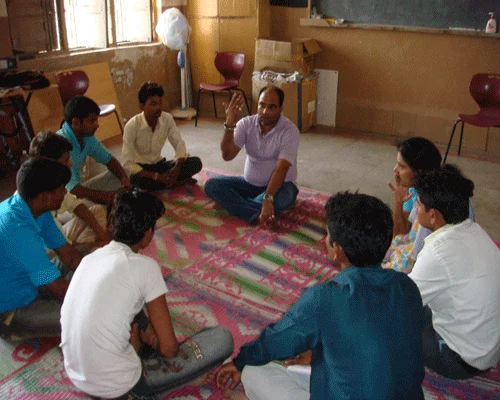
A Samabhavana training session. Classroom time works best when it is tied to jobs nearby.
2. Apprenticeship-linked projects
The government’s National Apprenticeship Promotion Scheme (NAPS-2) shares the cost of apprentice stipends: the employer pays at least 75% and the government pays 25%, up to ₹1,500 a month per apprentice, directly into the apprentice’s bank account (myScheme). Government stipend support applies only to NSQF-aligned courses (Uttarakhand DSDE), and government departments and PSUs do not receive it (Odisha DTET). A CSR project can fund the basic training and job matching that gets young people ready for these apprenticeships at other employers.
3. Women’s livelihood projects
Tailoring, food processing, beauty and care work, often run through self-help groups. Many participants want self-employment rather than a salaried job, so the right measure is income, not placement. See how we approach this on our women empowerment page.
4. Digital and office skills
Computer basics, accounting software and digital marketing for entry-level office roles. These are quick to start and cheap to run. The market is crowded, so a course only stands out if it is tied to real hiring.
5. Sector-certified technical courses
Courses aligned to the National Skills Qualifications Framework (NSQF) and assessed by a Sector Skill Council, for example in electronics, automotive or retail. Employers recognise the certificates. They cost more, because of equipment, longer hours and third-party assessment.
Project type
Best for
What to measure
Vocational centre
Youth, 18–25, near job hubs
Placement, retention, salary
Apprenticeship-linked
ITI / 10th–12th pass youth
Apprenticeships started and completed
Women’s livelihood
Women seeking flexible work
Monthly income before and after
Digital and office skills
Urban youth with basic schooling
Placement into office roles
Sector-certified
Technical job roles
Certification pass rate, placement
What most guides miss: certificates are not jobs
The government’s own flagship skilling scheme shows the problem clearly. Under the first three versions of the Pradhan Mantri Kaushal Vikas Yojana (PMKVY), 56.88 lakh candidates were certified under short-term training and 24.38 lakh were reported placed, around 43% (Lok Sabha reply, July 2024). In Maharashtra, the figure was 30.4%: 80,950 placed out of 2.60 lakh certified (Lok Sabha reply, July 2024).
Under PMKVY 4.0, the ministry says the focus has shifted to “empowering the trained candidates to choose their varied career path” (Lok Sabha reply, August 2025). Placement is no longer the headline number.
This matters for CSR because many skill projects copy the same reporting: students enrolled, students certified. Those numbers say the training happened. They don’t say whether anyone’s life changed. A project that trains 300 people and places 60 can look better on paper than one that trains 100 and places 70, unless you ask for the second number.
Before you fund a skill project, ask the partner three questions:
What percentage of your last two batches were placed within three months, and how do you verify it?
How many were still in that job after six months?
What was the starting salary, and how far was the job from the trainee’s home?
If the partner cannot answer, that is your answer.
How to plan a skill development CSR project in 6 steps
1. Start with jobs, not courses
List the employers and job roles within reach of the community you want to serve: entry salary, shift timings, travel time. Choose the course after that. A good course for jobs that are two hours away will not hold trainees.
2. Pick a certification employers recognise
Prefer NSQF-aligned courses assessed by a Sector Skill Council or a state board. Check the certifying body’s name on the partner’s documents yourself. Recognised certification also matters if you want trainees to move into NAPS apprenticeships later.
3. Check the implementing partner
Since the 2021 amendment, implementing agencies must be registered with the Ministry of Corporate Affairs through Form CSR-1 (TaxGuru). Ask for CSR-1, 12A and 80G registration, records from past batches, trainer qualifications and a site visit. Our own registrations are listed on our certification page, and our track record is in our capability statement.
4. Budget the full cost
Trainers, equipment, consumables, rent and assessment fees are the obvious lines. The ones that get cut are the ones that drive results: trainee travel or stipends, a placement officer, and follow-up calls at three and six months. Remember that the company’s administrative overheads cannot exceed 5% of its total CSR spend for the year (CSR Rules), so build monitoring into the project budget rather than overheads.
5. Write placement into the agreement
Agree the targets before the first batch: placement within three months, retention at six months, and how both will be verified. Some funders tie a part of the payment to these outcomes. Even if you don’t, putting them in writing changes how the partner runs the programme.
6. Plan reporting and impact assessment
Ask for name-level data, collected with consent, and verify a sample by phone yourself. If your company’s average CSR obligation is ₹10 crore or more, projects with outlays of ₹1 crore or more need an independent impact assessment, carried out at least a year after completion. Its cost is capped at 5% of total CSR spend or ₹50 lakh, whichever is lower (CSR Rules).
How to measure results
These are the numbers we suggest asking for, in this order of importance:
Metric
How it is calculated
Why it matters
Placement rate
Placed within 3 months ÷ certified
The main outcome
Retention
Still employed at 6 months ÷ placed
Shows the job was a fit
Income change
Monthly income after minus before
Key for self-employment
Cost per placement
Total project cost ÷ placed
Compares projects fairly
Completion rate
Completed ÷ enrolled
Early warning on dropout
Certification rate
Certified ÷ completed
Shows training quality
Cost per placement is the one most CSR reports leave out. Cost per trainee rewards large batches. Cost per placement rewards results.
How we're building Samabhavana's vocational institute
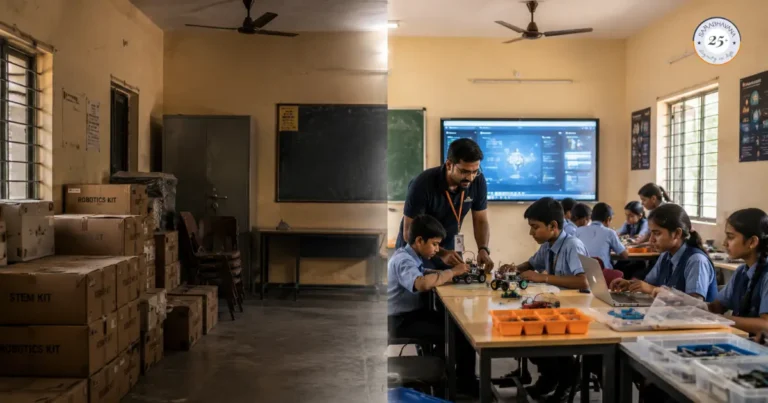
Robotronics (classroom, Navi Mumbai): 210 hours of practical and theory training, with apprenticeship support, certified through the Electronics Sector Skills Council of India (ESSCI). Open to 10th pass students aged 18 and above.
Digital Marketing (online, recorded sessions): 90 days covering SEO, ads, WordPress and social media.
Tally & Accounts (online, recorded sessions): 90 days covering Tally Prime and financial analysis, with Tally certification.
Samabhavana has run community training programmes for over 25 years.
Frequently asked questions
Is skill development an eligible CSR activity?
Yes. Item (ii) of Schedule VII covers employment-enhancing vocational skills, especially for children, women, the elderly and persons with disabilities, along with livelihood enhancement projects. The Ministry of Corporate Affairs has said Schedule VII items can be interpreted liberally, so most job-oriented training and livelihood work qualifies, as long as it does not mainly benefit your own employees.
Can CSR funds pay stipends to trainees?
The CSR Rules do not bar stipends or travel support for project beneficiaries, and many skill projects include them because they reduce dropout. What is excluded is spending that benefits the company's own employees. Record stipends as a project cost in the agreement, and confirm the approach with your CSR committee before the project starts.
Can our company hire people trained through our CSR project?
Trainees can apply to any employer, including you. The risk is a project designed mainly to fill your own vacancies, which can look like normal business activity, and that is excluded from CSR. Keep the project open to all employers in the area, and get your CSR committee's view early.
How do you measure the impact of a CSR skill project?
Track placement within three months, retention at six months and the change in monthly income. Certificates and enrolment show activity, not outcomes. Ask for name-level data collected with consent, and phone a sample of trainees yourself. Large projects may also need an independent impact assessment under the CSR Rules.
How do I choose an NGO for a skill development project?
Check that the NGO is registered with the Ministry of Corporate Affairs through Form CSR-1, and holds 12A and 80G. Ask for placement and retention figures from past batches, meet the trainers and visit the centre. A partner who tracks outcomes will share them without being asked twice.
Planning a skill development project? You can fund a Robotronics batch, lab equipment or placement support at our Navi Mumbai centre, or sponsor seats in our online courses. Talk to our team. If your focus is school education instead, read our guide to CSR in education.