Category: Education

  • STEM Education in India: Why It Belongs in Every Classroom โ€” Not Just Toppers

    STEM Education in India: Why It Belongs in Every Classroom โ€” Not Just Toppers

    Introduction: The Label That Limits

    For too long, STEM education in India has carried an invisible label: for bright students only.

    Walk into most Indian classrooms and you will find this belief quietly at work. The “topper” gets called to solve the equation on the board. The “average” student is guided toward arts or commerce. The child who struggles with marks is told โ€” directly or through silence โ€” that science and mathematics are not for them.

    This is not just wrong. It is damaging. And it is costing India the potential of millions of children who have been sorted out of STEM before they ever had a fair chance in it.

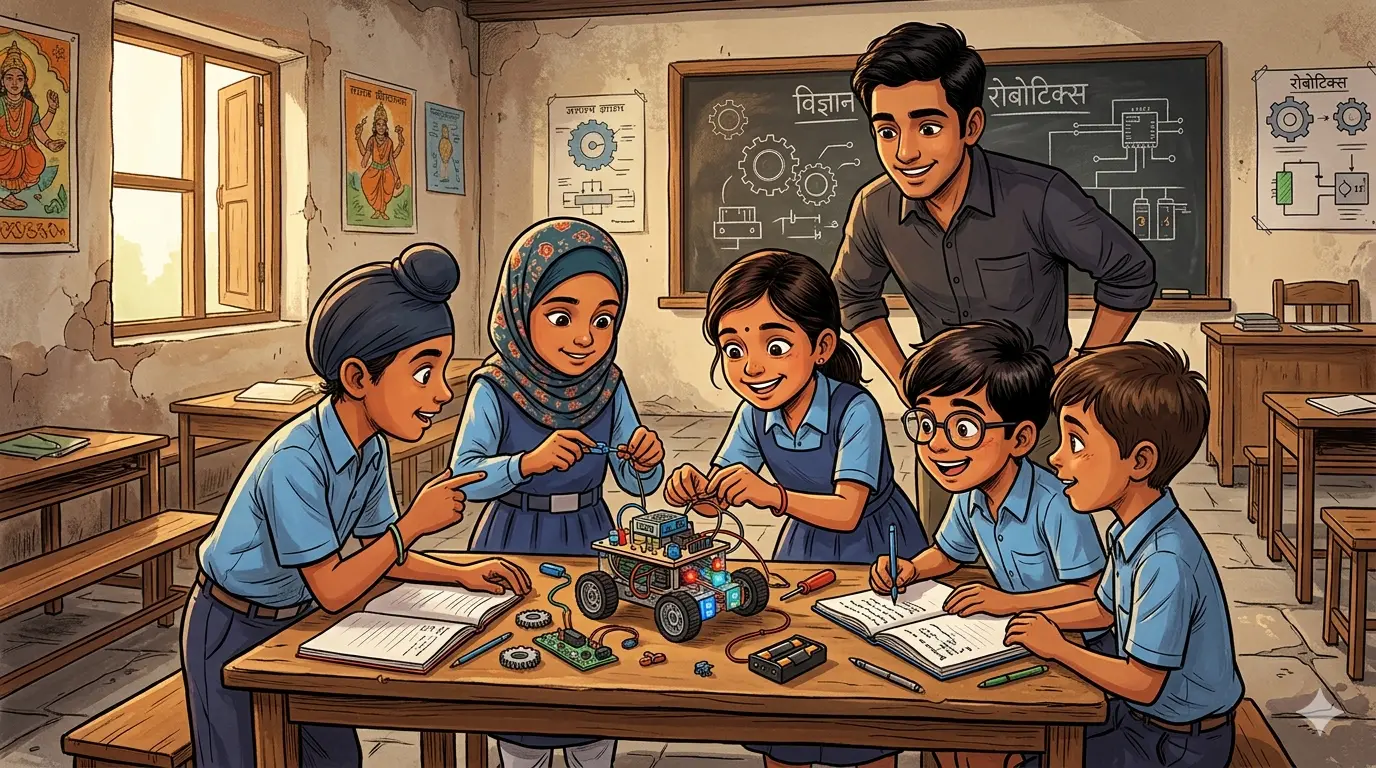
    At Samabhavana, through the Smile Hub Programme, we have seen what happens when that label is removed โ€” when a child who has been told they are “weak in science” is given a model to build, a problem to solve, or a robotics kit to program.

    What happens, consistently, is this: they discover they are not weak in science at all. They were just being taught in a way that didn’t reach them.

    STEM โ€” Science, Technology, Engineering, and Mathematics โ€” is not about speed, memorisation, or marks. It is about curiosity, observation, experimentation, and the willingness to try again when something fails. And those qualities exist in every child.


    The State of STEM Education in India: What the Numbers Show

    STEM education in India is at a pivotal moment. The infrastructure is growing rapidly, but access remains deeply uneven.

    In the CSR space, the impact is also measurable: corporate-funded STEM programmes have collectively reached 20 lakh+ students across 5,800+ schools and 400+ districts, supported by 30,000+ trained teachers. (India CSR, 2026)

    These are real achievements. But they also reveal the gap. India has over 1.5 million schools. The children in the hundreds of thousands of government schools that don’t yet have ATLs, STEM labs, or experiential learning programmes are still learning science from textbooks โ€” and being evaluated by whether they can memorise it.

    STEM education in India has the policy, the funding intent, and the corporate investment. What it still lacks, in too many classrooms, is the implementation that gets it to children who have been systematically excluded from it.


    Why Early Labels Are So Destructive

    In Indian classrooms, academic categorisation happens early โ€” and it sticks.

    By Class 5 or 6, many children have already absorbed a fixed belief about where they sit in the academic hierarchy. “Good at studies.” “Weak in maths.” “Not a science type.”

    These labels are not conclusions children reach about themselves through neutral observation. They are conclusions formed through comparison, grading, and the responses of adults around them.

    When a child repeatedly fails written tests in science, they do not conclude that written tests are a poor measure of scientific ability. They conclude that they are poor at science. The distinction matters enormously, because only one of those conclusions is true.

    The problem with how STEM is taught in many Indian schools is not the content โ€” it is the medium. When the primary delivery method is textbook reading and the primary assessment is written recall, the children who excel are those who learn well through reading and writing.

    Children who learn through doing, building, discussing, or visualising are systematically disadvantaged โ€” not because they lack aptitude, but because the classroom was never designed for how they learn.

    Hands-on STEM changes this. It creates multiple pathways to competence, and it surfaces intelligence that written exams leave invisible.


    What Happens When STEM Becomes Experiential

    The shift that occurs when children engage with hands-on STEM education is one that teachers describe with consistent surprise.

    A child who cannot recall Newton’s laws from a textbook will intuitively grasp the principle of inertia when a ball rolls off a table in a structured experiment. A student who freezes during maths assessments will estimate, calculate, and adjust confidently when building a model bridge under load.

    A girl who has been told she is “not good at science” may turn out to be the most precise observer in the room when given a specimen to examine.

    This is not exceptional. It is typical โ€” once the medium changes.

    Experiential learning works because it activates multiple cognitive pathways simultaneously. Doing, seeing, discussing, adjusting, and reflecting encode information far more durably than reading a static page. It also removes the performance anxiety that written assessment creates.

    When the goal is to make the experiment work rather than to produce the correct answer on paper, children engage differently โ€” more fully, more honestly, and more effectively.

    At Samabhavana’s Smile Hub centres, this is the foundation of how STEM is delivered. Activities are designed around curiosity and construction. Mistakes are built into the process.

    The question is not “did you get it right?” but “what did you observe, and what does that tell you?”


    STEM, Girls, and Marginalized Communities

    Inclusive STEM education in India has a specific and urgent gender dimension.

    Despite India’s growing presence in global technology and space science, women remain significantly underrepresented across STEM fields. An EY report published in January 2026, Breaking the Code: The Rise of Women in India’s STEM Landscape, documents both the progress made and the persistent barriers โ€” particularly for girls from lower-income, first-generation learner households. (EY, 2026)

    The barriers are not intellectual. They are social and structural. Girls in many communities receive subtle and not-so-subtle messages that STEM careers are not for them โ€” from families, from peer groups, and sometimes from the school environment itself. Early exposure to STEM in a genuinely inclusive, non-competitive setting disrupts this trajectory before it becomes entrenched.

    The same logic applies for children from marginalised communities, first-generation learners, and students with learning differences. Hands-on, experiential STEM creates a classroom where participation does not require reading fluency, prior educational advantage, or the kind of cultural capital that urban, upper-income households provide by default.

    Samabhavana’s Smile Hub programmes deliberately include girls, children from marginalised communities, and students who have been performing poorly in conventional academic settings โ€” because these are precisely the children for whom inclusive STEM education has the highest transformative potential.


    The CSR Case: Why STEM in Government Schools Deserves Corporate Investment

    STEM education in India โ€” specifically in government and low-resource schools โ€” is one of the most compelling CSR investments available under Schedule VII of the Companies Act, 2013. It qualifies under education, skill development, and promotion of scientific temper, providing multiple Schedule VII compliance pathways.

    The case for corporate investment is strong and multidimensional:

    India’s STEM workforce gap is real. NASSCOM estimates India needs to add over one million skilled technology workers annually to meet digital economy demand through 2030. The pipeline begins in school โ€” and it cannot be built from the top of the academic distribution alone.

    The multiplier effect is significant. One well-equipped STEM programme in a government school cluster reaches hundreds of children per year, for the duration of the programme. Teacher training components extend impact to every cohort those teachers subsequently teach.

    Government co-investment creates leverage. With PM SHRI schools, ATL infrastructure, and NEP implementation all creating public investment in STEM, corporate CSR supplements rather than duplicates โ€” extending the reach of government programmes into communities and schools that the flagship schemes haven’t yet reached.

    Impact measurement is structured and MCA-compliant. Pre- and post-assessments, teacher observation data, and participation records provide the documented outcome evidence that PSU CSR teams and corporate sustainability reports require.

    Samabhavana works with CSR partners to design and implement STEM education programmes aligned with Schedule VII requirements โ€” with full compliance documentation for CSR-2 filing and annual reporting.

    🔗 Explore Samabhavana’s Education programmes: Education 

    🔗 See the full Smile Hub STEM curriculum: Smart Digital Class 

    🔗 Partner with us for CSR implementation: Donors & Partners


    Samabhavana’s Smile Hub: STEM for Every Child

    The Smile Hub Programme at Samabhavana is built on a foundational conviction: that STEM education should reach every child โ€” not just those in well-resourced schools or those who score well in written examinations.

    Smile Hub delivers an integrated STEM curriculum that includes:

    • Robotics and engineering โ€” building, programming, and testing robots using age-appropriate kits, developing logical thinking and collaborative problem-solving
    • Astronomy and space science โ€” hands-on sky observation, solar system models, and India’s space story through ISRO
    • Digital literacy and AI basics โ€” practical computer skills, coding fundamentals, and an introduction to how artificial intelligence works
    • Virtual reality learning โ€” immersive, curriculum-mapped experiences that bring textbook concepts to life
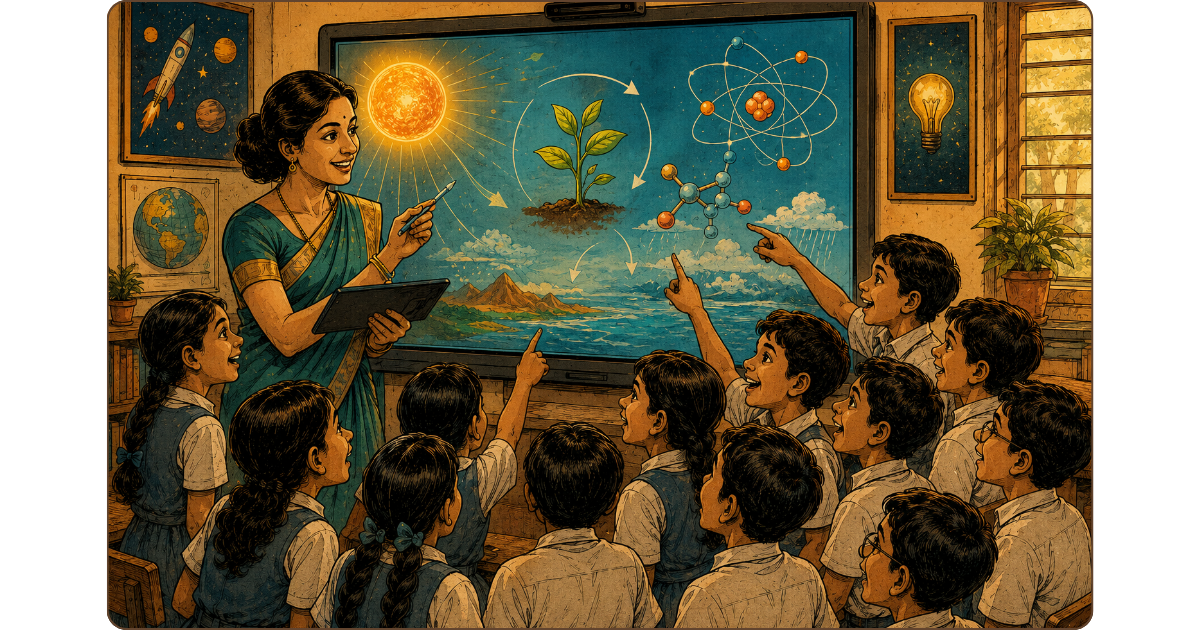
    • Smart classroom technology โ€” interactive learning tools that make abstract concepts visible and engaging

    Every programme component is designed for low-resource settings, delivered by trained facilitators, and assessed at baseline and endline.

    CSR partners receive structured impact reports documenting knowledge gains, participation levels, and qualitative observations from educators.


    Frequently Asked Questions

    1. Is STEM education in India only for academically strong students?

    Absolutely not โ€” and this is the most important misconception to correct. STEM education in India’s most effective programmes is specifically designed to reach children who have struggled in conventional academic settings, because hands-on, experiential learning surfaces intelligence and aptitude that written-exam systems miss entirely.

    Curiosity and problem-solving ability are not correlated with exam scores.

    2. How does hands-on STEM improve learning outcomes?

    Experiential learning activates multiple cognitive pathways simultaneously โ€” doing, observing, adjusting, and reflecting. Research consistently shows that children retain and apply knowledge significantly better when they have engaged with it physically and practically.

    STEM activities also reduce the performance anxiety associated with written tests, allowing more children to participate fully.

    3. Is STEM CSR eligible under Schedule VII?

    Yes. STEM education programmes in schools qualify under the education and vocational skills provisions of Schedule VII of the Companies Act, 2013.

    They also align with the promotion of scientific temper โ€” a value enshrined in Article 51A(h) of the Indian Constitution โ€” providing an additional compliance narrative particularly relevant for PSU CSR teams.

    4. How can STEM education support girls’ advancement in India?

    Early, positive exposure to STEM in a supportive, non-competitive environment directly counters the social messaging that tells girls science and technology are not for them.

    Programmes that actively include and encourage girls โ€” particularly in communities where this messaging is strongest โ€” show measurable improvement in STEM confidence, participation, and aspiration.

    Samabhavana’s Smile Hub is designed with gender inclusion as a structural priority.

    5. Can STEM be taught effectively in schools without laboratories or infrastructure?

    Yes. The most important ingredient in effective STEM education is not equipment โ€” it is a pedagogical approach. Well-designed STEM activities using low-cost materials, structured observation exercises, and project-based challenges can produce genuine learning outcomes in any classroom.

    Smile Hub is specifically designed for resource-constrained government school settings.

    6. What does Samabhavana’s STEM programme deliver for CSR partners?

    Samabhavana provides CSR partners with programme design, educator training, material development and delivery, structured baseline and endline assessments, quarterly progress reports, and full MCA-compliant documentation for CSR-2 filing.

    Our programmes are designed to be delivered in or near your operational geography, with measurable outcomes reported across student, teacher, and school levels.


    Conclusion: STEM Education Belongs to Every Child in India

    STEM education in India is not a privilege. It is not a reward for academic performance. And it is not reserved for children who already know how to succeed in school.

    It belongs to the child who has been told they are weak in maths. It belongs to the girl who has been quietly guided away from science. It belongs to the first-generation learner in a government school who has never seen a working model, conducted an experiment, or been asked to solve a real problem.

    India’s ambitions โ€” in space, in technology, in manufacturing, in healthcare โ€” require a workforce that is not drawn from the top 10% of the academic distribution. They require thinkers and problem-solvers from every community, every background, every type of mind.

    STEM education in India that is inclusive, hands-on, and community-rooted is not a compromise on standards. It is the only version that actually builds India’s future.

    At Samabhavana, this belief drives everything we do.

    Every child has the capacity to observe, question, and create. When STEM education is designed to meet children where they are โ€” rather than where a textbook assumes they should be โ€” that capacity emerges consistently, and powerfully.


    Samabhavana is a Mumbai-based NGO with 25+ years of experience in CSR implementation across education, health, skill development, and community development.

    Our Smile Hub programme delivers inclusive STEM education across robotics, astronomy, digital literacy, AI basics, and VR in government schools.

    To explore how your organisation can fund this work through CSR, get in touch with us.

  • Smart Digital Class India: What Really Changes in Schools?

    Smart Digital Class India: What Really Changes in Schools?

    Walk into a government school in rural Maharashtra or a municipal school on the outskirts of Delhi, and you might find something that would have seemed improbable a decade ago: a teacher guiding students through an animated science lesson on an interactive panel.

    A child in the back row raising her hand to answer a question she would have whispered to a friend just two years earlier. The idea of a smart digital class India is no longer an experiment โ€” it is becoming the baseline expectation for what learning can and should look like.

    But this shift is not just about hardware. Swapping a blackboard for a smartboard does not automatically change educational outcomes. The transformation is real when it is accompanied by trained teachers, reliable electricity, relevant content in regional languages, and a school environment where technology is used purposefully rather than decoratively. This is the conversation India needs to have โ€” and increasingly, it is having it.

    The Policy Foundation: NEP 2020

    The National Education Policy 2020 placed technology-enabled learning at the heart of India’s educational reform agenda. NEP 2020 envisions a shift from rote memorisation to experiential, inquiry-based learning โ€” and digital tools are seen as essential enablers of that shift, not ends in themselves.

    The policy calls for equipping all schools with ICT infrastructure, training teachers in digital pedagogy, and ensuring that content is available in regional languages and in accessible formats for children with different learning needs.

    What Makes a Smart Digital Class India Different?

    A smart digital class India, when properly implemented, offers several concrete shifts in the learning experience. Interactive panels replace static blackboards, allowing teachers to display animated diagrams, run simulations, and replay content for students who need reinforcement.

    Content aligned with the NCERT curriculum โ€” available in Hindi, English, and regional languages โ€” means that children are not navigating a language barrier on top of a subject-matter challenge.

    Assessment changes too. Digital tools allow teachers to quickly gauge comprehension through in-class quizzes, track which concepts are not landing, and adjust lessons accordingly. This is formative assessment in practice โ€” something that large, under-resourced classrooms have historically struggled to deliver.

    Perhaps most importantly, a well-implemented smart classroom can reignite curiosity. Children who have never seen the solar system animated, who have never watched a chemistry reaction play out step by step, respond to these stimuli with a kind of engagement that traditional instruction often cannot produce.

    Teachers who have worked in both environments consistently report that students ask more questions and stay more focused when learning is visual and interactive.

    The Teacher at the Centre – Smart Digital Class India

    Technology is only as effective as the person using it. This is the part of the smart classroom story that often goes untold. Across India, many schools have received smartboards and interactive panels that remain switched off because teachers were never trained to use them confidently. Equipment without capability development is wasted investment.

    Effective smart classroom implementation requires multi-day teacher training programmes, ongoing technical support, and school leadership that encourages experimentation. Teachers need to understand not just how to operate the technology, but how to redesign their pedagogy around it โ€” how to use the 45-minute class period differently when you have a tool that can show, not just tell.

    Samabhavana’s education programmes, detailed on our education page, have consistently prioritised teacher training alongside infrastructure deployment. In our experience, teacher capability development is the single biggest differentiator between a smart classroom that transforms learning and one that collects dust.

    The CSR Angle: Why Companies Are Funding Digital Education

    Under Schedule VII of the Companies Act 2013, expenditure on the promotion of education and livelihood enhancement qualifies as CSR spending. This has made smart classroom infrastructure one of the most popular CSR activities among Indian corporates.

    Education consistently ranks as the top recipient of CSR funds in India โ€” receiving approximately 37% of total CSR expenditure in FY 2023โ€“24, when overall CSR spending crossed โ‚น34,900 crore nationally.

    CSR-funded smart digital class India projects have particular value when they are targeted at government and municipal schools serving first-generation learners โ€” children whose parents may never have used a computer, let alone attended a school with a projector. The impact per rupee in these contexts is significantly higher than in already-well-resourced private schools.

    For companies looking to maximise Schedule VII compliance through education CSR, the key questions are: Which schools will benefit most? Who will train the teachers? How will outcomes be measured? These questions are what distinguish a genuine impact programme from a box-ticking exercise.

    To explore CSR partnerships in education, visit our PSU and donor partners page.

    Common Implementation Challenges

    Several recurring challenges can undermine even well-funded smart classroom projects. Unreliable power supply in rural schools means that technology-dependent lessons can be disrupted without warning. Poor internet connectivity limits the use of cloud-based content and video resources.

    Schools in areas with extreme heat or humidity face hardware maintenance challenges. And in schools where a single teacher handles multiple grades simultaneously, integrating digital tools into instruction requires creative adaptation.

    None of these challenges are insurmountable, but they require honest assessment upfront. The most successful smart classroom programmes conduct a thorough school-readiness audit before installation โ€” checking power, connectivity, space, and teacher capacity โ€” and then design implementation accordingly.

    Content localisation is another underappreciated factor. Digital content in English, covering examples drawn from urban middle-class life, has limited resonance with a child in a village school in Chhattisgarh.

    Content in the child’s mother tongue, with examples drawn from familiar environments, dramatically improves engagement and retention.

    Measuring the Difference

    How do you know if a smart classroom programme is working? The honest answer is that measurement in Indian school education remains weak. Learning outcomes data is patchy, attendance records are inconsistently maintained, and most corporate CSR reports focus on inputs โ€” number of schools covered, number of students reached โ€” rather than outputs, such as what those students actually learned.

    The shift toward outcome measurement is slowly happening. ASER (Annual Status of Education Report) data provides a useful national benchmark on foundational literacy and numeracy. Some NGOs running smart classroom programmes have developed pre- and post-assessment tools that capture learning gains.

    Samabhavana’s approach to education CSR includes built-in monitoring and evaluation โ€” tracking both usage rates and learning indicators over the project period.

    For companies preparing BRSR (Business Responsibility and Sustainability Reporting) submissions, outcome data from well-documented education programmes is increasingly valuable in demonstrating genuine social impact to investors and regulators.

    SEBI now requires the top 1,000 listed companies to file BRSR disclosures, and education CSR data โ€” when it is outcomes-focused and verifiable โ€” strengthens those submissions considerably.

    The Road Ahead

    India has roughly 1.5 million schools. Government data suggests fewer than 40% have functional computer facilities. PM SHRI covers 14,500. Atal Tinkering Labs, the government’s innovation-in-schools initiative, now operates in more than 10,000 schools, engaging over 1.1 crore students โ€” and the Union Budget 2025โ€“26 announced plans to expand to 50,000 more schools over the next five years. These are ambitious numbers, and meaningful progress is being made.

    But the gap between policy ambition and classroom reality remains large. Bridging it requires sustained investment, multi-year commitments rather than one-off donations, and genuine partnerships between government, corporates, civil society, and the schools themselves.

    Samabhavana has been working at this intersection for 25 years โ€” understanding both the ambition of the policy environment and the ground-level complexity of school transformation. That experience informs every initiative we design and implement, from site selection to teacher training to impact reporting. Learn more about our education programmes here.


    FAQ

    Q1: What is a smart digital class in India?

    A smart digital class in India is a classroom โ€” most commonly in a government or municipal school โ€” equipped with interactive panels, projectors, and NCERT-aligned digital content, backed by teacher training to use these tools effectively. The goal is to shift learning from passive listening to active, visual, inquiry-based engagement.

    Q2: How does a smart digital class India benefit government school students?

    Students in government schools often have limited access to learning resources outside the classroom. A smart digital class India gives them exposure to animated lessons, subject simulations, and multilingual content that helps bridge learning gaps and spark curiosity โ€” particularly valuable for first-generation learners.

    Q3: What is the PM SHRI scheme and how does it relate to smart classrooms?

    PM SHRI (Pradhan Mantri Schools for Rising India) is a centrally sponsored scheme with a โ‚น27,360 crore outlay (2022โ€“27) to upgrade 14,500 government schools into NEP 2020-aligned model institutions. Each upgraded school receives smart classrooms, ICT labs, and vocational infrastructure, with smart classrooms mandated for use at least twice a week per subject.

    Q4: Can CSR funds be used for smart classroom projects?

    Yes. Under Schedule VII of the Companies Act 2013, the promotion of education qualifies as a CSR activity. Smart classroom installations in government and municipal schools are among the most common education CSR investments, eligible for the mandatory 2% net profit spend.

    Q5: What makes a smart classroom programme succeed rather than fail?

    The key differentiator is teacher training. Schools that receive hardware without capability development rarely see meaningful change. Successful programmes also include school-readiness audits, localised digital content, ongoing technical support, and outcome measurement frameworks.

    Q6: How can companies partner with an NGO for smart classroom CSR?

    Companies should partner with experienced NGOs that have deep school networks, teacher training capacity, and documented impact track records. Samabhavana has 25 years of education programme experience across Maharashtra and beyond. Contact us to explore a partnership.


    CONCLUSION

    India’s classrooms are changing. The pace is uneven, the challenges are real, and the distance still to travel is considerable. But the direction is clear: smart, technology-enabled learning is becoming standard in the aspirations of policymakers, CSR heads, and parents alike.

    Every smart digital class India creates is a commitment to a child’s future โ€” and when designed and implemented thoughtfully, it is a commitment that delivers.

    If your company is exploring education CSR and wants to move beyond one-time donations toward sustained, measurable impact,

    Contact Samabhavana to learn how we design and deliver programmes that change what learning looks like in India’s most underserved classrooms.

  • Learning With Robots: When Children Build Something With Their Own Hands

    Learning With Robots: When Children Build Something With Their Own Hands

    Introduction

    There is a particular kind of focus that comes over a child when they are building something that might actually work. Not filling in a worksheet, not reciting a definition โ€” but assembling components, testing a circuit, arguing with a classmate about why the sensor is not firing the way it should.

    Robotics education India has moved from a privilege of elite private schools to a growing presence in government classrooms and community learning centres, and the difference it is making is measurable.

    The shift is not just about cool technology. Robotics, artificial intelligence, and the Internet of Things (IoT) are tools for teaching children how to think โ€” how to break a problem into components, hypothesise, test, fail, revise, and try again.

    These are capabilities that the Indian economy of 2030 will need at scale. The question is whether the education system โ€” and the CSR ecosystem that increasingly funds it โ€” is building them fast enough.

    The State of Robotics Education India Today

    The Atal Innovation Mission, launched in 2016, has been the defining government initiative in this space. Through its Atal Tinkering Labs (ATL) programme, the government has established more than 10,000 labs in schools across India, engaging over 1.1 crore students as of 2025.

    The government has disbursed โ‚น1,391.84 crore directly to schools for this purpose. Maharashtra leads with 1,033 labs, followed by Tamil Nadu (975), Uttar Pradesh (955), Karnataka (798), and Andhra Pradesh (713). Crucially, more than 60% of these labs are in government and rural schools โ€” not just well-funded private institutions.

    For organisations designing CSR programmes in education, this creates a clear alignment opportunity โ€” corporate investment can complement and accelerate a government initiative that already has momentum and institutional backing.

    The data on impact is encouraging. Studies show that 74.4% of schools with ATLs report growth in STEM subject interest, and 69.4% show improved academic performance outcomes.

    More than 16 lakh innovation projects have been created by students in these labs. These are not just tinkering sessions โ€” they are formative learning experiences that change how children see themselves in relation to science and technology.

    What Hands-On Learning Actually Looks Like

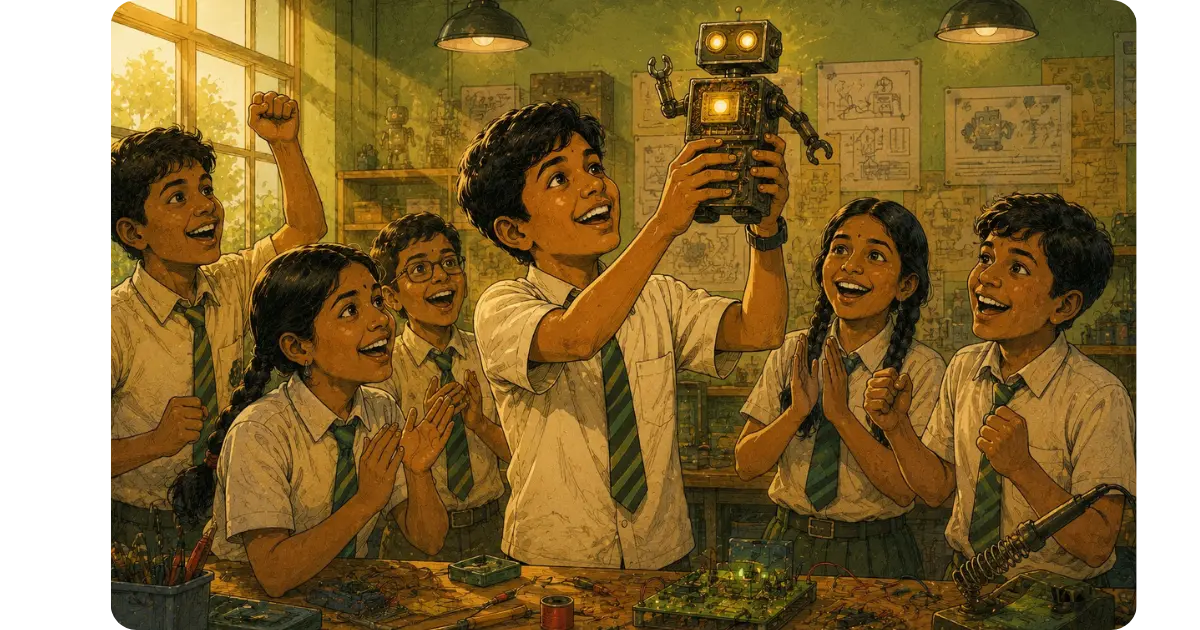
    The phrase “hands-on learning” is used often and defined rarely. In the context of robotics education India, it means children physically assembling a robot from components โ€” connecting motors, sensors, microcontrollers, and power sources โ€” and then writing the code that tells the assembled device what to do.

    When it works, the satisfaction is immediate and visceral. When it does not work, the child is confronted with a concrete problem that requires systematic diagnosis.

    This process builds skills that no textbook exercise can replicate. Spatial reasoning develops as children figure out how components relate physically. Logical reasoning grows through the debugging process.

    Collaboration becomes necessary because most builds are too complex for one student to manage alone. Communication is exercised when teams present their projects to judges, teachers, or visiting corporate partners.

    AI and IoT dimensions add further layers. Children who learn to collect data from sensors and use it to drive decision-making in a small system gain an intuitive understanding of how AI works โ€” not through abstract definition, but through direct experience.

    An IoT project where students build a smart plant-watering system that checks soil moisture before activating a pump is more than a robotics exercise: it is an entry point into environmental awareness and systems thinking.

    Samabhavana’s Smile Hub initiative integrates these elements into an enriched community learning environment. You can explore the education work we do here.

    NEP 2020 and the Policy Case for Robotics

    The National Education Policy 2020 explicitly recognises the importance of computational thinking, coding, and maker-space learning as core educational experiences for children from Class 6 onward.

    NEP 2020 envisions every school having access to a tinkering lab environment โ€” a vision that Atal Tinkering Labs and CSR-funded robotics programmes are working to realise.

    The policy also emphasises multi-disciplinary learning โ€” the idea that science, mathematics, arts, and humanities should be taught as interconnected rather than siloed subjects.

    Robotics is naturally multi-disciplinary: it draws on mathematics (geometry, algebra), physics (mechanics, electronics), computer science (programming logic), and design (aesthetics, user experience). A single robotics project can activate learning across four or five traditional subject areas simultaneously.

    This aligns with what education researchers have long argued: that children learn more deeply when knowledge is applied to solve real problems rather than studied in abstract isolation. Robotics education India is one of the clearest practical expressions of this principle at scale.

    CSR Investment in Robotics Education India

    CSR investment in robotics education India is accelerating, driven by several converging factors. First, the technology sector โ€” one of India’s largest and most profitable โ€” has a natural affinity for STEM education CSR.

    Companies in IT, manufacturing, and infrastructure understand that their long-term talent pipeline depends on a stronger STEM foundation in the school system.

    Second, robotics programmes produce highly visible outputs โ€” competitions, demonstrations, exhibitions โ€” that make for compelling CSR impact communications. When a group of government school students presents a working robot at a district-level competition, it is a story that resonates with employees, customers, investors, and regulators alike.

    Third, Schedule VII of the Companies Act 2013 qualifies expenditure on education and livelihood enhancement as CSR, giving companies clear legal backing for robotics lab investments.

    For companies preparing BRSR disclosures, a well-documented robotics programme with learning outcome data provides exactly the kind of social impact evidence that ESG frameworks reward.

    The most effective CSR-funded robotics programmes are not one-off lab installations. They include multi-year commitments, trained facilitators who guide student projects, structured curriculum, and linkage to competitions and external recognition.

    Samabhavana works with corporate partners to design programmes that deliver these elements systematically. Visit our PSU and donor partners page to understand our partnership model.

    The Facilitator Question

    As with smart classrooms, the technology is only as powerful as the human being guiding its use. A robotics lab without a trained, enthusiastic facilitator is a room full of boxes.

    The facilitator โ€” whether a specially trained teacher, an NGO staff member, or a community educator โ€” is the person who turns a child’s frustration with a broken circuit into a learning moment rather than a reason to disengage.

    Facilitator training for robotics education requires specific investment. It is not enough for a teacher to know how to assemble a robot; they need to know how to create the psychological safety for students to fail productively, how to scaffold complexity as skills develop, and how to link the hands-on work to the broader curriculum the child is expected to master. This is a specialised skill set, and it needs to be built deliberately.

    Samabhavana’s approach integrates facilitator development into every robotics education programme โ€” ensuring that the human infrastructure matches the physical infrastructure.

    Inclusion and Equity in Robotics Education

    One of the most important questions in robotics education India is who gets access. Historically, the answer has been children in private schools and urban areas. 

    Gender is a particular concern. Girls in many school environments are informally steered away from STEM. Robotics programmes that actively recruit girls, provide role models, and create a culture of inclusion can be powerful counters to this pattern.

    The ATL programme reports that 96% of its labs are in co-educational or all-girls schools, a design choice that makes girls’ participation structurally possible. CSR programmes should build on this by explicitly tracking and reporting on girls’ participation and achievement.

    Diversity and inclusion considerations matter in education just as they matter in workplaces. Samabhavana’s commitment to these values is reflected across all our programme areas, including education. Learn more about our diversity and inclusivity work.


    FAQ

    Q1: What is robotics education India and why does it matter?

    Robotics education India refers to programmes that teach children to build and programme robots, using this as a vehicle for developing STEM skills, logical reasoning, collaboration, and creativity. It matters because these capabilities are foundational for India’s future workforce and are currently under-developed in the traditional curriculum.

    Q2: How does robotics relate to AI and IoT education?

    Robotics, AI, and IoT are naturally interconnected. Children learning to programme robots often use AI principles (decision trees, sensor-based logic) and IoT concepts (connecting devices to exchange data). These experiences give children an intuitive, practical understanding of technologies that will define the future economy.

    Q3: Can companies fund robotics education through CSR?

    Yes. Schedule VII of the Companies Act 2013 includes the promotion of education and livelihood enhancement as qualifying CSR activities. Robotics lab installations in government schools are an eligible, high-visibility use of CSR funds with measurable student impact.

    Q4: What is the Smile Hub initiative by Samabhavana?

    Smile Hub is Samabhavana’s enriched community learning environment that integrates STEM, robotics, digital literacy, and experiential learning for children in underserved communities. It is designed to complement school learning with hands-on, curiosity-driven exploration.

    Q5: How can a company set up a robotics CSR programme with Samabhavana?

    Samabhavana designs end-to-end robotics education CSR programmes โ€” from site selection and lab setup to facilitator training, curriculum delivery, and impact reporting. Contact us to discuss a programme tailored to your CSR goals and geography.


    CONCLUSION

    When a child builds a robot that does what they programmed it to do, something changes in how they understand their own capability. That moment โ€” small, specific, and entirely theirs โ€” is what robotics education India at its best produces, at scale, in classrooms that have never had access to this kind of learning before.

    For companies thinking seriously about their education CSR strategy, robotics education India is one of the most powerful investments available within Schedule VII. The technology is accessible. The evidence is strong. The policy support is in place.


    Contact Samabhavana to explore how we can build a robotics education programme together โ€” one that delivers measurable outcomes, supports your BRSR disclosures, and leaves a lasting mark on children’s lives.

  • Looking Up: How Astronomy Education CSR Gives Children a Bigger World

    Looking Up: How Astronomy Education CSR Gives Children a Bigger World

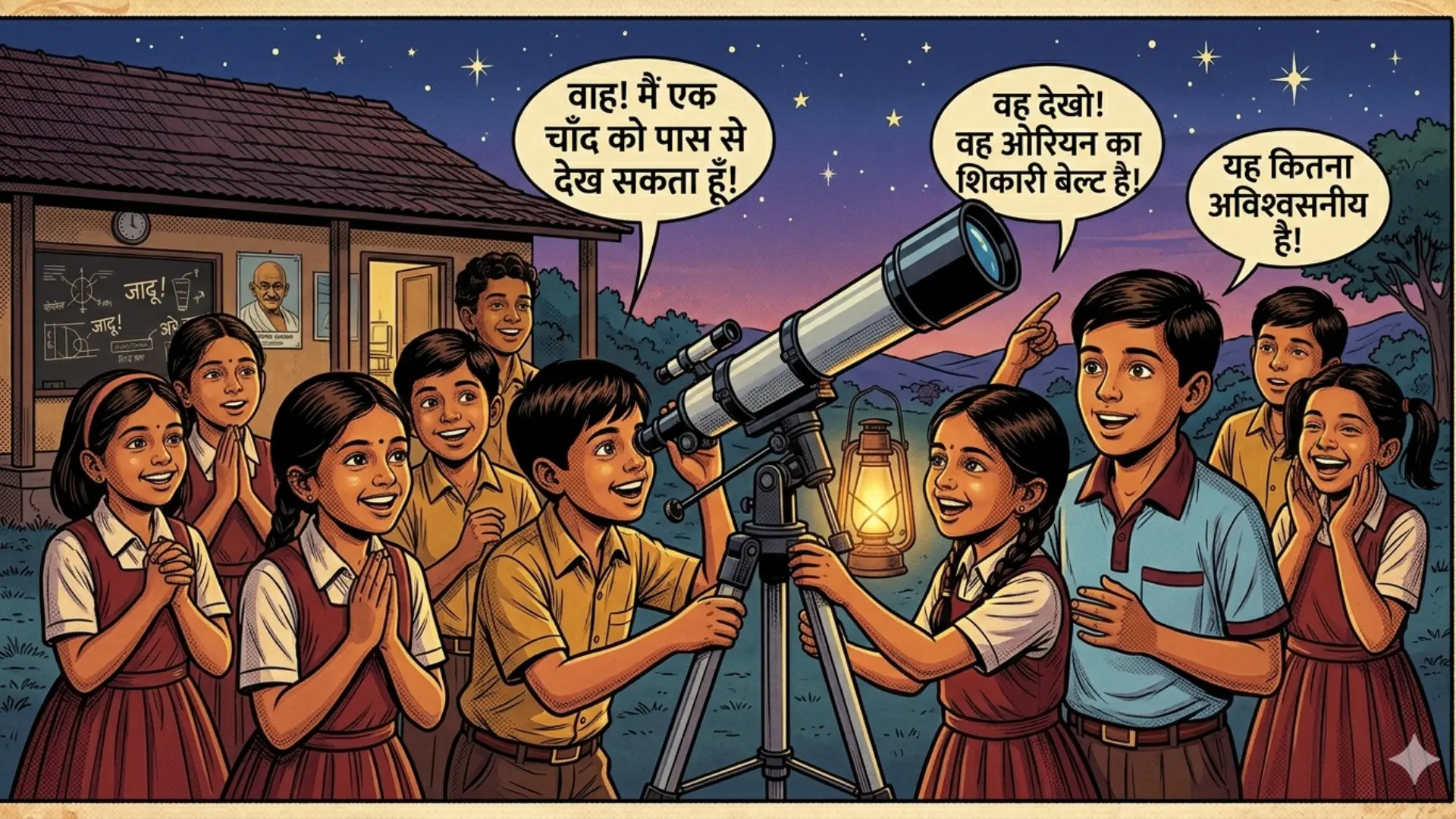
    There is a moment โ€” it happens reliably, across cultures and geographies โ€” when a child looks through a telescope for the first time and sees the rings of Saturn. Not in a textbook diagram, not on a screen, but actually sees them: faint, precise, impossibly real.

    The effect is difficult to describe and impossible to forget. Astronomy education CSR brings this experience to children in government schools and underserved communities who would otherwise never encounter it โ€” and in doing so, it opens something that extends far beyond a science lesson.

    India has a particular relationship with the cosmos. ISRO’s achievements โ€” from Chandrayaan-3’s historic soft landing on the Moon’s south pole in 2023, to the Aditya-L1 solar mission, to the ambitions of Gaganyaan โ€” have given the country a renewed sense that space is not just a domain for the powerful and the wealthy, but a frontier that belongs to India.

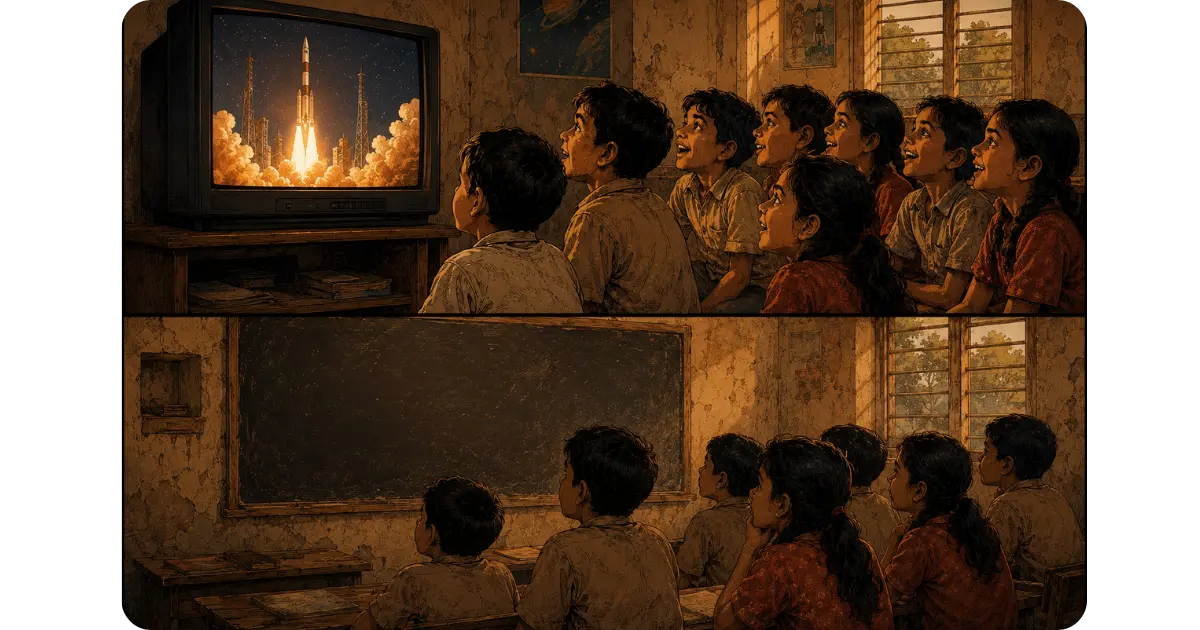
    When a child in a village school in Rajasthan sees ISRO scientists celebrating a successful lunar mission on a classroom screen, something shifts in what they believe is possible for people like them. Astronomy education in schools is the bridge between that inspiration and a child’s own sense of potential.

    The Science of Wonder: What Astronomy Teaches

    Astronomy is not a subject that can be taught in isolation. It draws on mathematics, physics, geography, history, and culture simultaneously โ€” making it one of the most naturally multi-disciplinary subjects in the school curriculum.

    When children learn about the scale of the solar system, they are practising mathematical reasoning. When they track the movement of stars across seasons, they are learning about the Earth’s rotation and orbit.

    When they explore cultural astronomy โ€” the ways in which Indian civilisations mapped the stars, named the nakshatras, and used celestial observation to develop the calendar and navigate the seas โ€” they are connecting science to history, culture, and identity.

    This multi-disciplinary richness makes astronomy an unusually effective vehicle for inquiry-based learning. A child who wants to know why Jupiter has so many moons will need mathematics, physics, and persistence. A child who wants to know how the ancient astronomers of Ujjain built the Jantar Mantar will need history, geometry, and spatial reasoning. The subject does not allow passive reception โ€” it demands active curiosity.

    For children who have struggled to find a way into the sciences through textbook instruction, astronomy can be a revelatory entry point. It begins with observation โ€” something every child can do โ€” and builds from there toward deeper understanding. The barrier to entry is lower than in many other STEM subjects, yet the ceiling is as high as anyone wants to take it.

    ISRO and the Inspiration Ecosystem

    ISRO runs the START (Space Science and Technology Awareness Training) programme for post-graduate and final-year undergraduate students, and the Antriksh Jigyasa portal for online space science learning.

    These initiatives create an ecosystem of space inspiration that CSR-funded school astronomy programmes can connect to โ€” giving children a pathway from a stargazing session in their school courtyard to the possibility of a career in India’s space sector.

    When a Samabhavana Smile Hub astronomy programme brings a telescope to a school in a semi-urban area of Maharashtra, it is not just providing a science activity. It is connecting children to this larger ecosystem of inspiration โ€” letting them see themselves as part of India’s space story, not just distant spectators of it.

    Why Astronomy Education CSR Works

    Astronomy education CSR works for several reasons that are specific to the format and the context. First, the experience of looking through a telescope is intrinsically memorable. Most school education asks children to absorb information; astronomy asks them to see something that they have never seen before and will not forget. That quality of experience is the foundation of lasting curiosity.

    Second, astronomy is accessible. You do not need expensive lab equipment to run a meaningful astronomy session. A telescope, a clear sky, a knowledgeable facilitator, and a group of children who have never looked at the moon’s craters up close is enough to create a profound learning experience.

    Astronomy makes scientific wonder accessible at relatively low cost โ€” an important consideration for NGOs and CSR programmes working at scale across many schools.

    Third, astronomy has strong cultural resonance in India. The country’s astronomical heritage โ€” the Vedic calendar, the Panchangam, the observatory traditions, the mathematical contributions of Aryabhatta โ€” means that school astronomy can be taught as both modern science and cultural heritage. This dual framing builds engagement across diverse communities and gives the subject a grounding that feels meaningful, not merely technical.

    Astronomy education CSR qualifies under Schedule VII of the Companies Act 2013 as promotion of education and, where delivered in government schools serving disadvantaged communities, as a livelihood enabler โ€” since STEM education directly affects employability in an economy where technology skills are increasingly central to income.

    Samabhavana’s Smile Hub: Astronomy as Community Experience

    Samabhavana’s Smile Hub initiative integrates astronomy into a broader community learning experience. Regular stargazing sessions bring children โ€” and often their parents and siblings โ€” together for guided observation, storytelling about the cosmos, and discussion of India’s space achievements.

    These sessions are designed to be social as well as educational: they create community around learning, building the kind of collective curiosity that sustains scientific interest beyond a single event.

    The facilitators who run Smile Hub astronomy sessions are trained not just in astronomy content but in facilitation techniques that work with the specific age groups, learning contexts, and cultural backgrounds of the communities they serve.

    They know how to connect Saturn’s rings to a child’s sense of wonder, how to link Chandrayaan-3 to a class discussion about Indian achievements, and how to handle the genuine questions โ€” “How big is the universe?”, “Is there life on other planets?” โ€” that astronomy reliably produces.

    For corporate partners, Smile Hub offers a well-designed, community-rooted platform for education CSR investment that produces visible, memorable outcomes. Children and communities remember astronomy experiences. They talk about them. They inspire other children to attend. The ripple effect of a well-run stargazing programme extends well beyond the children who participated on the night.

    Learn more about Samabhavana’s education work, including Smile Hub, on our education page.

    Cultural Astronomy and the Indian Tradition

    India’s astronomical heritage is one of the richest in the world and one of the least known to school-age children. The Jantar Mantar observatories of Jaipur, Delhi, Mathura, Varanasi, and Ujjain โ€” built by Maharaja Jai Singh II in the eighteenth century โ€” are UNESCO World Heritage Sites that represent one of the most sophisticated pre-telescopic astronomical traditions anywhere.

    The Aryabhatiyam, written in the fifth century CE, accurately calculated the earth’s rotation and laid the foundation for Indian mathematics and astronomy for a millennium. The Indian National Calendar is derived directly from this tradition.

    Astronomy education programmes that incorporate these cultural dimensions are not just teaching science โ€” they are reconnecting children to a heritage of intellectual achievement that belongs to them.

    For many children in communities where self-confidence and aspiration are in short supply, the discovery that people from their civilisation were mapping the stars while much of the world was in what Europe called the Dark Ages can be genuinely transformative.

    This is the depth of what astronomy education CSR at its best can do โ€” not just teach the mechanics of the solar system, but expand a child’s sense of who they are and what they come from.

    CSR Partner Engagement

    For corporate partners interested in astronomy education CSR, Samabhavana offers programme designs that range from single-school telescope installations with facilitator training to multi-school, multi-year Smile Hub partnerships with regular programming and impact reporting.

    We work with CSR teams to align the programme with their sector focus, geography, and BRSR reporting requirements.

    Astronomy CSR is also an effective employee engagement vehicle: corporate volunteers who participate in a Smile Hub stargazing session alongside community children consistently report it as one of the most meaningful volunteer experiences they have had. It creates connection between employees and community in a way that feels genuine rather than performative.

    Explore CSR partnership opportunities on our PSU and donor partners page, or contact us directly to discuss a programme.


    FAQ – Astronomy Education CSR

    Q1: What is astronomy education CSR and how does it work in India?

    Astronomy education CSR involves corporate-funded programmes that bring stargazing experiences, telescopes, astronomy workshops, and space science learning to school children โ€” particularly in government schools and underserved communities. It operates under Schedule VII of the Companies Act 2013 as education CSR.

    Q2: How does ISRO inspire school astronomy programmes?

    ISRO’s missions โ€” including the Chandrayaan-3 Moon landing and Gaganyaan โ€” have made space a source of national inspiration. ISRO’s own programmes, including YUVIKA (for Class 9 students) and START (for undergraduates), create a broader ecosystem that school-level astronomy CSR can connect to, giving children a sense of belonging to India’s space story.

    Q3: Is astronomy education eligible under Schedule VII CSR?

    Yes. Astronomy education delivered in school or community settings qualifies under Schedule VII as the promotion of education. Where delivered in government schools serving underprivileged communities, it also supports livelihood enablement through STEM skills development.

    Q4: What is the Smile Hub programme?

    Smile Hub is Samabhavana’s enriched community learning platform that integrates astronomy, STEM, digital literacy, and cultural education for children in underserved communities. It combines telescope-based stargazing sessions with storytelling, Indian astronomical heritage, and ISRO-inspired learning.

    Q5: Why is cultural astronomy important in Indian school education?

    India has one of the world’s richest astronomical heritages โ€” from Aryabhatta’s fifth-century calculations to the Jantar Mantar observatories. Incorporating cultural astronomy into school programmes connects children to this heritage, builds cultural pride, and creates a bridge between ancient and modern science.

    Q6: How can companies support astronomy education through CSR?

    Companies can fund telescope installations, trained facilitators, curriculum materials, and multi-year Smile Hub programmes. Samabhavana handles programme design, implementation, and impact reporting.

    Contact us to design an astronomy education CSR programme for your communities.


    CONCLUSION – Astronomy Education CSR

    When a child looks through a telescope and sees the rings of Saturn for the first time, something changes that no worksheet or textbook can produce.

    Astronomy education CSR is one of the most imaginative investments available within India’s Schedule VII framework โ€” and one of the most memorable. It builds curiosity, connects children to India’s space heritage, and opens doors to STEM careers through an experience that lasts a lifetime.

    Contact Samabhavana to bring a Smile Hub Astronomy Programme to your CSR communities. Let your investment be the night a child looked up โ€” and decided to reach higher.