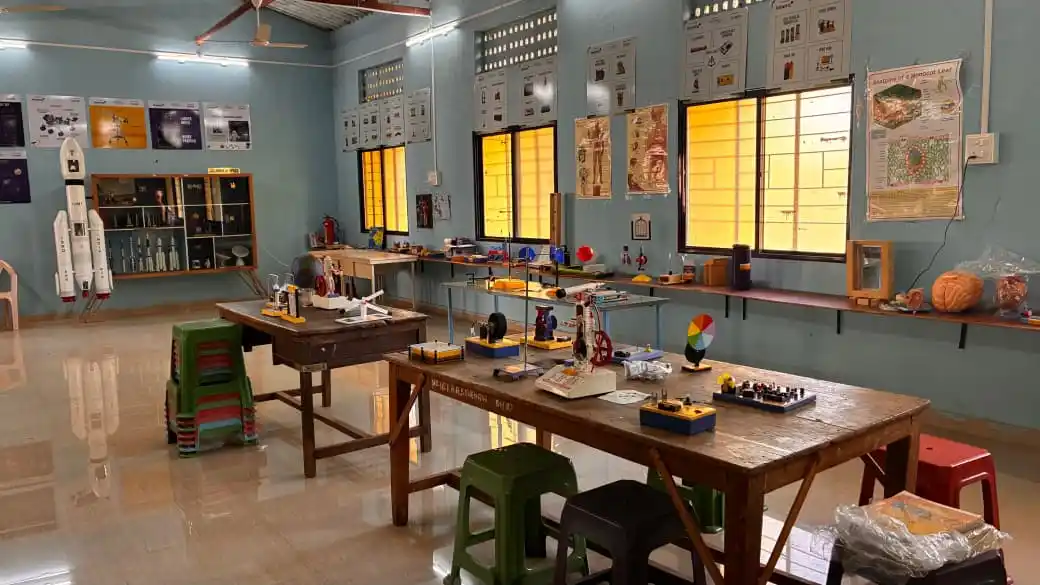
For many years, classrooms in government and underserved schools have been viewed only as spaces for basic instruction. Learning meant listening, memorising, and repeating information back on an exam paper. That system delivered foundational knowledge, but it left little room for creativity, experimentation, or the kind of skill-building India’s classrooms now need.
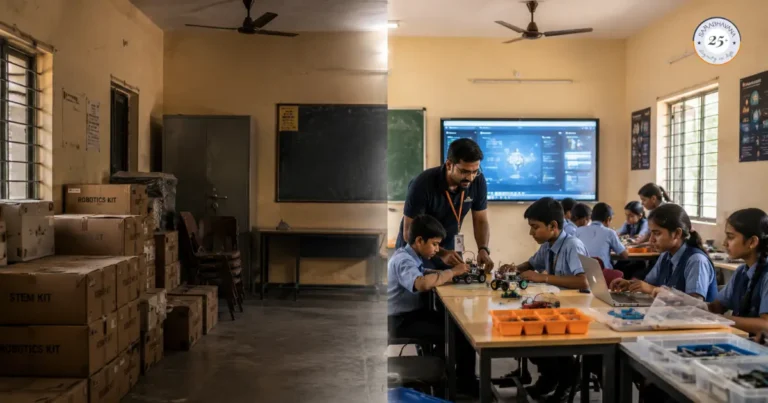
At Samabhavana, we believe a classroom can be more than that. Through SMILE Hub — Student Mastering Important Life Skills Education — government school classrooms are being transformed into innovation hubs: spaces where students explore, build, and actively participate in their own learning, rather than sitting through it.
Why Government Classrooms Need More Than Textbooks
Most government schools in India were never short on effort — teachers show up, students show up, and the curriculum gets covered. What’s been missing is exposure: to technology, to hands-on experimentation, to the kind of experiential learning that private and international schools have offered for years.
Limited infrastructure, minimal digital access, and a system still built around rote memorisation mean that millions of capable children are learning science from a diagram instead of a working model, and learning about computers from a chapter instead of a keyboard. SMILE Hub was built specifically to close that gap — not by adding one more disconnected programme, but by rethinking what a classroom in a government school can actually contain.
What Makes SMILE Hub an Innovation Hub
SMILE Hub is a 360° learning ecosystem, not a single intervention. It brings together, under one roof:
- Smart Digital Classrooms
- Computer and Digital Literacy Labs
- STEM Education
- Robotics, Artificial Intelligence (AI), and Internet of Things (IoT)
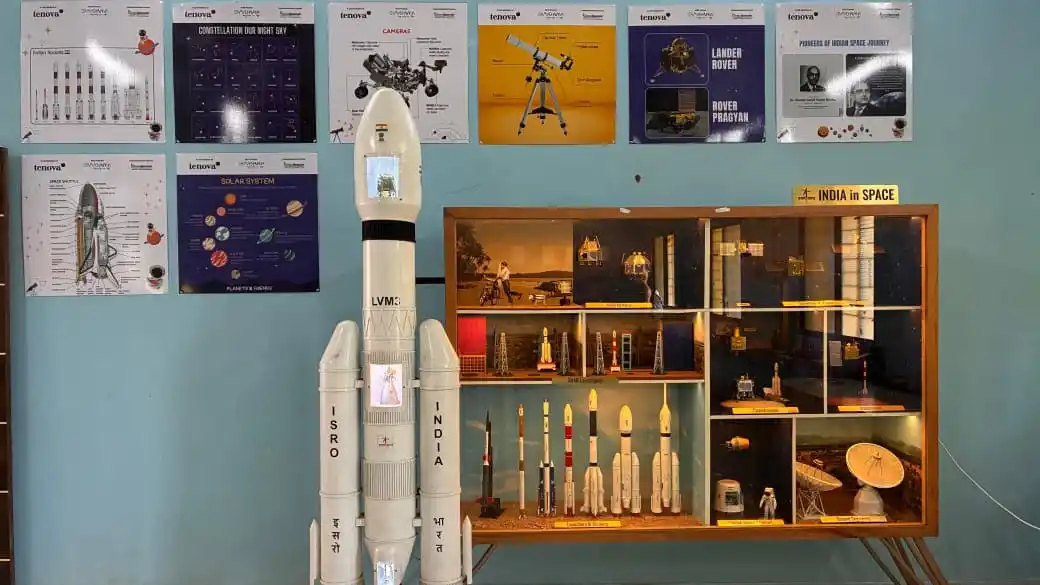
- Astronomy and Scientific Exploration
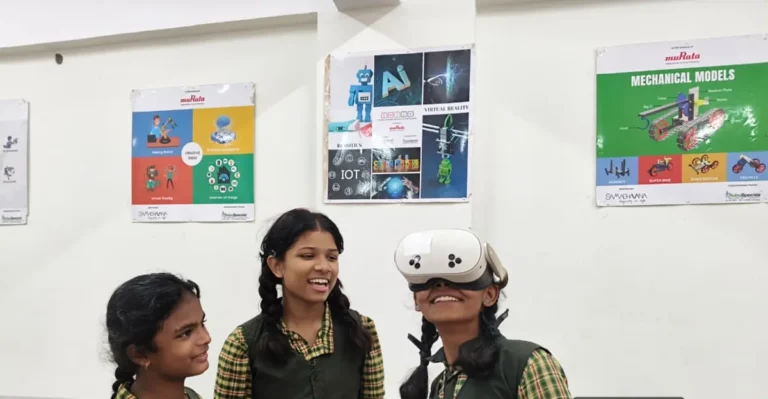
- Virtual Reality (VR) based experiential learning
This integrated design is deliberate. Rather than teaching robotics in isolation from digital literacy, or digital literacy in isolation from classroom instruction, SMILE Hub lets these elements reinforce each other — closely aligned with the National Education Policy 2020, which explicitly calls for experiential learning, coding exposure, and skill-based education starting early. A child in a SMILE Hub school isn’t learning subjects in silos; they’re seeing how a sensor, a circuit, and a line of code connect to the physics chapter they read that morning.
Smart Digital Classrooms: The Foundation
Smart classrooms are where the SMILE Hub experience begins. Interactive panels replace static blackboards, letting teachers show animated diagrams, run simulations, and replay a concept for students who need it repeated — without repeating themselves.
For teachers, this cuts down on repetitive board-work and frees them to actually teach, not just transcribe. For students, especially those who’ve struggled to stay engaged through pure lecture, a visual and interactive lesson does something a textbook page can’t: it holds attention. Teachers running SMILE Hub classrooms consistently report the same shift — students who used to drift off now ask more questions, not fewer.
Digital Literacy: Building Future-Ready Skills
Digital literacy isn’t a bonus skill anymore — it’s a basic one, on par with reading and arithmetic. Through the computer labs set up under SMILE Hub, students learn to use a computer confidently, type and format a document, understand safe internet use, and complete simple digital projects of their own.
For many of these children, this is their first real interaction with a computer of any kind. The effect doesn’t stop at the school gate: parents frequently report that their children come home and teach family members what they’ve just learned — a small but telling sign of how digital confidence spreads outward from a single classroom into a household, and eventually a community.
STEM, Robotics, AI & IoT: Learning by Doing
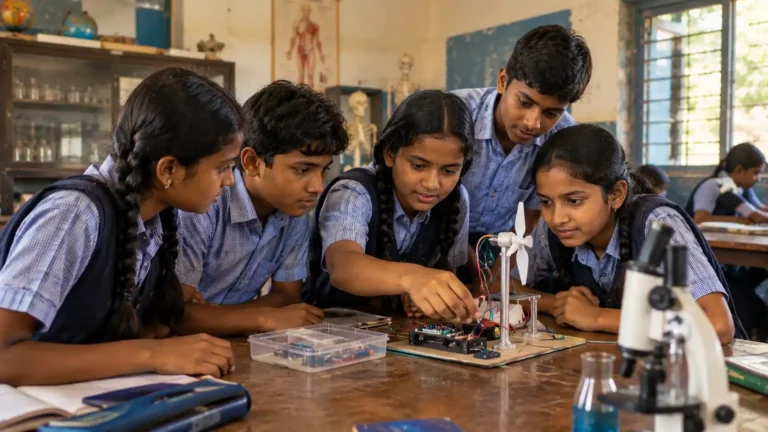
The most visible shift SMILE Hub brings is hands-on learning. Instead of reading about how a circuit works, students build one. Instead of memorising what a sensor does, they wire one to a microcontroller, test it, watch it fail, and fix it.
Robotics, AI, and IoT sessions are pitched at an age-appropriate level, but the thinking they build is not: students learn to break a real problem into smaller pieces, test a hypothesis, and revise it — the same process an engineer uses, just with simpler tools. They also see, directly, that these technologies solve everyday problems — in farming, in energy use, in safety — which does more to demystify “advanced” learning than any lecture could. A child who has built something that works stops believing that STEM belongs only to students in better-funded schools.
Astronomy & VR: Igniting Curiosity Through Experience
Astronomy sessions — sky observation, solar system models, discussions of planets and stars — build something textbooks rarely manage: patience and genuine scientific wonder. Watching the moon’s phases change over weeks teaches a kind of sustained attention that a single classroom period cannot.
Virtual Reality extends that same principle further. A VR headset can put a child inside a cell, on the surface of the moon, or in front of a historical monument they will likely never visit in person — turning an abstract diagram into something they’ve, in a real sense, seen. Learning built on genuine curiosity sticks. Learning built on pressure to pass an exam usually doesn’t.
Empowering Teachers, Not Just Students
An innovation hub that only serves students is half-built. SMILE Hub also equips teachers — with training, tools, and ongoing support — so that they’re not just delivering content but facilitating discovery. Teachers who’ve worked in both a conventional and a SMILE Hub classroom describe the shift plainly: less repetition, more mentoring, and a classroom that runs on curiosity instead of compliance. That shift shows up in teacher satisfaction as much as it does in student outcomes.
Infrastructure That Supports Learning
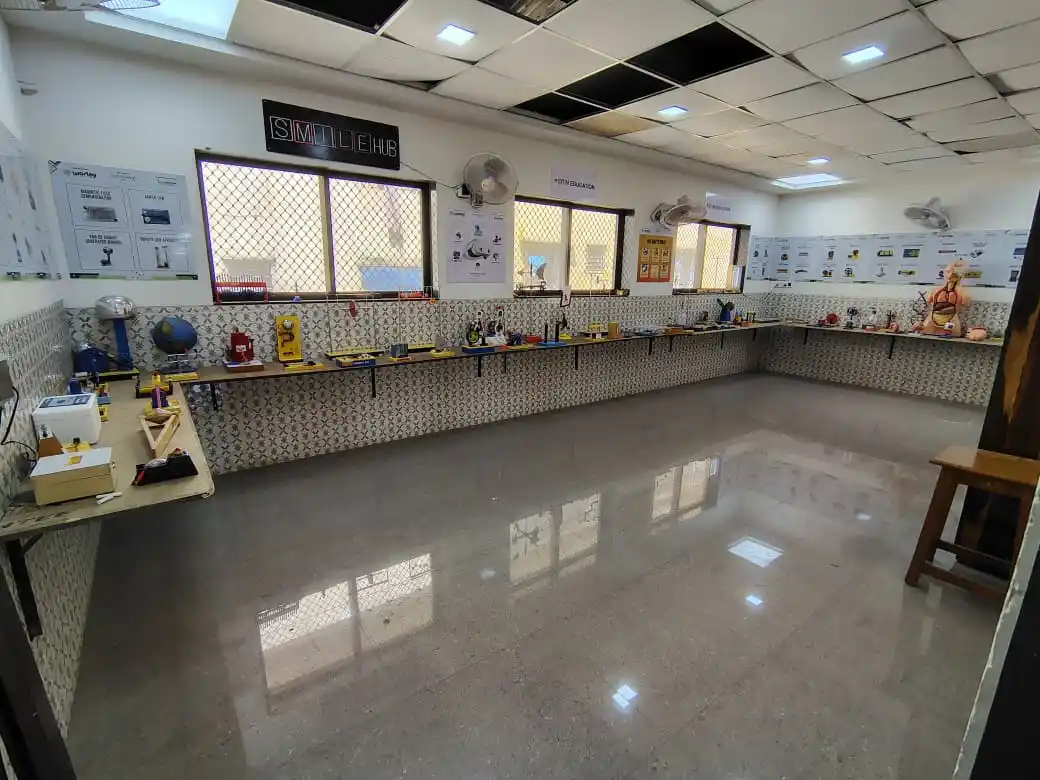
Technology alone doesn’t transform a school. SMILE Hub initiatives are frequently paired with classroom renovation, better lighting and seating, library upgrades, and playground development — because a child’s sense of what they’re capable of is shaped, in part, by the physical space they learn in. A well-maintained school signals dignity, not just function, to the students and teachers who spend their days there.
SMILE Hub and CSR: Schedule VII Alignment for Corporate Partners
For corporate CSR teams, SMILE Hub sits squarely within Schedule VII of the Companies Act, 2013 — covering the promotion of education, digital literacy, skill development, and inclusive learning environments in a single, integrated programme rather than four separate ones.
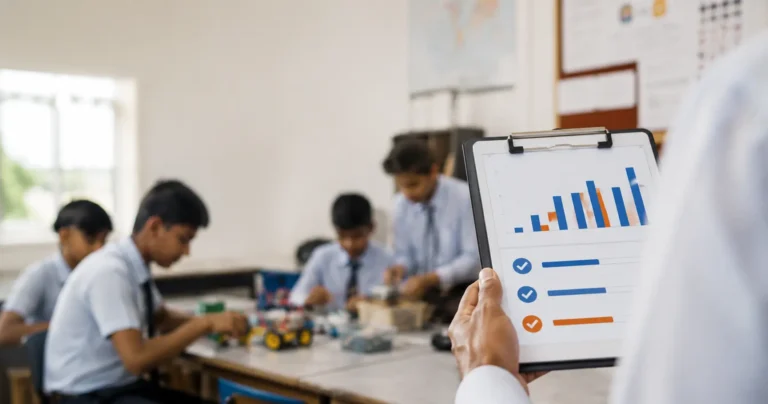
That matters practically: one well-documented SMILE Hub partnership can satisfy multiple Schedule VII categories at once, while producing the kind of visible, measurable outcomes — trained teachers, equipped classrooms, assessed students — that hold up under BRSR and CSR-2 reporting scrutiny. Corporate partnerships are what let Samabhavana scale SMILE Hub into more government schools, upgrade existing sites, and extend the programme’s reach across regions.
Real Impact: From Classrooms to Communities
The change SMILE Hub produces doesn’t stay inside the classroom walls. Students become more confident, more curious, more willing to ask a question out loud. Parents get more involved, often because their own children are the ones explaining what a SMILE Hub session covered that week. Teachers, freed from constant repetition, report feeling genuinely supported rather than stretched thin.
Communities notice too. A SMILE Hub school frequently becomes something the surrounding community points to with pride — evidence that a government school can be a place of opportunity, not just a place with limited options.
Frequently Asked Questions
What does SMILE Hub stand for?
SMILE Hub stands for Student Mastering Important Life Skills Education — Samabhavana’s integrated learning programme combining smart classrooms, digital literacy, STEM, robotics, AI, IoT, astronomy, and VR for government school students.
Which grades can use a SMILE Hub programme?
SMILE Hub is designed to work across primary and secondary levels, with content and activities adapted by grade — commonly delivered from Class 1 through Class 10, depending on the school and programme scope.
Is SMILE Hub eligible for CSR funding in India?
Yes. SMILE Hub aligns with Schedule VII of the Companies Act, 2013, under the promotion of education, digital literacy, and skill development — making it a qualifying use of a company’s mandatory CSR spend.
Do teachers need special training to run a SMILE Hub classroom?
Yes, and it’s built into the programme. SMILE Hub includes structured teacher training and ongoing support, because equipment without trained facilitators rarely produces real learning outcomes.
How is SMILE Hub different from a standalone STEM lab?
A standalone STEM lab typically covers one component — robotics or coding, for instance. SMILE Hub is a 360° model that integrates smart classrooms, digital literacy, STEM, robotics, AI, IoT, astronomy, and VR into one connected programme, rather than isolated add-ons.
Conclusion: From Learning Spaces to Innovation Spaces
When a classroom becomes an innovation hub, the question students ask changes. It stops being “will this come in the exam?” and starts being “what can we build?” — “how does this work?” — “what if we try this?”
That shift is the entire point of SMILE Hub. Samabhavana isn’t just placing equipment in government school classrooms; it’s redefining what those classrooms can become — spaces of creativity, confidence, and possibility. Because when learning is hands-on, inclusive, and genuinely engaging, classrooms stop just teaching lessons. They start building futures.