Category: Smile Hub

  • SMILE HUB vs. Standalone STEM Labs: What CSR Managers Should Know Before Choosing

    SMILE HUB vs. Standalone STEM Labs: What CSR Managers Should Know Before Choosing

    Every CSR manager evaluating a STEM education programme faces the same choice at some point: buy equipment and donate it to a school, or invest in a full programme that includes a trainer, curriculum, teacher development, and impact reporting. The first option looks cheaper.

    The second option looks complicated. This guide cuts through both impressions and gives you a clear, honest comparison โ€” so you can make the decision that is right for your company’s CSR goals, compliance requirements, and reputation.

    What a Standalone STEM Lab Actually Gives You

    A standalone STEM lab is exactly what it sounds like: a set of equipment โ€” STEM models, robotics kits, computers, science instruments โ€” procured and installed in a school. The school takes ownership from day one.

    In ideal conditions, a motivated teacher picks up the material, figures out how to use it, integrates it into teaching, and sustains the programme independently.

    SMILE HUB vs. Standalone STEM Labs for CSR

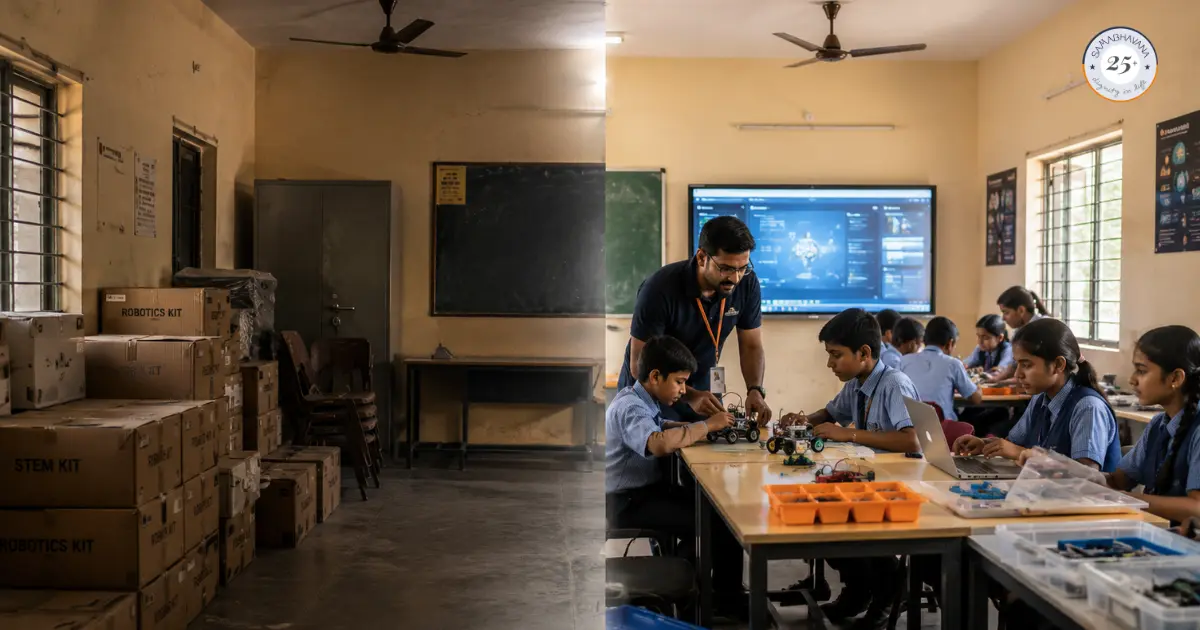
    In practice, this happens in a minority of schools. What more commonly happens: equipment is installed, a photograph is taken for the CSR report, and within 12โ€“18 months the lab is locked because no one knows how to run it, the equipment has not been maintained, and the school’s daily schedule has not been adjusted to accommodate it.

    This is not a hypothetical โ€” it is a pattern that is well-documented across India’s CSR landscape.

    Our post on Inside a Robotics CSR Project in Rural Schools covers what actually happens when technology CSR is implemented without sustained support โ€” and what a properly run programme looks like instead.

    What SMILE HUB Gives You

    SMILE HUB is not a product. It is a programme. The distinction matters because it changes what you are actually buying.

    When you invest in SMILE HUB through Samabhavana, you are not buying equipment โ€” you are buying a running programme that produces documented outcomes. What that includes:

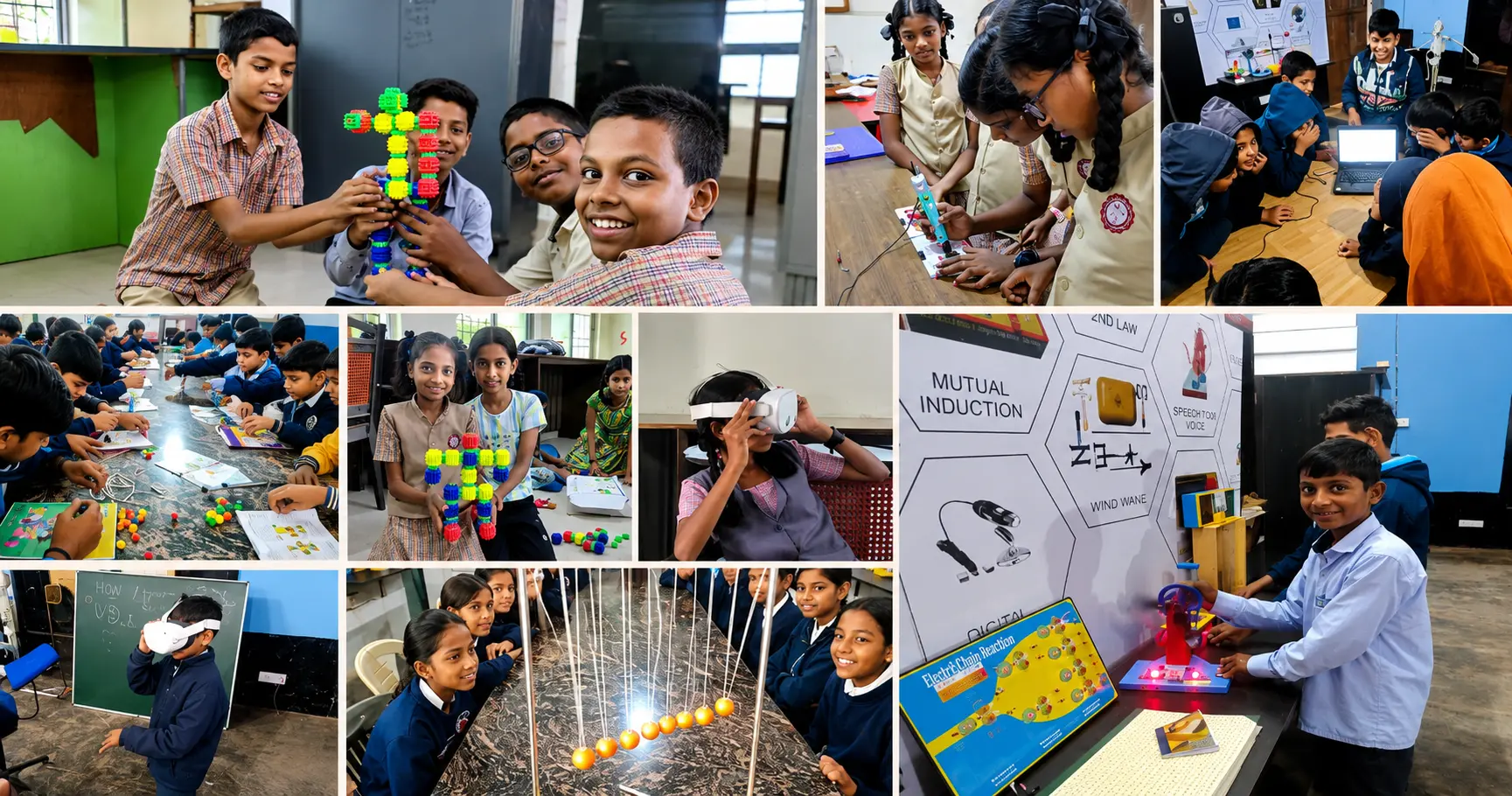
    • 9 technology learning modules โ€” STEM, Robotics, AI, IoT, Astronomy, VR, Coding, Smart Digital Classroom, and Computer Literacy โ€” integrated into a single programme.
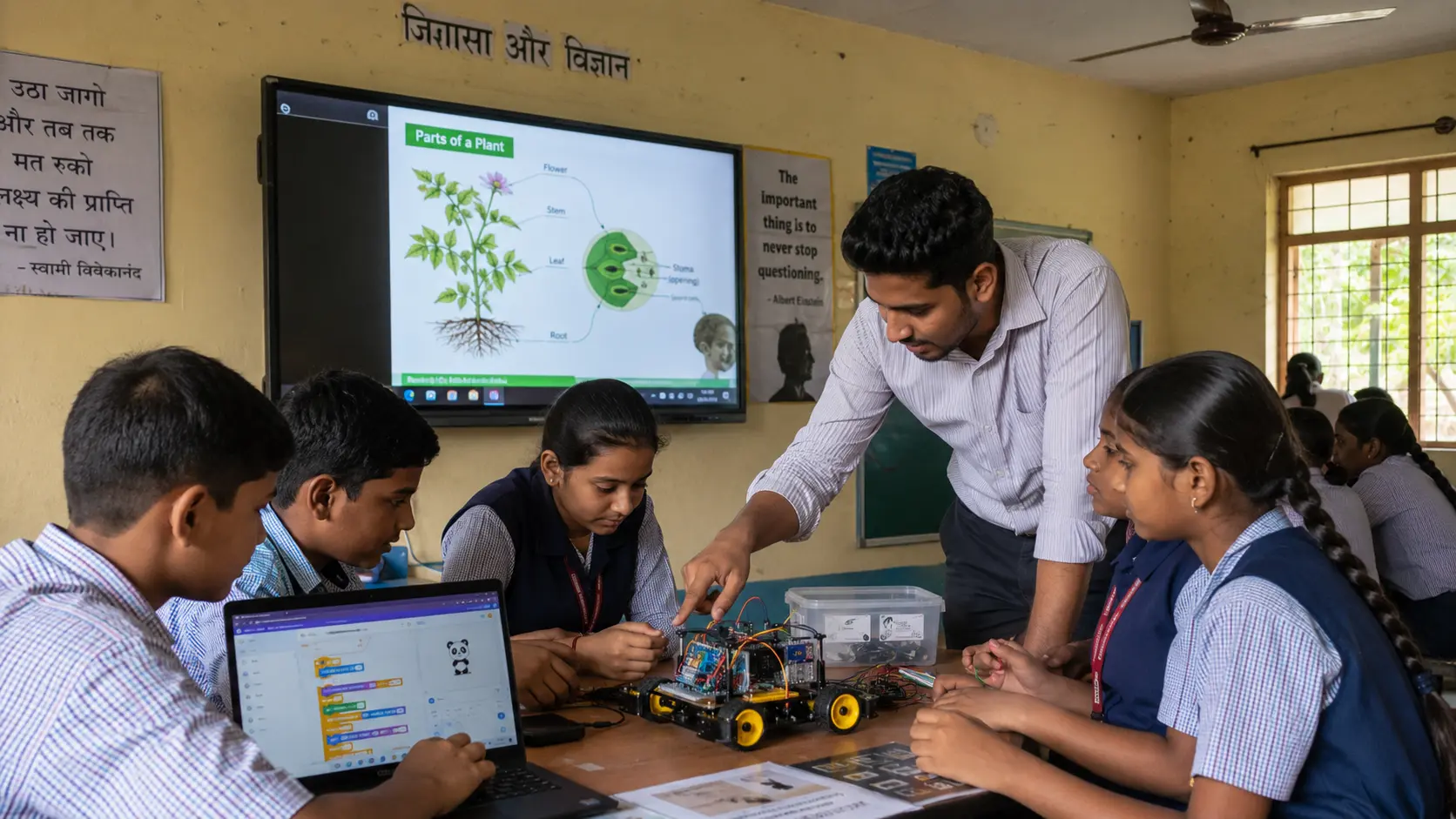
    • A dedicated on-site trainer who runs daily student sessions and monthly teacher training throughout the programme period.
    • NCERT/SCERT-mapped curriculum for every grade level served.
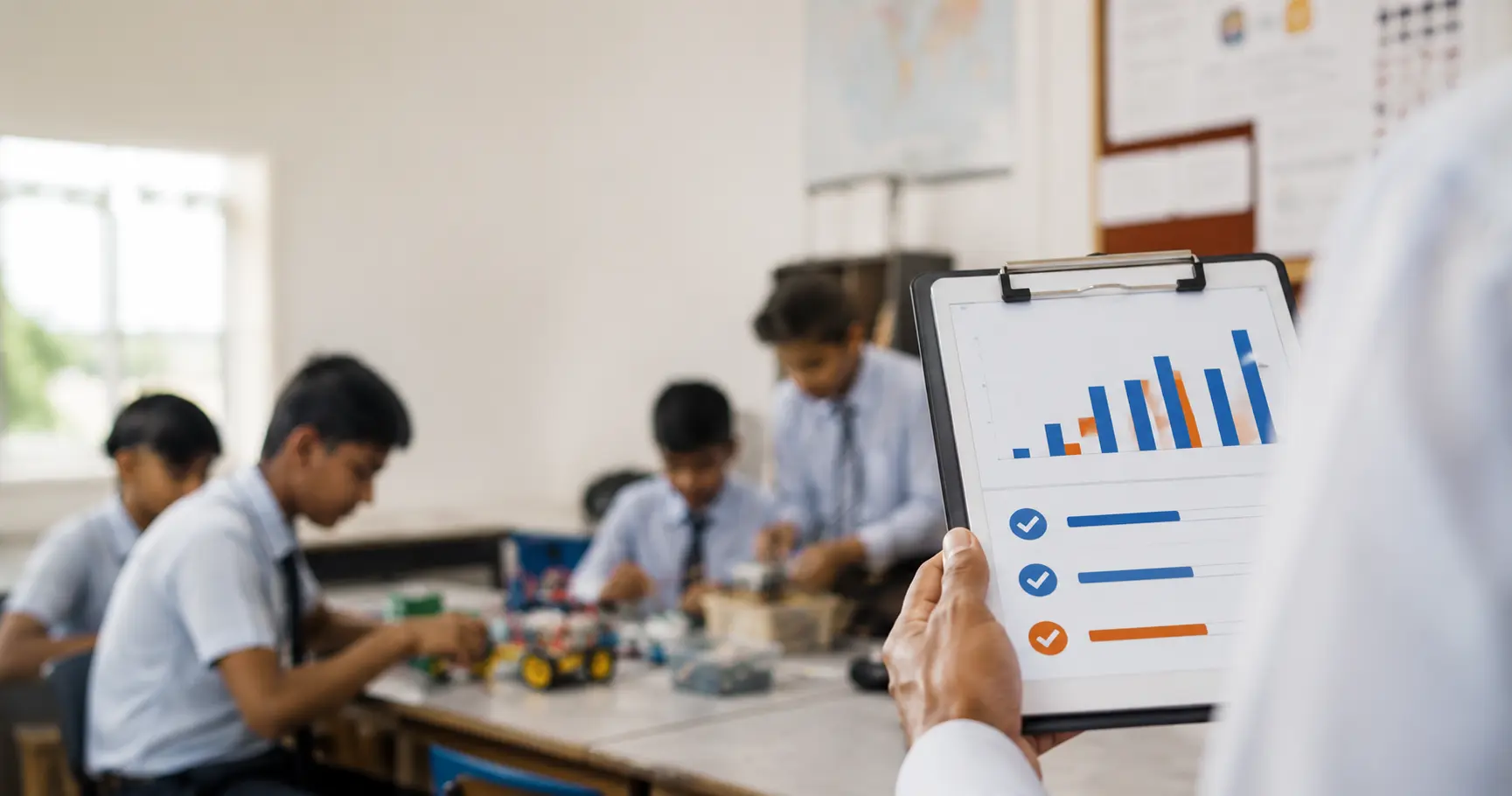
    • Quarterly impact reports with student outcome data โ€” pre/post assessments, session hours, beneficiary demographics.
    • Equipment maintenance support throughout the programme.
    • Full documentation for Schedule VII compliance, CSR-2 filing, and Principal 8 disclosure.

    Head-to-Head Comparison – SMILE HUB vs standalone STEM lab CSR

    Factor

    Standalone STEM LabSMILE HUB Full Programme
    What’s includedEquipment onlyEquipment + Trainer + Curriculum + Reports
    Teachers TrainingTwice or thrice a year onlyScheduled once a month Teachers training
    Dedicated trainerNoYes โ€” daily student sessions
    Curriculum mappingNCERT/SCERT: rarelyYes โ€” mapped to all grade levels
    Impact reportingOutput data onlyFull outcome data + documentation
    Schedule VII fitBorderline (equipment only)Strong โ€” structured education programme
    BRSR complianceWeakFull Principal 8 support provided
    Programme lifeEquipment degrades, no sustainabilitySustained โ€” trainer maintains engagement
    CSR-2 filing supportNoneIncluded โ€” utilisation certificate + reports
    Typical cost rangeโ‚น8โ€“20 lakhโ‚น20โ€“50 lakh per school (full programme)

    The Trainer Question: Why It Is Non-Negotiable

    The single most important variable in any STEM education CSR programme is whether there is a dedicated, trained person running it every day. This is not a nice-to-have. It is the difference between a programme that works and one that doesn’t.

    A school teacher with a full curriculum load and no STEM training cannot be expected to run a STEM/ Robotics programme or an AI lab in their spare time.

    The evidence on this is consistent: STEM labs without dedicated trainers underperform significantly compared to those with sustained trainer support. The equipment is not the constraint โ€” the human expertise is.

    This is why Samabhavana’s approach to every SMILE HUB programme starts with trainer deployment, not equipment procurement.

    Our post on Teacher Training CSR: How a Programme Transforms Classrooms explains how we structure teacher development as a programme core โ€” not an afterthought.

    The Smart Digital Classroom Difference

    One module in SMILE HUB that standalone STEM labs cannot replicate is the Smart Digital Classroom โ€” because it is not about equipment in a lab, it is about transforming how all teachers teach, in all classrooms, across all subjects.

    A Smart Digital Classroom upgrade impacts every student in the school, not just those who use the STEM lab.

    For CSR managers trying to maximise beneficiary reach per rupee, this matters.

    Our post on The Power of Smart Digital Classroom CSR Programs covers how this component works and what it adds to the overall programme outcome.

    Total Cost of Ownership: What the Numbers Actually Show

    When CSR managers compare a โ‚น12 lakh standalone STEM kit to a โ‚น35 lakh SMILE HUB programme, the cheaper option looks obvious. Here is what the total cost of ownership calculation actually shows:

    • Standalone STEM lab โ€” Year 1: โ‚น12 lakh equipment. Year 2: โ‚น3โ€“5 lakh replacement/maintenance. Outcome data: none. BRSR impact disclosure: cannot file Principal 8 indicators. Total cost for zero documented outcomes: โ‚น15โ€“17 lakh.
    • SMILE HUB (full programme) โ€” Year 1: โ‚น35 lakh including trainer, curriculum, and reporting. Outcome data: pre/post assessments for 300+ students, 1,000+ session hours documented, Principal 8 indicators filed. Total cost for full compliance and documented impact: โ‚น35 lakh.

    The cheaper option produces no documentable outcome. The full programme produces the compliance record, the data, and the community impact.

    For companies subject to internal CSR audits, Core assurance,on CSR effectiveness, the total cost of the cheaper option is higher โ€” not lower.

    When a Standalone Lab Might Still Make Sense

    To be fair: there are situations where a standalone equipment donation is the right choice. If your company is making a one-time contribution to a school that already has strong teacher capacity and an existing STEM programme, supplementary equipment is a reasonable intervention.

    If you are testing a new geography before committing to a full programme, a small equipment pilot can inform a larger programme decision.

    What a standalone equipment donation should never be positioned as: a complete CSR programme. It is an input. Inputs are not outcomes.

    The Question That Settles It

    Ask yourself one question: in 18 months, will I be able to show my board, my auditor, and my CSR committee documented evidence that students in these schools learned something because of this programme โ€” not just that they received something?

    If the answer needs to be yes โ€” and for most companies it does โ€” then SMILE HUB is the right choice. If your company’s CSR programme is purely goodwill-driven with no compliance or reporting requirements, either approach may work.

    Most companies fall into the first category. That is why SMILE HUB exists. SMILE HUB vs standalone STEM lab CSR

    Want to see SMILE HUB before you commit?
    Samabhavana facilitates site visits to active SMILE Hubs for prospective CSR partners โ€” so your team can see the trainer in action, meet students, and verify the programme quality on the ground before making any commitment.

    Contact us: info@samabhavana.in
    Call: 022-45658306ย  |ย  samabhavana.in/smile-hub.html

    Related Reading: Inside a Robotics CSR Project  |  AI and IoT Education CSR India  |  Smart Digital Classroom CSR  |  The Role of NGOs in CSR

  • How to Measure and Report STEM Education CSR Impact | Samabhavana

    How to Measure and Report STEM Education CSR Impact | Samabhavana

    India’s Business Responsibility and Sustainability Reporting (BRSR) framework, mandated by SEBI for the top 1,000 listed companies, has fundamentally changed what CSR impact reporting must look like. Headcount numbers and inauguration photographs are no longer sufficient.

    BRSR requires structured, indicator-based disclosure โ€” and for education CSR programmes, this means learning outcome data, not just activities delivered.

    This guide explains what STEM education CSR impact reporting under BRSR requires, how to set up measurement from the beginning, and what a credible impact report should contain.

    Why BRSR Has Raised the Stakes on Education CSR Impact

    Before BRSR, most companies’ CSR reporting on education programmes was narrative-based: we set up labs in X schools, we reached Y students, here are photographs. This approach no longer satisfies BRSR’s disclosure requirements โ€” and for the companies subject to BRSR Core (mandatory for the top 150 listed entities from FY2023-24 onwards), it does not meet the reasonable assurance standard either.

    BRSR Principal 8 (Inclusive Growth and Equitable Development) requires companies to disclose the details of their CSR social impact assessments โ€” including the indicators used to measure impact, the methodology for data collection, and the outcomes achieved.

    For STEM education programmes, this translates to a specific set of data points that must be collected during the programme, not reconstructed after it ends.

    The single most common BRSR compliance failure for education CSR: collecting activity data (sessions held, kits distributed) but no outcome data (what students actually learned). Activity data does not satisfy BRSR Principal 8.

    Output vs. Outcome: The Distinction That Determines Your Score

    Outputs (What You Did)

    Outputs are the activities and resources delivered by the programme. They are necessary to report but insufficient on their own:

    • Number of STEM labs / SMILE Hubs set up
    • Number of schools covered
    • Number of students enrolled in programme sessions
    • Number of teacher training sessions conducted
    • Number of session hours delivered
    • Value of equipment procured and installed

    Outcomes (What Changed)

    Outcomes are the changes in knowledge, skills, or behaviour that the programme produced. These are what BRSR requires:

    • Pre- and post-assessment scores: What percentage of students improved their science/technology competency scores after the programme?
    • Skill demonstration: Can students build a circuit, program a robot, or explain an AI concept at the end of the programme?
    • Teacher confidence scores: Did teachers’ self-reported confidence in teaching STEM topics improve?
    • Retention and participation: What was the student session attendance rate over the programme period?
    • Gender breakdown: What percentage of female students participated vs. male โ€” and were outcomes comparable?

    For context on what strong outcome data looks like in practice, our post on AI and IoT Education CSR in India includes the outcome measurement framework Samabhavana uses across all technology education programmes.

    BRSR Principal 8: What the Indicators Require

    Under BRSR’s Essential Indicators for Principal 8, companies must disclose:

    • Details of Social Impact Assessments (SIA) conducted for CSR projects with an outlay of โ‚น1 crore or more โ€” including whether the SIA was third-party verified.
    • Details of ongoing or concluded CSR projects in the current financial year.
    • For projects above โ‚น1 crore: project name, location, amount spent, and impact outcomes.
    • Whether the company has a policy for preferring locally-sourced goods and services in CSR projects.

    Under the Leadership Indicators (voluntary but increasingly expected):

    • Breakdown of persons benefited from CSR activities by gender, geography, and programme type.
    • Details of adverse social impacts from CSR activities (if any) and corrective measures taken.

    How to Set Up STEM CSR Impact Measurement from Day One

    The most important rule in CSR impact measurement: set up your data collection framework before the programme begins, not after. Here is the minimum framework for a SMILE HUB or STEM education CSR programme:

    Baseline Assessment (Before Programme Begins)

    Administer a simple pre-assessment to the students who will participate in the programme. Measure: current science/technology knowledge, current ability to perform relevant tasks (e.g., identify circuit components, understand what a robot does), and teacher’s current confidence in teaching STEM subjects. This becomes your baseline against which outcomes are measured.

    Ongoing Activity Log (During Programme)

    Your implementing NGO should maintain a session-by-session log including: date, school, grade, number of students (male/female), topic covered, module used, and trainer name. This is your output documentation โ€” required for CSR-2 filing and basic BRSR disclosure.

    Quarterly Impact Reports

    Every three months, compile: cumulative session hours, cumulative student reach by grade and gender, mid-point competency assessment scores, teacher training sessions completed, and any notable student project outcomes (robot built, coding project completed, astronomy observation recorded).

    End-line Assessment (Programme Conclusion)

    Re-administer the same assessment given at baseline. Document: improvement in student scores, percentage of students demonstrating defined competency, teacher confidence improvement, and student feedback on programme quality. This is the data that goes into your BRSR Principal 8 disclosure.

    For companies working with PSU partners, our guide on CSR for PSU Companies in India outlines the additional documentation standards that apply CSR programmes.

    What Samabhavana Provides for Reporting

    Every SMILE HUB programme from Samabhavana includes a standardised impact reporting package:

    • Quarterly Impact Reports: student reach by school, grade, and gender; session hours; trainer activity log; equipment utilisation.
    • Learning Outcome Assessment: pre-programme baseline and post-programme end-line scores, with percentage improvement by grade.
    • Teacher Training Record: dates, topics, trainer, attendance, and post-training confidence survey results.
    • Beneficiary Database: anonymised student records with demographic data for BRSR Principal 8 disclosure.
    • Programme Narrative: a written summary of key programme activities and outcomes, formatted for your Annual Report and CSR section.
    • Financial Utilisation Certificate: issued by Samabhavana’s auditor for your CSR-2 filing.

    For programmes above โ‚น1 crore, Samabhavana can arrange third-party Social Impact Assessment (SIA) support to meet mandatory SIA disclosure requirement.

    For a deeper look at how teacher development integrates into the overall programme impact measurement framework, see our post on Teacher Training CSR: How a Programme Transforms Classrooms.

    A Note on Third-Party Verification

    BRSR Core requires companies to obtain reasonable assurance on their BRSR disclosures โ€” including CSR impact claims. For education CSR programmes, reasonable assurance means that an independent third party has reviewed your outcome data and confirmed that it was collected and reported accurately.

    Samabhavana’s impact reporting framework is designed to support third-party verification โ€” all assessment data is documented with school sign-off, and session logs are maintained in a format that an independent assessor can review.

    Want BRSR-ready impact reports built into your SMILE HUB programme?

    Every SMILE HUB programme from Samabhavana includes quarterly impact reports with student outcome data, teacher training records, and beneficiary demographics โ€” structured for direct use in your Principal 8 disclosure and CSR-2 filing.

    Contact us: info@samabhavana.in
    Call: 022-45658306ย  |ย  samabhavana.in/smile-hub.html

    Related Reading: CSR for PSU Companies India  |  AI and IoT Education CSR India  |  The Role of NGOs in CSR

  • How to Set Up a STEM Education CSR Programme in Government Schools | Samabhavana

    How to Set Up a STEM Education CSR Programme in Government Schools | Samabhavana

    Setting up a STEM education CSR programme in government schools is one of the most impactful things a company can do with its CSR budget โ€” and one of the most mismanaged. The gap between a well-executed STEM programme and an expensive equipment donation that produces no outcomes comes down almost entirely to how the programme is designed and who implements it.

    This step-by-step guide is written for CSR managers who are either planning their first STEM programme or looking to improve on a previous attempt.

    Before You Begin: Two Things to Get Clear On

    Most CSR managers begin their STEM programme planning by looking at equipment catalogues or NGO brochures. That is the wrong starting point. Before any of that, get clarity on two things:

    • What do you want students to know or be able to do when this programme ends? A clear learning outcome โ€” even a simple one โ€” will shape every other decision.
    • What is your CSR geography and how many schools are you realistically able to cover in year one? Spreading budget too thin across too many schools produces shallow impact everywhere. Concentration produces depth.

    With these two anchors in place, the rest of the planning follows a logical sequence.

    The 6-Step Process

    Identify and Shortlist Government Schools

    Work with your District Education Officer (DEO) or municipal education authority to identify government schools in your CSR geography. Selection criteria should include: student enrolment size (larger schools give more beneficiary impact per rupee), existing infrastructure (a room that can house equipment securely), and school management willingness to participate (a resistant principal will undermine any programme).

    For companies with a STEM focus, prioritise schools with strong Science enrolment in Grades 8โ€“12.

    Choose Your Modules Based on Grade Profile

    A STEM education programme is not one-size-fits-all. The right modules depend on the grades you are targeting. For primary schools (Grades 1โ€“5): STEM models, Smart Digital Classroom, and Computer Literacy are the right entry points. For middle and secondary schools (Grades 6โ€“10): add Robotics, Coding, and IoT.

    For senior secondary (Grades 11โ€“12): AI, IoT, and Astronomy are appropriate. SMILE HUB’s 9-module structure covers all three levels โ€” and can be implemented in full or in select combinations based on your school’s grade profile.

    Vet the Implementing NGO Thoroughly

    The implementing NGO is the most important variable in your programme’s success. Equipment can be replaced. A bad NGO relationship cannot be easily unwound mid-year. Before signing any agreement, verify: CSR-1 registration on the MCA21 portal (mandatory since 2021), 80G and 12A certificates, Niti Aayog registration, geographic presence in your specific CSR district โ€” not just a metro office, track record of multi-year programme implementation (not one-off events), and sample impact reports from previous programmes.

    Ask specifically: what happens to programme delivery if your assigned trainer leaves?

    Design for Impact โ€” Not for the Inauguration Photo

    The inauguration photo is not the outcome. The outcome is what students can demonstrate six months after the lab is running. Two decisions at the design stage determine this: whether a dedicated trainer is included (non-negotiable for sustained impact), and whether teacher training is treated as a programme priority (a trained teacher multiplies impact after the programme formally ends).

    Do not cut these to save budget. They are the programme.

    Set a Realistic Timeline and Phasing Plan

    A single-school SMILE HUB installation from project sign-off to operational takes 45โ€“60 days โ€” covering procurement, logistics, installation, trainer deployment, and teacher orientation. Multi-school rollouts are phased over 90โ€“120 days.

    Build this into your CSR planning calendar. Q3 and Q4 (Octoberโ€“March) are the most active deployment months โ€” do not plan for a March 31 inauguration without signing off in January.

    Impact measurement typically begins showing in month 3โ€“4 of operations.

    Define the Reporting Framework Before You Start

    The most common CSR reporting failure is trying to reconstruct impact data after the programme has run. Define upfront what you will report: student reach by grade and gender, session hours delivered, learning outcome assessment scores (pre and post), teacher training sessions completed, and equipment utilisation rate.

    A credible implementing NGO will have this framework built into their programme management system.

    For a detailed look at what a well-run technology education CSR programme looks like on the ground, read our post on Inside a Robotics CSR Project in Rural Schools โ€” it covers the realities of implementation that brochures rarely mention.

    The Smart Digital Classroom Question

    Many companies ask whether they should add a Smart Digital Classroom component to their STEM programme or treat it as a separate CSR initiative. Our recommendation: integrate it from day one.

    A Smart Digital Classroom upgrades every subject across every grade โ€” meaning your CSR investment impacts the entire school population, not just the students in the STEM lab.

    What a SMILE HUB Setup Covers (That Most Programmes Don’t)

    • Government and school liaison โ€” Samabhavana handles all MoU documentation with the school and education authority.
    • Custom curriculum mapping to NCERT/SCERT standards for the specific grades in each school.
    • Dedicated on-site trainer who conducts daily student sessions and monthly teacher training.
    • Equipment maintenance and replacement support throughout the programme period.
    • Quarterly impact reports with student outcome data, ready for BRSR and CSR-2 filing.

    For the compliance documentation your company needs for a government school STEM programme, see our guide: How Teacher Training CSR Programmes Transform Classrooms.

    Common Mistakes to Avoid – how to set up STEM education CSR programme India

    • Selecting schools based on convenience rather than community need โ€” this weakens your Schedule VII justification.
    • Splitting budget across too many schools in year one โ€” depth of impact in 2 schools is more valuable than presence in 10.
    • Choosing an NGO based on lowest cost rather than implementation track record.
    • Planning for a financial-year-end installation โ€” the effective programme period shrinks to weeks, not months.
    • Measuring success in equipment delivered rather than learning outcomes achieved.
    Bring SMILE HUB to Your CSR Geography Samabhavana handles every step in this guide โ€” from school selection and government liaison to installation, trainer deployment, and documentation. 25+ years. 1000+ SMILE Hubs. Pan India.

    Contact us: info@samabhavana.in

    Call: 022-45658306ย  |ย  samabhavana.in/smile-hub.html

    Related Reading: Inside a Robotics CSR Project  |  Smart Digital Classroom CSR  |  Teacher Training CSR

  • How SMILE HUB Qualifies Under Schedule VII Item II And What Documents Your Company Needs

    How SMILE HUB Qualifies Under Schedule VII Item II And What Documents Your Company Needs

    Before any CSR commitment is made, the compliance question must be answered first.

    For STEM education programmes, the question is almost always the same: does this qualify under Schedule VII of the Companies Act 2013, and what documentation does our company need to demonstrate that it does?

    This guide answers both questions specifically for SMILE HUB โ€” Samabhavana’s 9-module STEM education CSR programme.

    What Schedule VII Item II Actually Says

    Schedule VII of the Companies Act 2013 lists the categories of activities that qualify as eligible CSR expenditure. Item II is the education clause, and it covers two distinct categories that are relevant to SMILE HUB:

    “Promoting education, including special education and employment enhancing vocational skills especially among children, women, elderly, and the differently abled and livelihood enhancement projects.” โ€” Schedule VII, Item (ii), Companies Act 2013

    This single clause covers two separate qualifying routes for SMILE HUB:

    • Promoting education โ€” for STEM modules targeting students in government schools (Grades 1โ€“12). This is the primary qualification route for SMILE HUB’s STEM, Astronomy, Smart Digital Classroom, and Computer Literacy modules.
    • Employment-enhancing vocational skills โ€” for Robotics, AI, IoT, and Coding modules targeting students at the Class 8โ€“12 level, where the skills being developed are directly linked to future employment in technology sectors.

    Both routes are valid. Many SMILE HUB programmes will qualify under both simultaneously.

    The NEP-2020 Alignment Advantage

    Beyond the Schedule VII clause, SMILE HUB’s alignment with the National Education Policy 2020 strengthens the compliance case in a way that is increasingly valuable for CSR-2 filings and BRSR disclosures.

    NEP-2020 mandates the integration of Technology, Coding, Artificial Intelligence, and Computational thinking into school education across India. SMILE HUB is designed specifically to deliver on these NEP-2020 mandates in government schools that lack the internal capacity to implement them independently.

    A CSR programme that is explicitly aligned to a National Education Policy โ€” with documented curriculum mapping โ€” is a significantly stronger compliance position than one that simply donates equipment.

    This is a distinction we explore in detail in our post on AI and IoT Education CSR in India, which covers the policy context and implementation requirements for technology education CSR.

    Does SMILE HUB Qualify for PSU Companies? – SMILE HUB Schedule VII Compliance

    Yes โ€” and the compliance standard for PSU CSR is higher, not lower. PSU CSR programmes are subject to CAG scrutiny, RTI queries, and in some cases parliamentary review.

    As we outlined in our guide on CSR for PSU Companies in India, PSU CSR managers need an implementing agency that can provide documentation that holds up under audit โ€” not just a programme that delivers activities.

    SMILE HUB’s compliance infrastructure is built to meet this standard. Every programme includes beneficiary data, session logs, pre- and post-assessment scores, teacher training records, equipment utilisation data, and financial audit trail documentation โ€” structured for CAG-audit-ready reporting.

    BRSR Alignment: Which Principal Applies?

    For companies filing a Business Responsibility and Sustainability Report (BRSR), SMILE HUB programmes are reportable under Principal 8: Inclusive Growth and Equitable Development.

    Specifically:

    • Indicator 8.1: Social impact assessments โ€” SMILE HUB programmes include pre/post learning outcome assessments that satisfy this requirement.
    • Indicator 8.2: Rehabilitation and resettlement โ€” not applicable for education programmes.
    • Indicator 8.3: CSR details โ€” SMILE HUB’s structured quarterly reports provide all the programme-level data required for the BRSR CSR disclosure section.

    For companies that have adopted the BRSR Core (mandatory for the top 150 listed entities from FY2023-24), SMILE HUB’s outcome documentation is designed to meet the higher assurance standard required.

    What Documents Your Company Needs

    From Samabhavana (Implementing Agency) – SMILE HUB Schedule VII Compliance

    • CSR-1 Registration Certificate (MCA21 portal) โ€” mandatory since 2021 for any NGO receiving CSR funds
    • 80G Tax Exemption Certificate
    • 12A Income Tax Registration
    • Niti Aayog / NGO Darpan Registration Certificate
    • Maharashtra Charity Commissioner Registration
    • Audited financial statements (last 3 years)
    • Board resolution authorising CSR programme implementation
    • Project proposal with defined beneficiaries, activities, and outcomes

    From Your Company

    • Board-approved CSR Policy mentioning education / STEM / NEP-2020 alignment
    • CSR Committee resolution approving the programme and budget
    • Signed Implementation Agreement with Samabhavana
    • Transfer of funds to Samabhavana’s dedicated programme account
    • Annual CSR-2 Form filed with MCA, citing the programme under Schedule VII Item II

    For BRSR Disclosure – SMILE HUB Schedule VII Compliance

    • Programme name, objectives, and target community
    • Budget allocated vs. budget utilised
    • Beneficiary count by grade, gender, and school
    • Outcome indicators: learning assessment scores, teacher training sessions, session hours
    • Third-party verification reference (available on request for large programmes)

    One Important Clarification on Fund Transfer

    Some companies ask whether they can transfer CSR funds directly to a school rather than through a registered implementing agency.

    Legally, direct transfers to schools are permitted under the Companies Act, but they carry significant compliance risk: schools are not equipped to provide the structured impact documentation, CSR-1-backed receipts, or outcome reporting that CSR-2 filing requires.

    The implementing agency model โ€” where a registered NGO like Samabhavana holds the funds and manages the programme โ€” is the approach that minimises compliance risk for the corporate partner.

    A Note on the NEP-2020 and SOAR Programme Connection

    The Government of India’s SOAR (Skilling for AI Readiness) programme, launched in 2025, introduces foundational AI and machine learning modules for Classes 6โ€“12. SMILE HUB’s Robotics, AI, and IoT modules are directly aligned with the SOAR competency framework. CSR programmes that fund SOAR-aligned technology education can cite this alignment explicitly in their BRSR disclosures and CSR-2 filings โ€” strengthening the government policy justification for the expenditure.

    Want a compliance-ready SMILE HUB proposal for your company?
    Samabhavana holds valid 80G, 12A, and CSR-1 certifications and is registered with Niti Aayog. We provide the full documentation package your CSR-2 filing, BRSR report, and internal audit require โ€” as part of every programme.

    Contact us: info@samabhavana.in
    Call: 022-45658306  |  samabhavana.in/smile-hub.html

    Related Reading: CSR for PSU Companies India  |  AI and IoT Education CSR India  |  The Role of NGOs in CSR

  • How Much Does a STEM Education CSR Programme Cost?

    How Much Does a STEM Education CSR Programme Cost?

    A Budget Guide for CSR Managers

    It is usually the first question a CSR manager asks โ€” and for good reason. STEM education programmes range from modest single-school pilots to pan-India multi-year rollouts, and the cost difference between them can be tenfold or more. If you are planning to set up a STEM education programme as part of your company’s CSR mandate.

    This guide gives you an honest breakdown of what drives the cost, what realistic budget ranges look like, and what to watch for in quotes that look too good.

    Why There Is No Single Answer

    STEM education CSR costs vary significantly based on four variables: the number of schools you are covering, the modules you choose to implement, whether the programme includes a dedicated trainer or is equipment-only, and the geographic spread of your CSR mandate. A single-school pilot in Mumbai looks nothing like a 20-school rollout across Jharkhand.

    Getting clarity on these four variables before requesting quotes will save you significant time โ€” and prevent you from comparing programmes that are not actually comparable.

    The Two Models: Equipment-Only vs. Full Programme

    The Equipment-Only Model

    Some companies opt to procure and donate STEM equipment โ€” Robotics kits, Science models, computers โ€” to schools directly or through a vendor. The upfront cost is lower. A basic STEM model kit for a primary school can be sourced for โ‚น3โ€“8 lakh. A robotics kit setup might run โ‚น8โ€“15 lakh per school depending on the components. On paper, this looks like an efficient use of CSR budget.

    The problem is well-documented: equipment without training, curriculum, and sustained support routinely sits unused within 6โ€“12 months. A CSR report that shows โ‚น12 lakh of equipment donated with no documented student outcomes is not a compliance success โ€” it is a governance risk.

    As we outlined in our guide on Inside a Robotics CSR Project in Rural Schools, the trainer and the pedagogy are what make the equipment work.

    The Full Programme Model (SMILE HUB) – STEM Education CSR Programme

    A full STEM Education CSR programme โ€” like Samabhavana’s SMILE HUB โ€” Integrates Hardware, Curriculum, A Dedicated On-Site Trainer, Teacher Orientation, Quarterly Impact Reporting, and BRSR Documentation into a Single Implementation Package.

    This is the model that produces measurable, auditable outcomes. It costs more upfront. But it is the only model that delivers on what Schedule VII Item II actually requires:

    A Structured Education Initiative with Documented Beneficiary Outcomes.

    Realistic Budget Ranges for STEM Education CSR Programme in India

    ScopeBudget RangeWhat It Covers
    Single school, equipment onlyโ‚น10โ€“12 lakhSTEM models, robotics kit. No trainer, no curriculum.
    Single school, full programmeโ‚น35โ€“45 lakhEquipment + trainer + curriculum + quarterly reports.
    3โ€“5 schools, full programmeโ‚น1.3 crore โ€“ โ‚น1.5 croreMulti-school rollout with phased trainer deployment.
    10โ€“20 schools, pan-Indiaโ‚น5 crore โ€“ โ‚น7 crore+Full SMILE HUB suite, all 9 modules, dedicated staff.
    Multi-year, anchor partnershipโ‚น40 lakh per school (Full Programme)Sustained impact, BRSR-ready, named corporate partner.

    Note: These ranges are indicative. Actual costs depend on module selection, geography, trainer deployment model, and programme duration. Samabhavana provides detailed scope-based proposals โ€” not catalogue pricing.

    What Drives Cost Up โ€” and What Cheap Quotes Leave Out

    When you receive a quote that seems significantly lower than the ranges above, it is worth asking specifically what is included. The most common omissions in low-cost STEM CSR quotes:

    • No dedicated trainer โ€” the school teacher is expected to run the programme with minimal support. This is the single biggest predictor of programme failure.
    • No teacher training โ€” equipment is delivered without teacher orientation, meaning it sits in a cupboard.
    • No impact reporting โ€” outcomes are measured only in headcount (number of students reached), not in learning outcomes.
    • No curriculum mapping โ€” the programme is not aligned to NCERT/SCERT standards, making it difficult to justify under Schedule VII.
    • No BRSR documentation โ€” the implementing agency cannot produce the structured data your sustainability report needs.

    If you are looking to understand how a well-structured education CSR programme is delivered from design to documentation, our blog on AI and IoT Education CSR in India covers the full implementation framework in detail.

    The Real Cost Question: What Does Non-Compliance Cost?

    CSR managers sometimes calculate the cost of a STEM programme and conclude that a lower-cost, equipment-only approach saves money. This is true in year one.

    In year two or three, when an internal audit finds no documented beneficiary outcomes, or when a BRSR disclosure requires learning outcome data that doesn’t exist.

    The cost of remediation โ€” or the cost of reputational damage โ€” typically exceeds what a full-programme approach would have cost from the start.

    For PSU companies in particular, where CAG audits and RTI queries apply, the documentation standard is non-negotiable.

    Our guide on CSR for PSU Companies in India explains the specific compliance requirements that PSU CSR managers need to plan for.

    How Samabhavana Structures SMILE HUB Programme Costs

    Every SMILE HUB proposal from Samabhavana is scope-based and transparent. We break down costs into four categories: Hardware and Equipment, Trainer Deployment and Training Operations, Curriculum and Materials, and Programme Management and Reporting.

    We do not offer catalogue pricing because no two CSR geographies or school contexts are identical.

    What every SMILE HUB programme includes regardless of scope: NCERT/SCERT-mapped curriculum, a dedicated On-Site Trainer, Quarterly Impact Reports with Student Outcome Data, Teacher Training, Equipment Maintenance Support, and full BRSR and CSR-2 Documentation.

    Key Questions to Ask Any STEM CSR Programme Provider

    • Is a dedicated trainer included, or is the school expected to manage the programme independently?
    • Does the curriculum map to NCERT/SCERT standards for the specific grades?
    • What impact metrics are tracked โ€” outputs (kits delivered) or outcomes (learning levels)?
    • Can you provide sample impact reports from previous programmes?
    • What documentation is provided for CSR-2 filing and BRSR reporting?
    • What is your NGO’s CSR-1 registration number on the MCA21 portal?
    Ready to discuss SMILE HUB for your CSR geography?
    Samabhavana has implemented 1000+ SMILE Hubs across India over 25 years. We’ll help you design the right programme scope, budget, and timeline โ€” and handle all the documentation for your BRSR and CSR-2 filing.

    Contact us: info@samabhavana.in
    Call: 022-45658306ย  |ย  samabhavana.in/smile-hub.html

    Related Reading: Inside a Robotics CSR Projectย  |ย  AI and IoT Education CSR Indiaย  |ย  CSR for PSU Companies India

  • From Classrooms to Innovation Hubs: The Power of SMILE Hub in Government Schools

    From Classrooms to Innovation Hubs: The Power of SMILE Hub in Government Schools

    For many years, classrooms in government and underserved schools have been viewed only as spaces for basic instruction. Learning often meant listening, memorising, and repeating information. While this system delivered foundational knowledge, it left little room for creativity, experimentation, or skill-building.

    At Samabhavana, we believe classrooms can be much more than that.

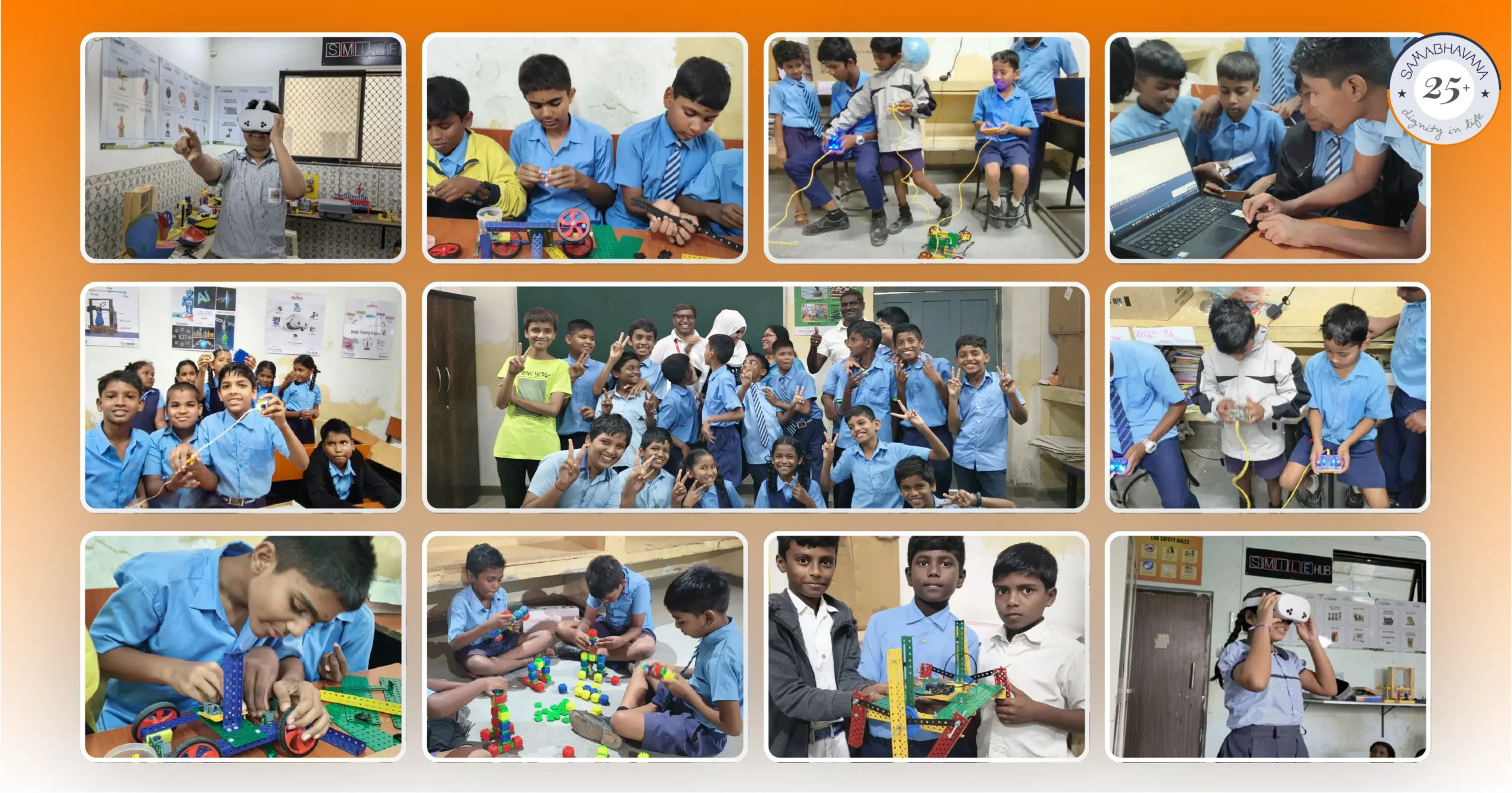
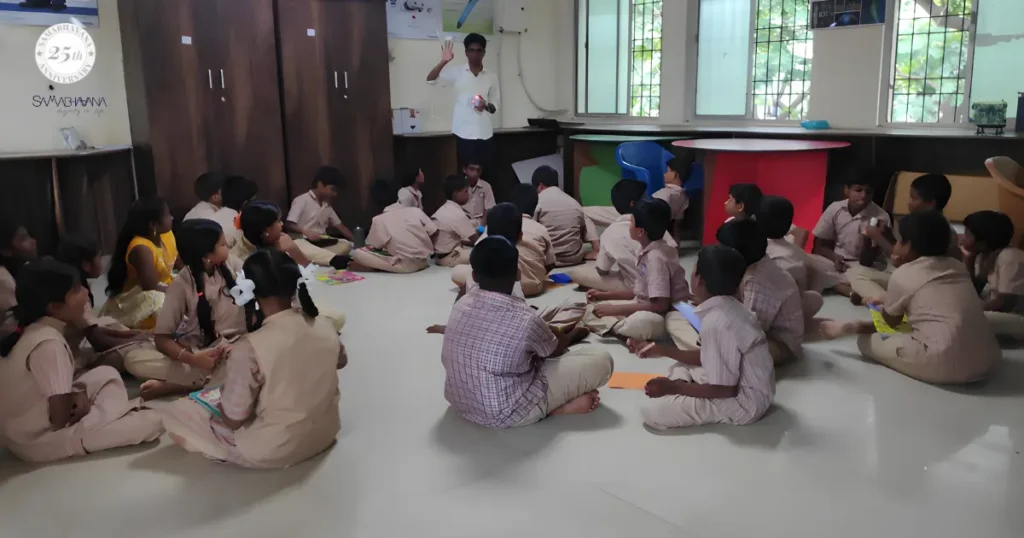
    Through the SMILE Hub (Student Mastering Important Life Skills Education) initiative, classrooms are being transformed into innovation hubsโ€”spaces where students explore, experiment, and actively participate in their learning journey.

    Rethinking the Purpose of a Classroom

    A classroom is not just four walls and a blackboard. It is where confidence is built, curiosity is shaped, and futures begin to take form. However, many government schools face challenges such as limited infrastructure, lack of digital tools, and minimal exposure to experiential learning.

    SMILE Hub was designed to address these gaps in a practical and sustainable way.

    Instead of adding isolated programs, Samabhavana introduced a 360ยฐ learning ecosystem that integrates technology, hands-on learning, and life skills within the existing school structure.

    The result is not just upgraded classroomsโ€”but empowered learning environments.

    What Makes SMILE Hub an Innovation Hub

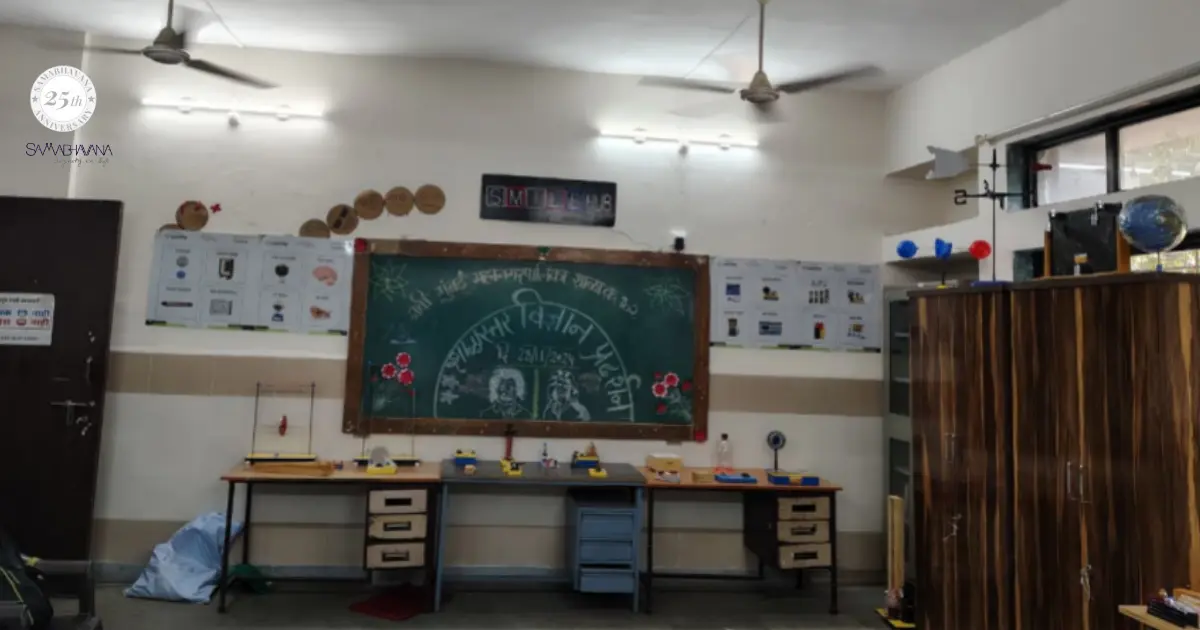
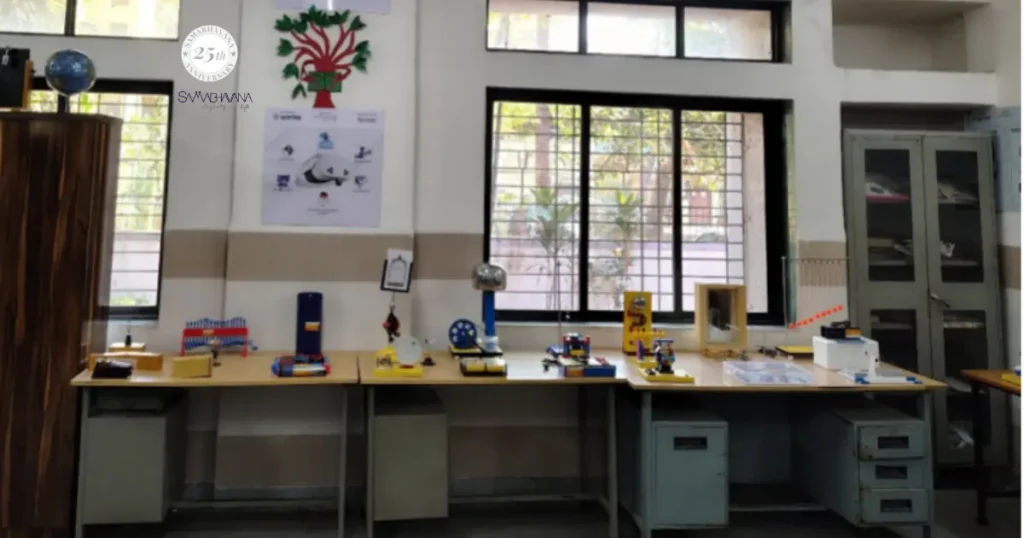
    SMILE Hub is a one-stop learning solution that brings together multiple modes of education under one roof. It combines:

    โ€ข Smart Digital Classrooms
    โ€ข Computer and Digital Literacy Labs
    โ€ข STEM Education
    โ€ข Robotics, Artificial Intelligence (AI), and Internet of Things (IoT)
    โ€ข Astronomy and Scientific Exploration
    โ€ข Virtual Reality (VR) Based Experiential Learning

    This integrated model aligns closely with the National Education Policy (NEP 2020), which encourages experiential learning, coding, AI exposure, and skill-based education from an early age.

    Instead of learning concepts in isolation, students experience how subjects connect to the real world.

    Smart Digital Classrooms: Making Learning Engaging

    Smart classrooms form the foundation of the SMILE Hub model. Through digital content, visual aids, and interactive lessons, students understand concepts more clearly and retain information longer.

    For teachers, smart classrooms reduce repetitive work and help explain complex ideas with ease. Lessons become structured, engaging, and inclusive.

    Students who once struggled to stay attentive become active participants when learning is visual and interactive.

    Digital Literacy: Building Essential Skills

    Digital literacy is no longer optional. It is a basic life skill.

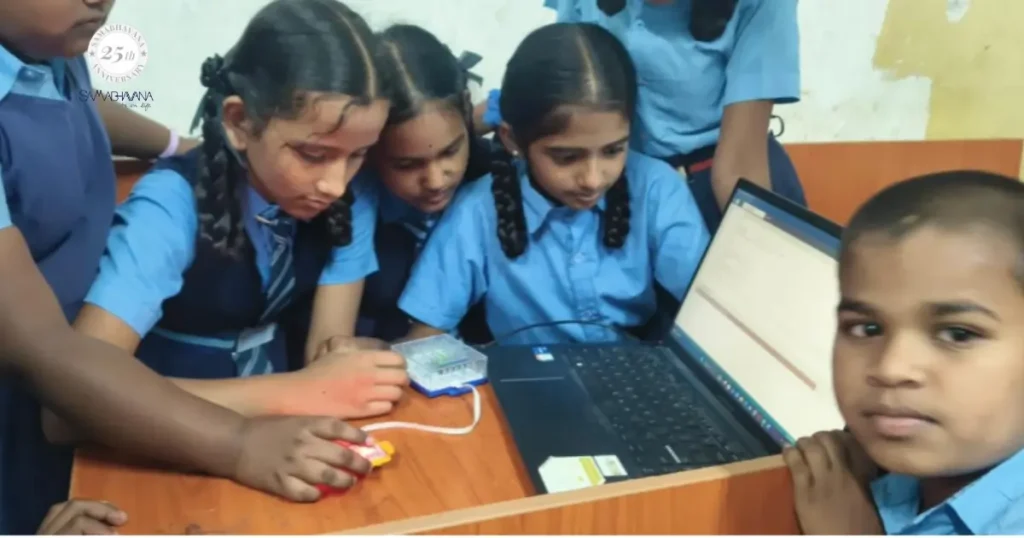
    Through computer labs set up under SMILE Hub, students learn how to:

    โ€ข Use computers confidently
    โ€ข Type and create digital documents
    โ€ข Understand basic internet usage and safety
    โ€ข Work on simple digital projects

    These skills prepare students not only for academics but also for future employment opportunities. For many children, this is their first meaningful interaction with technology.

    Parents often share that children begin teaching family members what they learn at schoolโ€”showing the ripple effect of digital education.

    STEM, Robotics, AI, and IoT: Learning by Doing

    One of the most powerful shifts brought by SMILE Hub is hands-on learning.

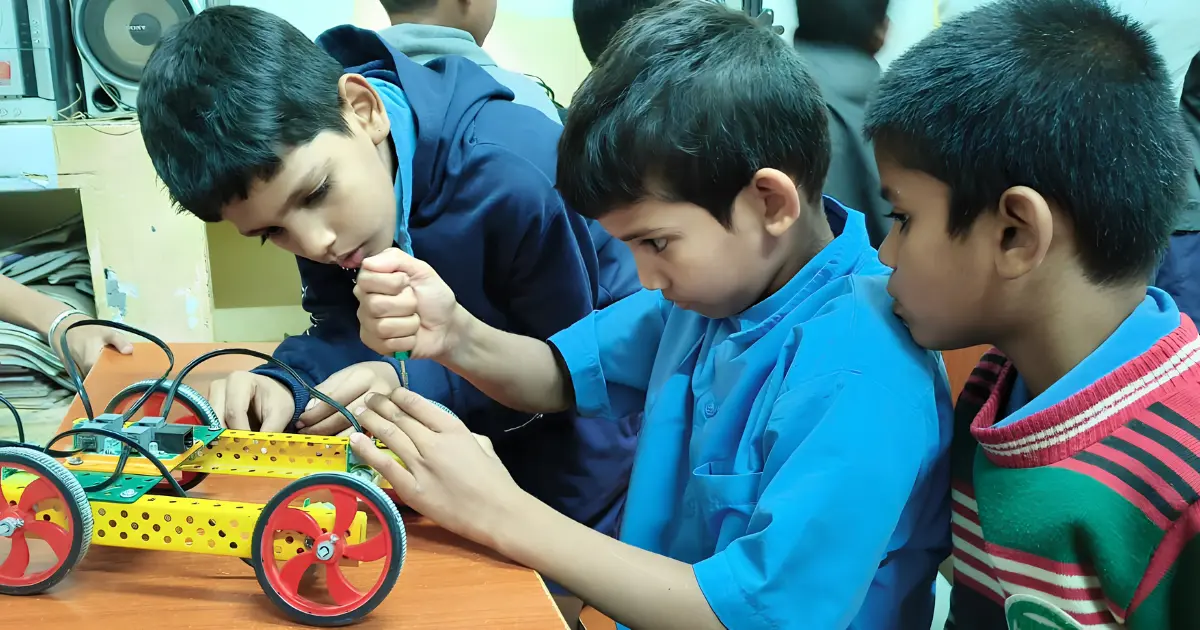
    Instead of only reading about science and technology, students build models, assemble robotics kits, and explore how machines work. They learn by experimenting, making mistakes, and trying again.

    Robotics, AI, and IoT sessions introduce future-ready concepts in simple, age-appropriate ways. Students learn how technology can solve everyday problemsโ€”from agriculture to energy to safety.

    This practical exposure builds confidence and shows children that advanced learning is accessible to everyone, not just students in elite schools.

    Astronomy and Experiential Learning

    Astronomy sessions ignite wonder and curiosity. Through solar system models, sky observations, and discussions about planets and stars, students develop scientific thinking and patience.

    Virtual Reality further enhances experiential learning. VR allows students to explore environments, understand abstract concepts visually, and connect learning to real-life contexts.

    Learning becomes memorable and exciting rather than stressful.

    Empowering Teachers Alongside Students

    Innovation hubs are not only about studentsโ€”they also support teachers.

    SMILE Hub provides teachers with tools, training, and resources that make teaching more effective and less exhausting. Teachers transition from being information providers to facilitators of learning.

    This shift improves classroom engagement and teacher satisfaction.

    Infrastructure That Supports Learning

    Samabhavana understands that learning environments matter. SMILE Hub initiatives often go hand-in-hand with:

    โ€ข Classroom renovation
    โ€ข Improved lighting and seating
    โ€ข Library enhancement
    โ€ข Playground development

    A well-maintained school creates a sense of dignity and motivation for both students and teachers.

    Impact Beyond the Classroom

    The transformation does not stop at school.

    Students become more confident, curious, and expressive. Parents become more involved. Teachers feel supported. Communities begin to see schools as centres of opportunity rather than limitation.

    SMILE Hub classrooms often become points of pride for entire communities.

    Alignment with CSR Goals

    SMILE Hub directly aligns with Section 135, Schedule VII of CSR in India, focusing on:

    โ€ข Promoting education
    โ€ข Digital literacy
    โ€ข Skill development
    โ€ข Inclusive learning environments

    Corporate partnerships enable Samabhavana to scale SMILE Hubs, upgrade infrastructure, and reach more government schools across regions.

    From Learning Spaces to Innovation Spaces

    When classrooms evolve into innovation hubs, students stop asking,
    โ€œWill this come in the exam?โ€

    They start asking,
    โ€œWhat can we build?โ€
    โ€œHow does this work?โ€
    โ€œWhat if we try this?โ€

    That shift changes everything.

    Through SMILE Hub, Samabhavana is redefining what government school classrooms can becomeโ€”spaces of creativity, confidence, and possibility.

    Because when learning is engaging, inclusive, and hands-on, classrooms donโ€™t just teach lessons.

    They build futures.

  • From Textbook to “I Was There”: How Virtual Reality Is Transforming Classrooms in India

    From Textbook to “I Was There”: How Virtual Reality Is Transforming Classrooms in India

    Introduction: The Moment Everything Changes | Virtual Reality Education India

    There is a particular moment that teachers across India describe when they introduce VR to students for the first time.

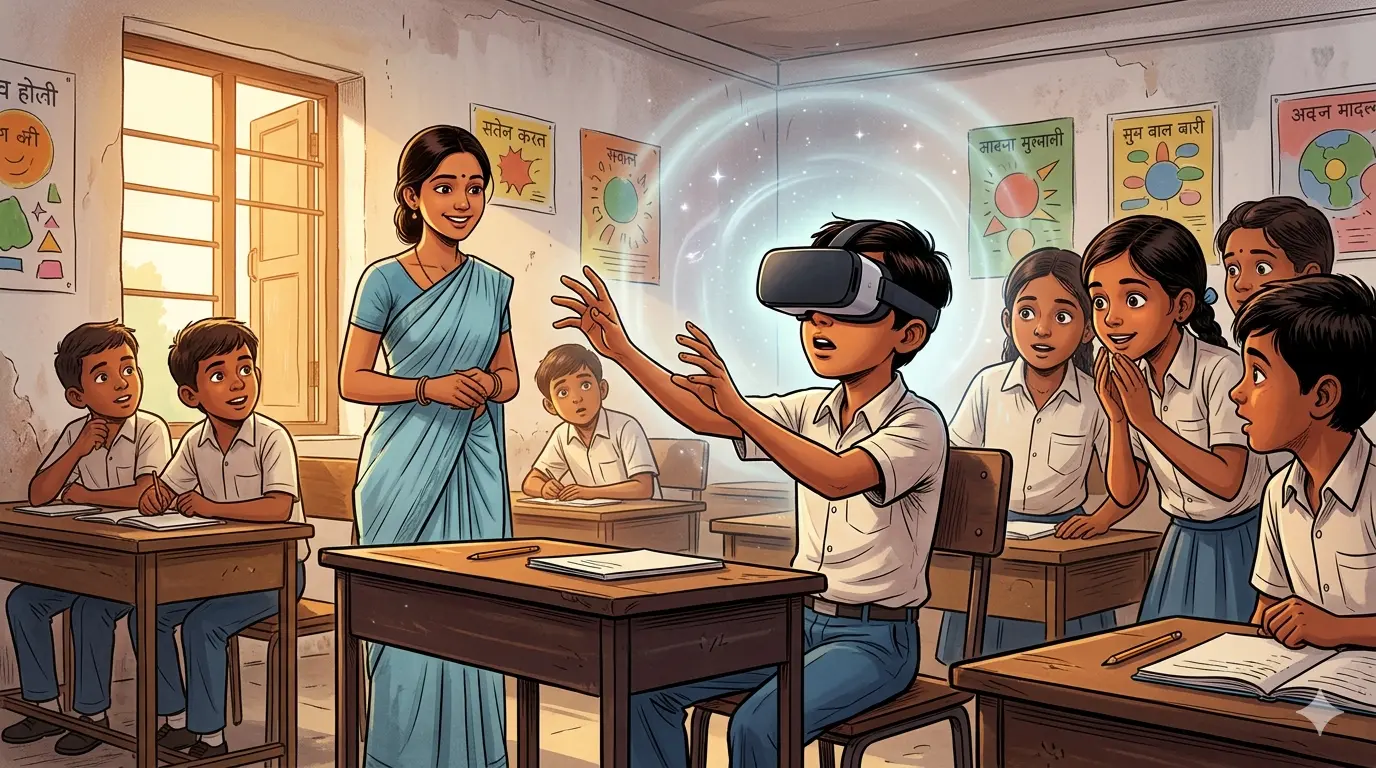
    A child puts on the headset. The room goes quiet. Then comes the turning โ€” the slow, instinctive rotation of the head as the child looks left, right, up, down, trying to take in the full 360 degrees of whatever world they have just entered.

    Sometimes it is the surface of the moon. Sometimes it is the inside of a human heart. Sometimes it is the Taj Mahal from three metres away.

    When the headset comes off, the expression is almost always the same: a kind of stunned delight.

    And then: “I felt like I was actually there.”

    That shift โ€” from reading about something to experiencing it โ€” is exactly what Virtual Reality (VR) brings to education. And for children in India’s government schools, where field trips are rare and laboratory access is limited, it may be one of the most significant educational tools of this decade.

    At Samabhavana, through the Smile Hub Programme, VR is not a futuristic experiment. It is a present-day classroom tool โ€” one we are already using to give children experiences that their circumstances would otherwise deny them.


    India’s VR Education Moment

    The adoption of VR in Indian education has moved faster than most people realise.

    In 2021, VR was present in just 7% of Indian high schools. By 2026, that figure has grown to nearly 38โ€“50% โ€” driven in large part by NEP 2020’s explicit push away from rote learning toward experience-based, competency-driven education.

    Government and institutional initiatives are accelerating this shift:

    • IIT Madras is developing a VR-based education model specifically designed for rural schools, focusing on subjects like social science, history, and science (PIB, Government of India)
    • IIT Guwahati launched Gyandhara in 2026 โ€” India’s first school-focused educational metaverse, beginning with PM SHRI schools
    • REC Limited, a PSU, signed a CSR agreement in May 2026 with IIT Delhi’s IHFC to fund a Green Innovator Immersive Learning Lab in Haryana schools โ€” bringing AR, VR, and 3D learning tools to government school students (India CSR, 2026)
    • Educational VR content is now available in 12 Indian languages, with plans to expand to all 22 scheduled languages

    India is not importing this technology passively. It is building it โ€” for its own schools, in its own languages, for its own children. The question is no longer whether VR belongs in Indian classrooms. It is how to ensure that every child, not just those in elite urban schools, gets access to it.


    The Exposure Gap VR Can Close

    For children studying in India’s government schools, the gap between curriculum and lived experience is often vast.

    The science textbook describes a rainforest ecosystem. But a child in a Nagpur suburb has never seen one. The history chapter covers the architecture of Hampi.

    But a child in a Mumbai chawl may never visit Karnataka. The biology lesson explains the human circulatory system. But there is no lab, no model, and no animation to make it real.

    Field trips are rare โ€” not because schools don’t value them, but because the logistical, financial, and safety barriers are enormous. Science labs, where they exist, are often understocked and oversupervised.

    Museums and cultural institutions are clustered in city centres, far from the communities where the need is greatest.

    VR collapses these barriers.

    With a single headset, a child can walk through the chambers of a 16th-century fort, observe the stages of photosynthesis from inside a leaf cell, witness the water cycle from the clouds, or float through the solar system to understand relative distances between planets.

    The experience is immediate, sensory, and โ€” crucially โ€” equal. Every child in the room has the same access to the same experience.

    This is VR’s most important contribution to Indian education: it is the great equaliser of exposure.


    Why Students Remember VR Experiences Longer | Virtual Reality Education India

    The retention advantage of immersive learning is well-documented. Studies in experiential education consistently show that immersive VR lessons improve information retention by over 30% compared to textbook-only instruction. (Prism Art Studio, 2026)

    The reason is rooted in how memory works.

    When we experience something โ€” when we are spatially present in a scene, when we look around and choose where to focus, when sensory input activates multiple pathways simultaneously โ€” the brain encodes that information differently and more durably than when we read a static page.

    Emotion is a key part of this. Traditional education has largely tried to separate emotion from learning โ€” to make the classroom neutral, calm, and objective. But the brain does not learn that way. Awe, surprise, curiosity, and delight are not distractions from learning. They are accelerants.

    When a child feels genuine wonder looking at the rings of Saturn in VR, that experience anchors the fact in memory in a way that “Saturn has rings made of ice and rock, see diagram 4.3” simply cannot.

    Teachers at Samabhavana’s Smile Hub centres observe this consistently: weeks after a VR session, children can describe in vivid detail what they saw, where they looked, and what surprised them. The experience creates a memory, not just a note.


    VR as an Inclusion Tool

    Beyond retention, VR creates a more equitable classroom in a specific and important way: it reduces the advantage that language and reading fluency currently confer.

    In a conventional classroom, a child who reads fluently processes the textbook faster, answers questions more confidently, and performs better in assessments.

    A child who struggles with language โ€” whether because of a learning difficulty, a multilingual home environment, or simply uneven prior schooling โ€” falls behind, not because they lack intelligence, but because the primary medium of learning disadvantages them.

    VR changes the medium | Virtual Reality Education India

    In an immersive experience, language is not the primary input. Spatial understanding, visual observation, and intuitive exploration take centre stage.

    Children who struggle in conventional lessons frequently surprise teachers in VR sessions โ€” engaging deeply, noticing details, asking questions that show sophisticated thinking.

    This matters enormously in India, where classrooms often contain children at dramatically different reading levels, from multiple language backgrounds, with highly varied prior educational exposure.

    VR doesn’t level the playing field โ€” it creates a different kind of playing field where more children can compete on equal terms.


    The Teacher’s Role Does Not Diminish โ€” It Deepens

    A concern sometimes raised about technology in classrooms is that it replaces teachers or makes their role redundant. With VR, the opposite is true.

    The most effective VR learning sessions follow a clear structure:

    • Pre-experience orientation โ€” the teacher contextualises what children are about to encounter and sets observation goals
    • The immersive experience โ€” typically 5โ€“12 minutes, focused on a specific concept or environment
    • Facilitated discussion โ€” the teacher draws out observations, corrects misconceptions, and deepens understanding
    • Reflection and connection โ€” students link the experience to the curriculum concept and to their own lives

    At every stage, the teacher is essential. VR without good facilitation becomes entertainment. VR with skilled facilitation becomes some of the most powerful teaching available.

    This is why Samabhavana’s approach to VR in the Smile Hub programme always includes educator training alongside the technology โ€” because the tool is only as good as the person wielding it.


    The CSR Case: VR in Government Schools | Virtual Reality Education India

    VR education CSR is an emerging and strategically valuable space for corporate partners. Here’s why it deserves serious consideration:

    Direct alignment with NEP 2020. The National Education Policy explicitly mandates experiential, inquiry-based learning. CSR investments in VR directly accelerate a national educational priority โ€” which matters for government stakeholder relations and compliance narrative.

    Schedule VII eligibility. VR-based learning programmes in schools qualify under the education and skill development provisions of Schedule VII of the Companies Act, 2013. Full documentation for CSR-2 reporting is available.

    Precedent from PSU leaders. In May 2026, REC Limited (a PSU) committed โ‚น1.40 crore to fund an immersive learning lab โ€” VR, AR, and 3D tools โ€” in Haryana government schools, in partnership with IIT Delhi. This demonstrates that VR education CSR is not just viable but actively being pursued by India’s most scrutinised CSR spenders.

    Strong visibility and storytelling. Few CSR investments produce more compelling content than a child in a government school experiencing VR for the first time.

    The story โ€” of access, of wonder, of a child who has never left their district suddenly standing at the foot of Everest โ€” is one that resonates far beyond the programme itself.

    Scalable impact measurement. Knowledge assessments before and after VR sessions, teacher observation reports, and student reflection exercises provide structured, MCA-compliant impact documentation.

    🔗 Explore Samabhavana’s Education programmes: Education

    🔗 Learn about the full Smile Hub STEM curriculum: Smart Digital Class

    🔗 Partner with us for CSR implementation: Donors & Partners


    Smile Hub’s VR Module: What It Delivers

    Within Samabhavana’s Smile Hub programme, VR is one component of a broader technology and STEM curriculum that includes digital literacy, robotics, astronomy, and AI basics.

    The VR module specifically delivers: Virtual Reality Education India

    • Curriculum-mapped immersive experiences โ€” VR content aligned to the school’s academic syllabus, not standalone novelty sessions
    • Educator-facilitated structured learning cycles โ€” pre-experience briefing, immersive session, and post-experience discussion in every class
    • Teacher training โ€” local educators are trained to facilitate VR sessions independently, building sustainable in-school capability
    • Multi-subject integration โ€” history, geography, science, environment, and civic education all covered through appropriate VR content
    • Impact documentation โ€” learning assessments, observation data, and session reports provided to CSR partners in MCA-compliant format

    Frequently Asked Questions

    1. Does VR in classrooms require expensive, high-end equipment?

    Not necessarily. Meaningful VR education can be delivered with entry-level standalone headsets, rotational sharing models (one headset serving multiple students per session), and offline-compatible content.

    Samabhavana designs Smile Hub VR modules for resource-constrained settings โ€” no permanent broadband connection or high-spec hardware required for core functionality.

    2. Is there evidence that VR actually improves learning outcomes?

    Yes. Studies consistently show retention improvements of 25โ€“35% for immersive learning versus textbook-only instruction. IIT Madras’s research on VR-based education for rural schools specifically focuses on outcome measurement.

    Within Smile Hub, pre- and post-session assessments allow direct measurement of knowledge gain from VR experiences.

    3. Can VR be used in government school settings?

    Yes, and it is increasingly being done so. REC Limited’s May 2026 CSR initiative, IIT Guwahati’s PM SHRI school metaverse project, and IIT Madras’s rural school VR research all demonstrate that government school VR implementation is not only possible but actively being scaled in India.

    4. Does VR work for children who struggle with reading or language?

    This is one of VR’s most important advantages. Because immersive learning is primarily visual and spatial โ€” not text-dependent โ€” it reduces the disadvantage that low reading fluency creates in conventional classrooms.

    Children who struggle with textbook learning frequently engage far more effectively in VR sessions.

    5. How is VR education funded through CSR?

    VR education programmes in schools qualify under Schedule VII’s education and skill development provisions. CSR partners can fund equipment, content development, educator training, and programme management.

    Samabhavana provides complete impact documentation for CSR-2 filing and annual CSR reporting.

    6. How does Samabhavana ensure VR is educationally effective and not just entertaining?

    Every Smile Hub VR session follows a structured facilitation model โ€” context-setting before, guided observation during, and discussion and reflection after.

    Educators are trained to lead this process. VR content is curriculum-mapped, not selected for novelty. And learning is assessed at baseline and endline to verify that the experience produced actual knowledge gain, not just engagement.


    Conclusion:

    Experience Is the New Texonomy, and digital literacy for children in underserved schools across India.

    To explore how your organisation can fund this work through CSR, get in touch with us.