CSR in Education in India: A Planning Guide for Companies
What qualifies under Schedule VII, the 6 types of education CSR projects, how to measure results, and why many school labs go unused. With real projects.
By
Samabhavana Team
·
29 October 2026
Education is where Indian companies put more CSR money than anywhere else. In FY 2023-24, companies spent about ₹12,135 crore on education, roughly a third of all CSR spending that year (PIB, March 2026).
Spending isn’t the hard part. The hard part is making a project still matter in year three. A CII study of education CSR found that the most common challenge is keeping results going after the project cycle ends, especially in government schools (CII). Labs get installed, photos get taken, and two years later the room is locked.
This guide is for CSR heads and teams planning an education CSR programme. It covers what qualifies under the law, the main types of projects, a six-step planning process, and how to measure and report results, with real examples from schools where we run SMILE HUB labs today.
What counts as education CSR under Schedule VII
Education is item (ii) of Schedule VII of the Companies Act, 2013: promoting education, including special education and employment-enhancing vocational skills, among children, women, the elderly and the differently abled. That covers almost everything from school buildings and science labs to teacher training and scholarships.
Who has to spend: under Section 135, a company must spend on CSR if, in the previous financial year, it had a net worth of ₹500 crore or more, turnover of ₹1,000 crore or more, or net profit of ₹5 crore or more. The obligation is 2% of its average net profit over the previous three years.
What doesn’t count: under the CSR Rules,
activities that benefit only your own employees and their families are not CSR;
neither is activity in the normal course of your business;
neither is sponsorship done mainly for marketing.
Who can implement it: since April 2021, any NGO or trust implementing CSR projects must be registered with the Ministry of Corporate Affairs and hold a CSR-1 registration number. Ask for it at the first meeting. (Samabhavana’s CSR-1, 80G and 12A certificates are on our certifications page.)
Multi-year projects are allowed. An “ongoing project” can run for up to three years beyond the year it starts. Money not spent in the year moves to an Unspent CSR Account and must be spent within three financial years. For education, where results take more than one academic year to show, this matters. Plan in years, not in one financial year.
Where education CSR money goes today
Education has been the largest CSR sector for years. Government data shows education CSR rising from about ₹6,720 crore in FY 2021-22 to ₹10,415 crore in FY 2022-23 and ₹12,135 crore in FY 2023-24 (PIB, March 2026). Maharashtra receives more CSR money than any other state, by a wide margin.
The same CII study describes the typical education CSR project:
largely rural;
mostly delivered through NGOs and implementing agencies;
covering several levels of schooling at once;
confident about short-term gains such as digital access;
much less confident about whether the change lasts.
So the money is there and the intent is there. What’s often missing is a plan for what happens after handover.
Hands-on science, coding, robotics, AI and IoT for school students
2–3 years for real results
Weekly active students, projects built, competitions
Digital and smart classrooms
Screens, content and devices for regular lessons
1–3 years
Hours of use per week, teachers using it
Teacher training
Better teaching methods, digital and STEM skills for teachers
Ongoing, in cycles
Teachers trained, classroom observation
Foundational and digital literacy
Reading, maths and basic computer skills
1–2 years per batch
Learning levels before and after
Scholarships and vocational skills
Fees, mentoring, job-linked training for older students
1–3 years
Course completion, placements
Most strong programmes combine two or three of these. A lab with no trained teacher doesn’t last, and neither does a smart classroom with no content plan. If you’re starting with STEM labs or smart classrooms, budget for teacher training from day one.
What does it cost? It depends on the number of schools, the modules you choose and whether a full-time trainer is included. Pricing depends on scope, so contact us for an estimate built around your geography.
What most guides miss: the lab that stops being used
The need is real. According to UDISE+ 2025-26, only about a quarter of government schools in India have functional computers. So when a company funds a lab, it’s often the first real technology the school has had.
That’s also why donated labs fail. The equipment arrives, but:
nobody is trained or paid to run it;
there’s no timetable slot, so it’s used only when a visitor comes;
there’s no curriculum, so sessions are random demonstrations;
when something breaks, there’s no budget to fix it;
nobody records how many students actually use it, so nobody notices when they stop.
A lab that is actually used looks different, and you can see it in the numbers. These are figures our SMILE HUB trainers reported in October 2026:
School (CSR partner)
Students using the lab (trainer-reported)
School enrolment
How often
Teachers trained
Govt. Hr. Sec. School, MGR Nagar, Chennai (Murata Electronics)
about 479
840
Daily, 5 days a week
4
Karnataka Public School, Bengaluru (Murata Electronics)
about 545
747
Daily, 5 days a week
4
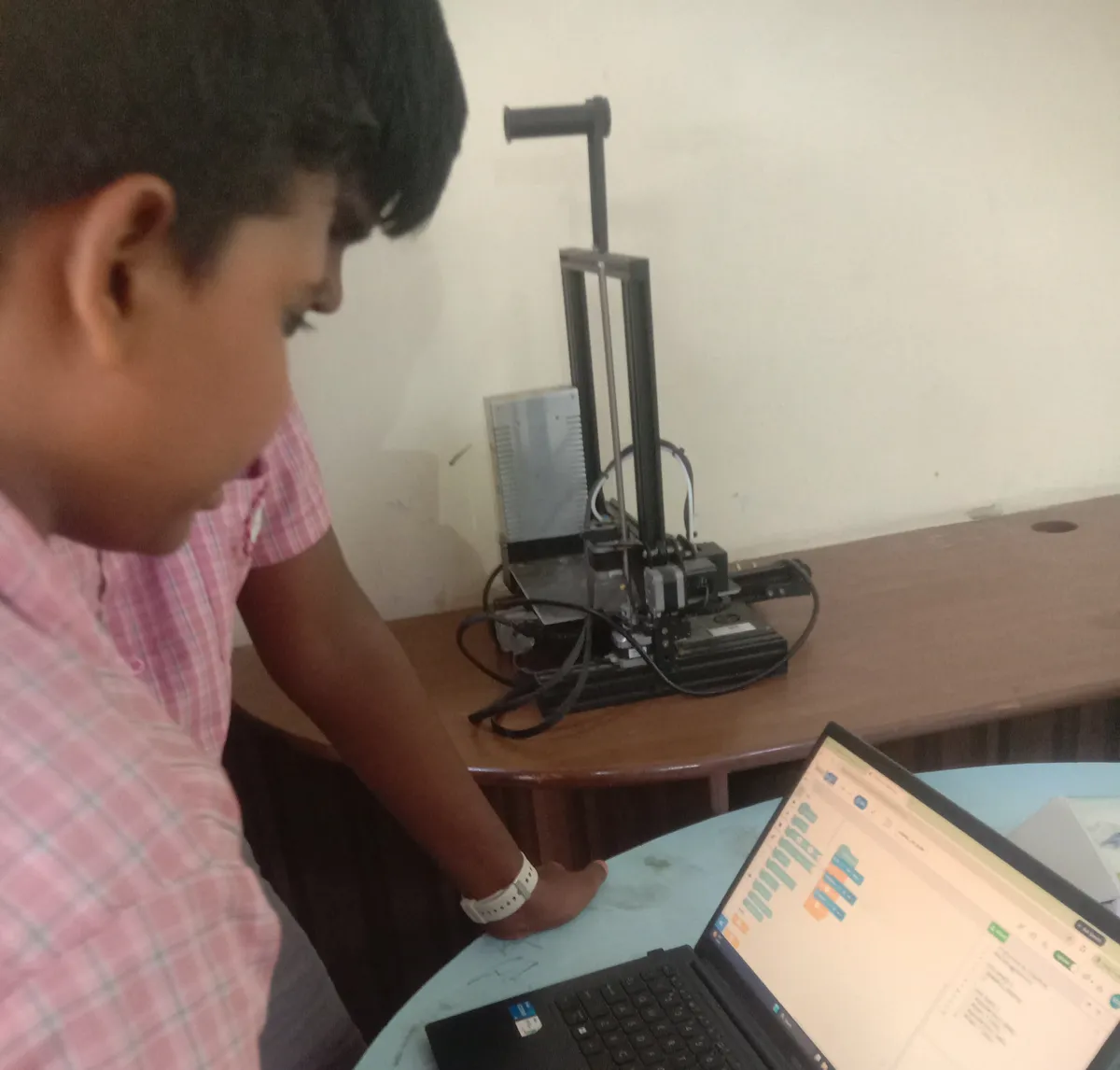
Coding an LED circuit in the SMILE HUB lab at Government Hr. Sec. School, MGR Nagar, Chennai (Murata Electronics).
In both schools, more than half of all students use the lab, every school day, and four teachers per school have been trained to use it.
What changes is visible in small things. In Chennai, teachers noticed that students were far more excited on lab days than in theory classes. Some would ask in the morning, “Do we have lab today?” After sessions on blinking LEDs and sensor readings, small groups kept arguing about why the LED blinked or why a sensor gave a particular reading. Teachers said they didn’t usually see that after a theory period.
What makes the difference isn’t the hardware:
a dedicated trainer at the school;
a timetabled curriculum linked to what students study in class;
teacher training, so the lab doesn’t depend on one person;
maintenance;
a monthly report on what is running and who is using it.
1. Choose schools with the district education office. Look at enrolment, existing facilities, electricity, internet and whether there’s a safe room for equipment. A short needs assessment now saves you from funding a lab in a school that can’t use it.
2. Decide what success looks like before you buy anything. Write down two or three outcomes you’ll report on. For example: students using the facility every week, teachers trained, learning levels in a basic assessment. If you can’t measure it, you can’t report it.
3. Choose an implementing partner, not a supplier. Check CSR-1 registration, years of work in schools, whether they have their own field staff, and ask to see a real monitoring report from an existing project. Our capability statement is a good example of what to ask for.
4. Budget for the whole project, not just the hardware. Setup is often the smaller part. Include the trainer, consumables, maintenance, teacher training and reporting for the full project period.
5. Sign an MoU with the school or education department. Cover the room, timetable periods, who can access the lab, how data is shared, and what happens at handover.
6. Measure, report and plan your exit from the start. Take a baseline at the start and an endline at the end, get reports every month or quarter, and agree in year one how the school will keep the programme going.
How to measure and report education CSR
Start by separating outputs from outcomes. “Lab installed in 5 schools” is an output. “Students in Grade 8 can build and code a working circuit” is an outcome. Boards and CSR committees increasingly ask for the second.
Simple indicators that work in government schools:
students using the facility each week;
sessions held per month;
teachers trained, and how many teach on their own;
student projects and competition entries;
change in a basic before-and-after assessment.
At SMILE HUB sites, every trainer files a monthly site report covering:
what is installed and actually running;
which grades use the lab;
how many students are active;
how many teachers are trained;
how often it’s used;
any competitions;
photos (with consent).
That gives the CSR team something concrete to put in front of its committee every quarter.
For annual disclosures, education projects usually sit under Principle 8 of BRSR (inclusive growth and equitable development). If your company’s average CSR obligation is ₹10 crore or more, the CSR Rules also require an independent impact assessment of projects worth ₹1 crore or more that finished at least a year earlier. Design your monitoring with that assessment in mind.
Education CSR projects in action
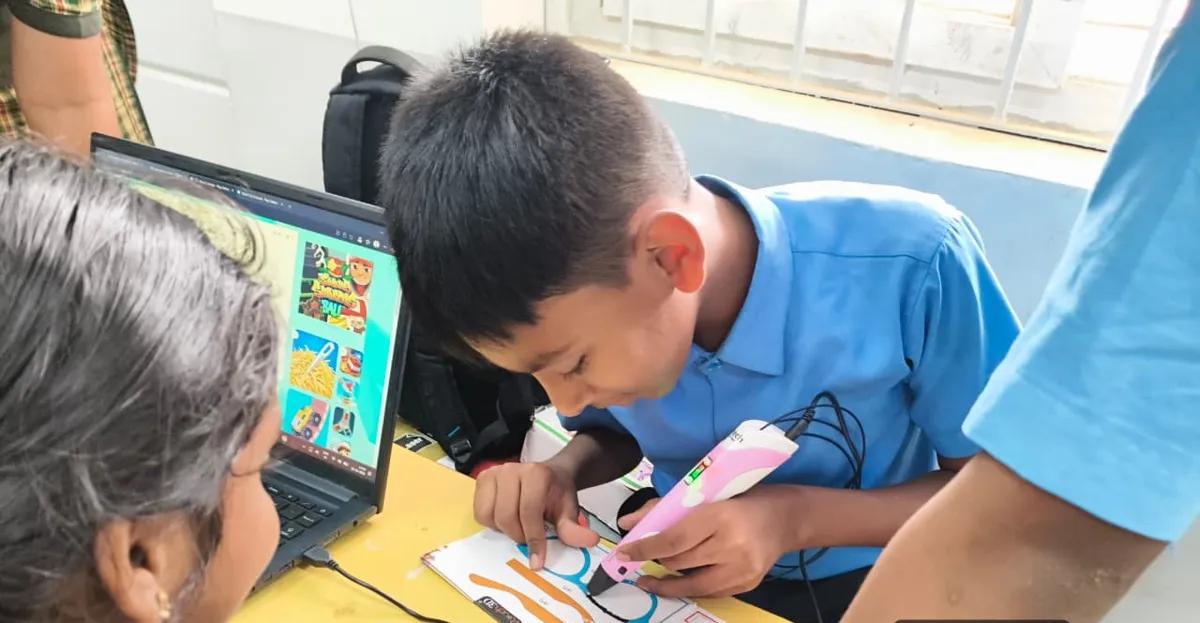
3D-pen design session at a Murata-funded SMILE HUB lab in Bengaluru.
Murata Electronics: Chennai and Bengaluru (since February 2025)
Murata funds SMILE HUB labs at Government Higher Secondary School, MGR Nagar, Chennai (a school of 840 students) and Karnataka Public School, Bengaluru (a school of 747).
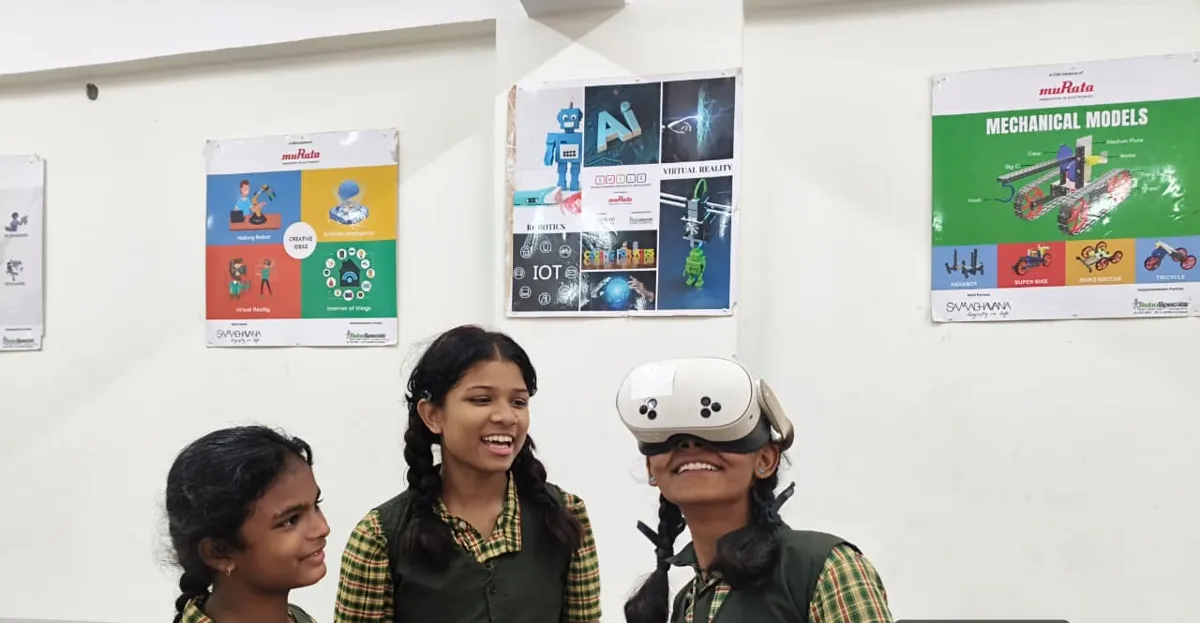
Students in Grades 5–8 work with robotics, AI, IoT, coding and virtual reality every school day.
Grade 8 students from Bengaluru took part in Samsung’s RISC on FPGA for High School programme on 21 November 2025, and each student received a RISC-V microcontroller .
Teachers in Bengaluru noticed that even quieter students started experimenting on their own during 3D-pen and VR sessions.
Johnson Matthey: Bawal, Rewari, Haryana (since December 2024)
Johnson Matthey supports SMILE HUB labs across government schools in the Bawal area. Five labs serve seven schools, including two nearby schools whose students come over to use them, and two more labs are being set up.
At GSSS Sulkha, two Class 9 students placed second in their categories at the block-level competition and qualified for the district level.
A newly admitted Class 9 student had been building projects by copying YouTube videos. He told his trainer that in the lab he finally understood what each component does, from sensors to the Arduino board to the code.
NHPC: Ballabhgarh, Faridabad, Haryana (since April 2026)
NHPC’s SMILE HUB is at a government girls’ model senior secondary school (a school of 800 students), for Grades 4–10. Modules include robotics, AI, IoT, astronomy, coding, VR and drones.
Grade 5 students explored space through VR during their Social Studies lesson on Sunita Williams.
Grade 9 students built a buzz-wire game to understand electric circuits.
As one teacher put it: “It is impressive to see students confidently building and testing things on their own.”
For PSUs, this is also a clean fit with education under Schedule VII. See our guide to CSR for PSU companies.
These are three of more than 500 SMILE HUBs that Samabhavana runs across India with 50+ corporate partners.
Frequently Asked Questions
Is education an eligible CSR activity under Schedule VII?
Yes. Item (ii) of Schedule VII covers promoting education, including special education and employment-enhancing vocational skills. School infrastructure, STEM labs, smart classrooms, teacher training, scholarships and literacy programmes all fall under it, as long as they benefit the community and not only your employees.
How much do Indian companies spend on education CSR?
Education is the largest CSR sector in India. Companies spent about ₹10,415 crore on it in FY 2022-23 and about ₹12,135 crore in FY 2023-24, roughly a third of total CSR spend each year. Exact figures are on the National CSR Portal.
Can a company fund a school where its employees' children study?
Activities that benefit only employees and their families don’t count as CSR. A project at a school that is open to and mainly serves the local community is generally treated differently. Check the details with your CSR committee or legal team before committing.
How do you measure the impact of an education CSR project?
Track outcomes, not only outputs: students using the facility each week, teachers trained, projects and competitions, and a simple before-and-after assessment. Monthly reports from the implementing partner make this easy. Larger projects may also need an independent impact assessment.
How much does an education CSR project cost?
It depends on scope: the number of schools, the modules chosen, and whether a full-time trainer is included. A lab without a trainer is cheaper on paper but often goes unused. Contact us for an estimate built around your geography.
Planning your FY 2027-28 education CSR? See how SMILE HUB works in government schools, or talk to our team about a programme for your CSR geography.