Introduction – STEM Education CSR in India
India produces more engineering graduates than any country in the world. And yet, walk into a government school in rural Maharashtra, Jharkhand, or Odisha — and you will find children learning science from a textbook published six years ago, in a classroom with no lab, no equipment, and a teacher who has never been trained in anything beyond chalk and board.
This is the paradox at the heart of India’s education story. And it is precisely the gap that STEM education CSR in India was designed to close.
Corporate Social Responsibility in India has grown substantially since the Companies Act 2013 mandated certain firms to spend 2% of their net profit on social initiatives, with education alone accounting for 30–38% of total CSR spending — covering school infrastructure, scholarships, and digital education tools.
Within that education spend, STEM education CSR in India is rapidly emerging as one of the highest-impact, most measurable, and most strategically aligned investments a company can make.
This guide walks CSR managers through everything they need to know — what STEM education CSR in India actually involves, how it fits within your compliance framework, what the most effective programme types look like, and how to choose an NGO partner with the ground-level experience to make it work.
What Is STEM Education CSR and Why Does It Matter in India
STEM education CSR in India refers to structured corporate social responsibility programmes that fund science, technology, engineering, and mathematics learning infrastructure, content, and teacher development in underserved government schools across the country.
It is not about donating microscopes. It is about building ecosystems — where children have access to laboratories, teachers know how to use them, and communities understand why they matter.
The need is urgent. In rural areas, the gender gap in STEM education is pronounced and persistent, with girls in rural communities facing layered structural barriers including higher rates of early marriage, greater household responsibilities, and social norms that actively discourage girls from pursuing education in mathematics and science. India CSR
The scale is significant. STEM Learning Social Enterprise has reached more than 20 lakh students across 5,800 schools, 30,000 teachers, and 400 districts — evidence that well-designed STEM education CSR programmes can scale far beyond their initial pilots when the implementation infrastructure is right. Protean
For CSR managers, STEM education CSR in India sits at a strategic intersection — it delivers measurable outcomes, aligns with national education policy priorities under NEP 2020, supports SDG 4 (Quality Education) and SDG 9 (Innovation and Infrastructure), and generates the kind of visible, photogenic impact that supports both your MCA reporting and your internal brand narrative.
How STEM Education CSR Aligns with Schedule VII
For CSR managers working within the compliance framework of Section 135 of the Companies Act 2013, STEM education CSR in India sits clearly within Schedule VII’s eligible activity categories.
Education is explicitly covered under Schedule VII of the Companies Act 2013 as an eligible CSR activity. Companies can invest in promoting education, including special education and employment-enhancing vocational skills, and this includes STEM and innovation labs such as Atal Tinkering Labs. Companies Act 2013
Education and skill development are recognised CSR activities under Schedule VII of the Companies Act. Structured programmes in these areas often allow measurable outcomes within defined timelines, making them suitable for organisations seeking clarity and accountability in deployment. CSR Education
Specifically, STEM education CSR programmes qualify under:
- Schedule VII Item II — promoting education, including special education and employment-enhancing vocational skills
- Schedule VII Item IX — contributions to research in science, technology, engineering, and medicine aimed at promoting Sustainable Development Goals
For PSU CSR teams in particular, STEM education programmes offer a specific compliance advantage — they are verifiable, asset-based investments that generate physical infrastructure (labs, equipment, smart panels) alongside documented learning outcomes.
This dual evidence trail — infrastructure plus impact — is exactly what withstands CAG audit scrutiny most robustly.
5 Types of STEM Education CSR Programmes That Deliver Results
Not all STEM education CSR in India is created equal. Here are the five programme types that consistently deliver measurable, sustainable outcomes:
1. Mini Science Centres
Dedicated science learning spaces installed inside government school premises — equipped with working models, experiment kits, and interactive displays. Mini Science Centres give children who have never seen a working microscope their first hands-on science experience.
Samabhavana has delivered 18 Mini Science Centres for GAIL India across Maharashtra and Madhya Pradesh, 10 for Michelin across Tamil Nadu and Karnataka, and 4 for BSES Rajdhani across New Delhi — impacting thousands of government school children directly.
2. STEM and Robotics Labs
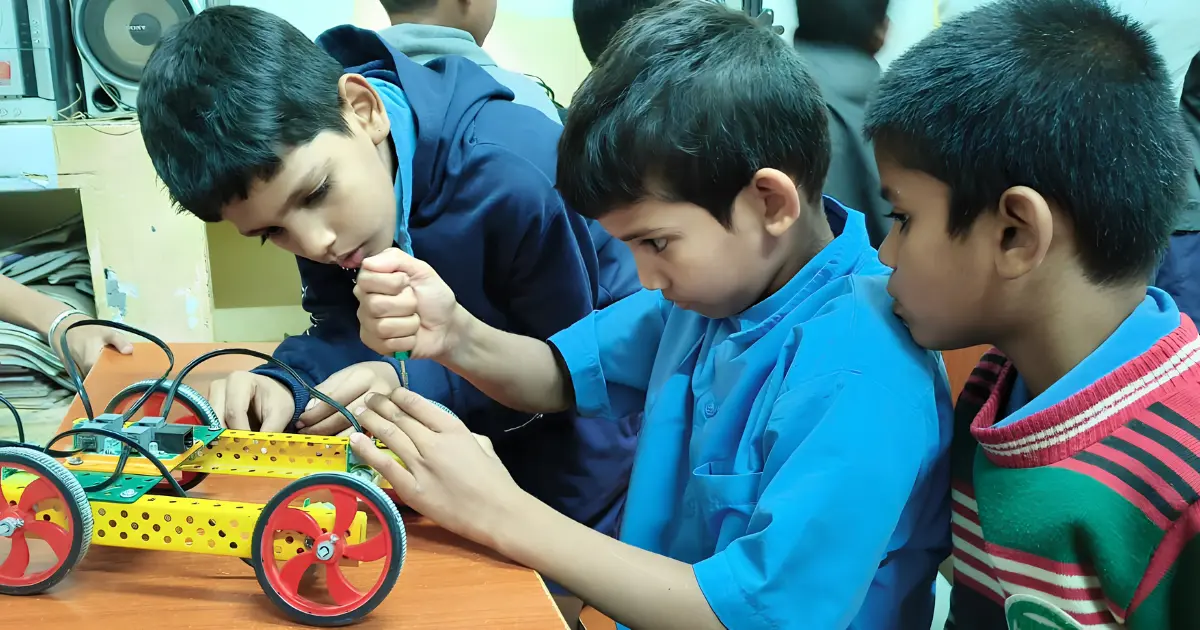
Full robotics, AI, and coding labs integrated into school infrastructure — with curriculum, teacher training, and ongoing content support built in.
STEM on Wheels initiatives and similar programmes have demonstrated that mobile science laboratories can expand access to quality STEM education for students, particularly girls, in infrastructure-constrained schools.
Fixed robotics labs go further — creating permanent innovation infrastructure that outlasts any single CSR funding cycle. India CSR
3. SMILE Hub — Integrated Technology Learning Ecosystems
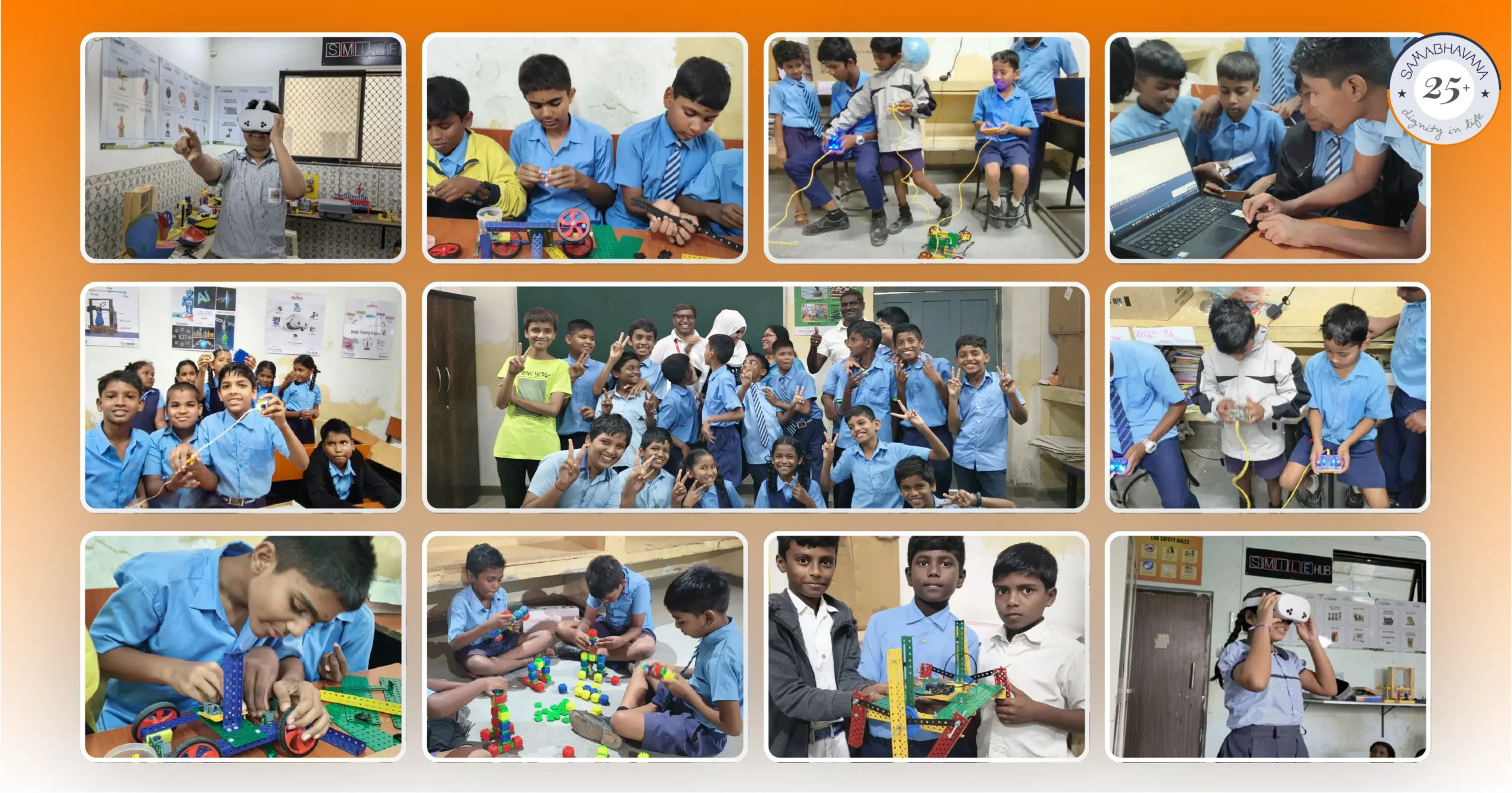
Samabhavana’s flagship SMILE Hub programme integrates SMART Digital Classrooms, Robotics, AI, IoT, Astronomy, and Virtual Reality into a single comprehensive learning ecosystem — designed specifically for government schools.
SMILE Hub goes beyond standalone equipment installation to create a complete technology education environment with curriculum alignment, teacher training, and impact documentation for MCA compliance.
4. Teacher Training Programmes
The most underfunded and most impactful component of STEM education CSR in India. A robotics lab without a trained teacher is a room full of equipment.
STEM teacher training programmes build the human infrastructure that makes physical investment sustainable — ensuring that corporate CSR funds deliver outcomes years after the installation date.
5. Digital Classroom and EdTech Integration
SMART Digital Classrooms that integrate curriculum-aligned digital content, interactive panels, and offline content servers for schools in areas with limited connectivity.
Particularly effective when combined with teacher training — the technology and the human capability are deployed together.
What Makes a STEM Education CSR Programme Actually Work
The difference between a STEM education CSR programme that transforms a school and one that generates a press release is almost entirely in the implementation quality. Here is what separates them:
Community needs assessment before design. The most effective programmes begin with a genuine understanding of the school context — existing infrastructure, teacher qualifications, local language requirements, and community engagement levels.
Programmes designed from a corporate office without field research consistently underdeliver.
Teacher training as a core component, not an afterthought. Research highlights STEM labs and teacher training as the interventions with the strongest measurable long-term outcomes.
Any STEM education CSR programme that allocates 90% of its budget to hardware and 10% to teacher development is likely to produce a well-equipped but underutilised space within two years. Csrbox
Curriculum alignment with state board syllabi. Generic STEM content designed for urban private school students does not work in a rural government school context.
Effective programmes include content in regional languages, aligned with specific state board curricula, developed in consultation with teachers.
Monitoring and impact documentation. Baseline assessments before the programme begins, quarterly progress monitoring, and end-of-year outcome reports — not just activity reports. For CSR obligations above ₹10 crore, a mandatory third-party impact assessment is required by MCA.
Even below that threshold, documented impact data is what separates a credible CSR programme from a compliance exercise.
Sustainability planning from day one. The most common failure mode in STEM education CSR in India is the sustainability gap — programmes that thrive during corporate funding and collapse when it ends.
Effective programmes build teacher ownership, community governance, and a maintenance plan that functions independently of the corporate CSR budget.
Samabhavana’s SMILE Hub —
Samabhavana has been delivering STEM education CSR programmes across India for over 25 years — for partners including GAIL India, Michelin, BSES Rajdhani, Suzuki Motorcycles, Johnson Matthey, and Worley.
Our SMILE Hub programme — Student Mastering Important Life Skills Education — represents the most comprehensive STEM education CSR programme available for government schools in India today. It integrates:
- SMART Digital Classrooms with curriculum-aligned content
- Robotics and AI basics with hands-on project kits
- Astronomy education with telescope and observation modules
- IoT and basic coding fundamentals
- Virtual Reality experiential learning
- Digital literacy for both students and teachers
Every SMILE Hub delivery includes school selection and community assessment, full installation and infrastructure preparation, comprehensive teacher training, curriculum alignment with the specific state board, and quarterly monitoring with MCA-compliant impact reporting.
Samabhavana holds valid CSR1, 80G, 12A, and Niti Aayog registrations — your STEM education CSR expenditure is legally sound and audit-ready from day one.
How to Choose the Right NGO Partner for STEM Education CSR
The quality of your STEM education CSR programme in India is almost entirely determined by the NGO partner you choose to implement it. Here is what to look for:
- Verified credentials.
CSR1 registration, 80G and 12A certifications, and Niti Aayog registration are non-negotiable. Without them, your expenditure may not withstand audit scrutiny regardless of how well the programme is delivered.
- Documented STEM delivery track record.
Ask for examples of previous STEM education programmes — which schools, which districts, how many students reached, what outcomes documented.
Companies like Infosys and Tata Group contribute to building and upgrading school facilities with state-of-the-art labs — but the organisations that consistently deliver are those with established community relationships and teacher training systems in place.
- Teacher training methodology.
Ask how the NGO trains teachers — pre-programme, refresher workshops, and ongoing support. An NGO that cannot describe its teacher training approach in detail is an NGO that treats it as optional.
- Reporting and documentation standards.
Request a sample impact report from a previous programme. The quality of that document tells you everything about the NGO’s accountability culture.
- Geographic experience in your target area.
Community trust, local language capability, and relationships with school authorities are built over years.
Choose a partner with established presence in the geographies where your CSR programme will be delivered.
Frequently Asked Questions –
Q1. Does STEM education CSR qualify under Schedule VII of the Companies Act?
Yes. STEM education programmes qualify under Schedule VII Item II — promoting education — and may also qualify under Item IX covering contributions to research in science, technology, engineering, and medicine aimed at promoting SDGs.
Both categories are well-established and clearly documented in MCA guidelines.
Q2. How much does a STEM education CSR programme cost in India?
Costs vary significantly based on programme scope and geography. A Mini Science Centre typically ranges from ₹3–8 lakh per school. A full SMILE Hub installation with robotics, AI, astronomy, and digital classroom integration ranges from ₹8–20 lakh depending on specifications.
Teacher training components add ₹1–3 lakh per school annually. Your NGO partner should provide a detailed project estimate with clear line items before any commitment.
Q3. How do I measure the impact of a STEM education CSR programme?
Effective measurement begins with baseline assessments before the programme launches — student science comprehension scores, teacher confidence levels, and school infrastructure ratings. Post-implementation data is collected at regular intervals against these baselines.
Key metrics include students reached, teacher training hours completed, pre and post learning assessments, and attendance changes. For obligations above ₹10 crore, a mandatory third-party impact assessment is required by MCA.
Q4. Can STEM education CSR programmes work in rural areas without internet connectivity?
Yes. Most effective STEM education CSR programmes in India are specifically designed for low-connectivity environments — with offline content servers, solar power backup systems, and downloadable curriculum materials.
Samabhavana’s SMILE Hub programme has been successfully delivered in rural Maharashtra, Madhya Pradesh, Tamil Nadu, and Karnataka — many of which have inconsistent internet connectivity.
Q5. What is the difference between a STEM lab and a SMILE Hub?
A STEM lab typically refers to a single-technology installation — a robotics kit, a coding corner, or a science experiment station.
A SMILE Hub is a comprehensive, multi-technology learning ecosystem that integrates robotics, AI, astronomy, VR, digital classrooms, and digital literacy into a single coordinated programme — with curriculum alignment, teacher training, and impact reporting built in from the start.
Q6. How long does a STEM education CSR programme typically run?
The most effective programmes run for a minimum of 12–24 months — enough time to complete infrastructure installation, deliver teacher training, run two complete academic cycles, and generate meaningful before-and-after outcome data.
Short 3–6 month programmes generate equipment and activity reports but rarely produce measurable learning outcomes.
Q7. Which companies in India are investing in STEM education CSR?
Companies including Infosys, Tata Group, and Wipro have invested in STEM through their CSR programmes, supporting science and technology education and infrastructure across schools in India.
PSUs including GAIL India, BSES Rajdhani, and NHPC have delivered Mini Science Centres and STEM labs through implementing NGO partners. The trend is accelerating — STEM Learning Social Enterprise alone has reached more than 5,800 schools through CSR partnerships.
A figure that underscores how central STEM education CSR in India has become to the corporate giving ecosystem. Protean
Discover Samabhavana’s SMILE Hub — India’s Most Complete STEM Education CSR Programme
If you are looking for a STEM education CSR programme that goes beyond a single lab installation — SMILE Hub is India’s most comprehensive answer.
Built and delivered by Samabhavana — a 25-year-old Mumbai-based NGO registered with Niti Aayog, Maharashtra Charity Commissioner, and IICA-MCA, holding valid 80G, 12A, and CSR1 certifications.
SMILE Hub integrates six technologies into a single, government school-ready ecosystem: SMART Digital Classrooms, Robotics & AI, Astronomy, IoT, Virtual Reality, and Digital Literacy.
Every installation includes school selection, full infrastructure setup, comprehensive teacher training, curriculum alignment with the state board, and quarterly MCA-compliant impact reporting — so your CSR expenditure is audit-ready from day one.
Samabhavana has delivered SMILE Hubs and Mini Science Centres for GAIL India, Michelin, BSES Rajdhani, Suzuki Motorcycles, Johnson Matthey, and 50+ corporate and PSU partners across 15+ states.
Every programme is documented, verified, and built to last beyond the funding period.
If your company is ready to move from CSR compliance to CSR impact — Download our Capability Statement or Get in touch today and we will design a SMILE Hub programme that fits your mandate, your geography, and your reporting requirements.
📞 022-45658306
📧 info@samabhavana.in
🌐 samabhavana.in