
From Textbook to "I Was There": How Virtual Reality Is Transforming Classrooms in India
Introduction: The Moment Everything Changes | Virtual Reality Education India
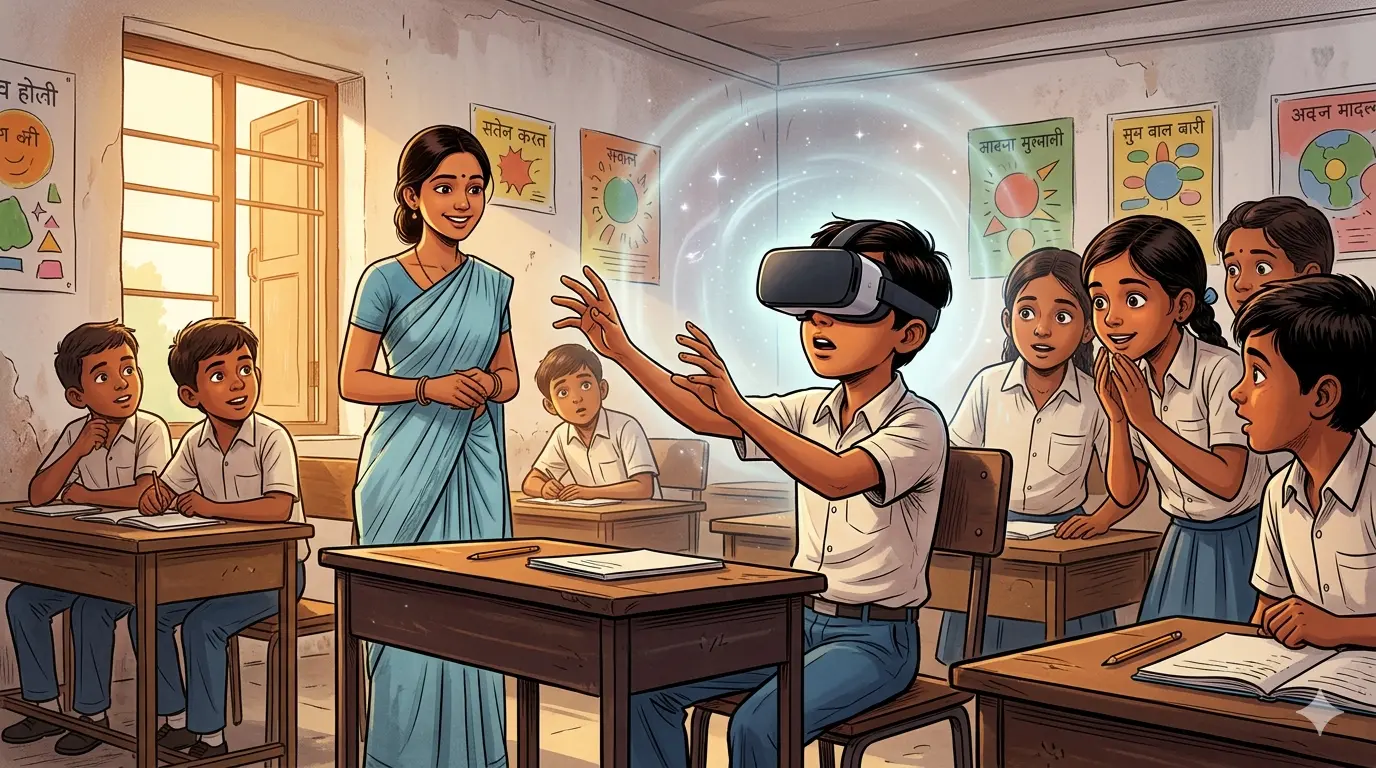
There is a particular moment that teachers across India describe when they introduce VR to students for the first time.
A child puts on the headset. The room goes quiet. Then comes the turning — the slow, instinctive rotation of the head as the child looks left, right, up, down, trying to take in the full 360 degrees of whatever world they have just entered.
Sometimes it is the surface of the moon. Sometimes it is the inside of a human heart. Sometimes it is the Taj Mahal from three metres away.
When the headset comes off, the expression is almost always the same: a kind of stunned delight.
And then: “I felt like I was actually there.”
That shift — from reading about something to experiencing it — is exactly what Virtual Reality (VR) brings to education. And for children in India’s government schools, where field trips are rare and laboratory access is limited, it may be one of the most significant educational tools of this decade.
At Samabhavana, through the Smile Hub Programme, VR is not a futuristic experiment. It is a present-day classroom tool — one we are already using to give children experiences that their circumstances would otherwise deny them.
India’s VR Education Moment
The adoption of VR in Indian education has moved faster than most people realise.
In 2021, VR was present in just 7% of Indian high schools. By 2026, that figure has grown to nearly 38–50% — driven in large part by NEP 2020’s explicit push away from rote learning toward experience-based, competency-driven education.
Government and institutional initiatives are accelerating this shift:
- IIT Madras is developing a VR-based education model specifically designed for rural schools, focusing on subjects like social science, history, and science (PIB, Government of India)
- IIT Guwahati launched Gyandhara in 2026 — India’s first school-focused educational metaverse, beginning with PM SHRI schools
- REC Limited, a PSU, signed a CSR agreement in May 2026 with IIT Delhi’s IHFC to fund a Green Innovator Immersive Learning Lab in Haryana schools — bringing AR, VR, and 3D learning tools to government school students (India CSR, 2026)
- Educational VR content is now available in 12 Indian languages, with plans to expand to all 22 scheduled languages
India is not importing this technology passively. It is building it — for its own schools, in its own languages, for its own children. The question is no longer whether VR belongs in Indian classrooms. It is how to ensure that every child, not just those in elite urban schools, gets access to it.
The Exposure Gap VR Can Close
For children studying in India’s government schools, the gap between curriculum and lived experience is often vast.
The science textbook describes a rainforest ecosystem. But a child in a Nagpur suburb has never seen one. The history chapter covers the architecture of Hampi.
But a child in a Mumbai chawl may never visit Karnataka. The biology lesson explains the human circulatory system. But there is no lab, no model, and no animation to make it real.
Field trips are rare — not because schools don’t value them, but because the logistical, financial, and safety barriers are enormous. Science labs, where they exist, are often understocked and oversupervised.
Museums and cultural institutions are clustered in city centres, far from the communities where the need is greatest.
VR collapses these barriers.
With a single headset, a child can walk through the chambers of a 16th-century fort, observe the stages of photosynthesis from inside a leaf cell, witness the water cycle from the clouds, or float through the solar system to understand relative distances between planets.
The experience is immediate, sensory, and — crucially — equal. Every child in the room has the same access to the same experience.
This is VR’s most important contribution to Indian education: it is the great equaliser of exposure.
Why Students Remember VR Experiences Longer | Virtual Reality Education India
The retention advantage of immersive learning is well-documented. Studies in experiential education consistently show that immersive VR lessons improve information retention by over 30% compared to textbook-only instruction. (Prism Art Studio, 2026)
The reason is rooted in how memory works.
When we experience something — when we are spatially present in a scene, when we look around and choose where to focus, when sensory input activates multiple pathways simultaneously — the brain encodes that information differently and more durably than when we read a static page.
Emotion is a key part of this. Traditional education has largely tried to separate emotion from learning — to make the classroom neutral, calm, and objective. But the brain does not learn that way. Awe, surprise, curiosity, and delight are not distractions from learning. They are accelerants.
When a child feels genuine wonder looking at the rings of Saturn in VR, that experience anchors the fact in memory in a way that “Saturn has rings made of ice and rock, see diagram 4.3” simply cannot.
Teachers at Samabhavana’s Smile Hub centres observe this consistently: weeks after a VR session, children can describe in vivid detail what they saw, where they looked, and what surprised them. The experience creates a memory, not just a note.
VR as an Inclusion Tool
Beyond retention, VR creates a more equitable classroom in a specific and important way: it reduces the advantage that language and reading fluency currently confer.
In a conventional classroom, a child who reads fluently processes the textbook faster, answers questions more confidently, and performs better in assessments.
A child who struggles with language — whether because of a learning difficulty, a multilingual home environment, or simply uneven prior schooling — falls behind, not because they lack intelligence, but because the primary medium of learning disadvantages them.
VR changes the medium | Virtual Reality Education India
In an immersive experience, language is not the primary input. Spatial understanding, visual observation, and intuitive exploration take centre stage.
Children who struggle in conventional lessons frequently surprise teachers in VR sessions — engaging deeply, noticing details, asking questions that show sophisticated thinking.
This matters enormously in India, where classrooms often contain children at dramatically different reading levels, from multiple language backgrounds, with highly varied prior educational exposure.
VR doesn’t level the playing field — it creates a different kind of playing field where more children can compete on equal terms.
The Teacher’s Role Does Not Diminish — It Deepens
A concern sometimes raised about technology in classrooms is that it replaces teachers or makes their role redundant. With VR, the opposite is true.
The most effective VR learning sessions follow a clear structure:
- Pre-experience orientation — the teacher contextualises what children are about to encounter and sets observation goals
- The immersive experience — typically 5–12 minutes, focused on a specific concept or environment
- Facilitated discussion — the teacher draws out observations, corrects misconceptions, and deepens understanding
- Reflection and connection — students link the experience to the curriculum concept and to their own lives
At every stage, the teacher is essential. VR without good facilitation becomes entertainment. VR with skilled facilitation becomes some of the most powerful teaching available.
This is why Samabhavana’s approach to VR in the Smile Hub programme always includes educator training alongside the technology — because the tool is only as good as the person wielding it.
The CSR Case: VR in Government Schools | Virtual Reality Education India
VR education CSR is an emerging and strategically valuable space for corporate partners. Here’s why it deserves serious consideration:
Direct alignment with NEP 2020. The National Education Policy explicitly mandates experiential, inquiry-based learning. CSR investments in VR directly accelerate a national educational priority — which matters for government stakeholder relations and compliance narrative.
Schedule VII eligibility. VR-based learning programmes in schools qualify under the education and skill development provisions of Schedule VII of the Companies Act, 2013. Full documentation for CSR-2 reporting is available.
Precedent from PSU leaders. In May 2026, REC Limited (a PSU) committed ₹1.40 crore to fund an immersive learning lab — VR, AR, and 3D tools — in Haryana government schools, in partnership with IIT Delhi. This demonstrates that VR education CSR is not just viable but actively being pursued by India’s most scrutinised CSR spenders.
Strong visibility and storytelling. Few CSR investments produce more compelling content than a child in a government school experiencing VR for the first time.
The story — of access, of wonder, of a child who has never left their district suddenly standing at the foot of Everest — is one that resonates far beyond the programme itself.
Scalable impact measurement. Knowledge assessments before and after VR sessions, teacher observation reports, and student reflection exercises provide structured, MCA-compliant impact documentation.
🔗 Explore Samabhavana’s Education programmes: Education
🔗 Learn about the full Smile Hub STEM curriculum: Smart Digital Class
🔗 Partner with us for CSR implementation: Donors & Partners
Smile Hub’s VR Module: What It Delivers
Within Samabhavana’s Smile Hub programme, VR is one component of a broader technology and STEM curriculum that includes digital literacy, robotics, astronomy, and AI basics.
The VR module specifically delivers: Virtual Reality Education India
- Curriculum-mapped immersive experiences — VR content aligned to the school’s academic syllabus, not standalone novelty sessions
- Educator-facilitated structured learning cycles — pre-experience briefing, immersive session, and post-experience discussion in every class
- Teacher training — local educators are trained to facilitate VR sessions independently, building sustainable in-school capability
- Multi-subject integration — history, geography, science, environment, and civic education all covered through appropriate VR content
- Impact documentation — learning assessments, observation data, and session reports provided to CSR partners in MCA-compliant format
Frequently Asked Questions
1. Does VR in classrooms require expensive, high-end equipment?
Not necessarily. Meaningful VR education can be delivered with entry-level standalone headsets, rotational sharing models (one headset serving multiple students per session), and offline-compatible content.
Samabhavana designs Smile Hub VR modules for resource-constrained settings — no permanent broadband connection or high-spec hardware required for core functionality.
2. Is there evidence that VR actually improves learning outcomes?
Yes. Studies consistently show retention improvements of 25–35% for immersive learning versus textbook-only instruction. IIT Madras’s research on VR-based education for rural schools specifically focuses on outcome measurement.
Within Smile Hub, pre- and post-session assessments allow direct measurement of knowledge gain from VR experiences.
3. Can VR be used in government school settings?
Yes, and it is increasingly being done so. REC Limited’s May 2026 CSR initiative, IIT Guwahati’s PM SHRI school metaverse project, and IIT Madras’s rural school VR research all demonstrate that government school VR implementation is not only possible but actively being scaled in India.
4. Does VR work for children who struggle with reading or language?
This is one of VR’s most important advantages. Because immersive learning is primarily visual and spatial — not text-dependent — it reduces the disadvantage that low reading fluency creates in conventional classrooms.
Children who struggle with textbook learning frequently engage far more effectively in VR sessions.
5. How is VR education funded through CSR?
VR education programmes in schools qualify under Schedule VII’s education and skill development provisions. CSR partners can fund equipment, content development, educator training, and programme management.
Samabhavana provides complete impact documentation for CSR-2 filing and annual CSR reporting.
6. How does Samabhavana ensure VR is educationally effective and not just entertaining?
Every Smile Hub VR session follows a structured facilitation model — context-setting before, guided observation during, and discussion and reflection after.
Educators are trained to lead this process. VR content is curriculum-mapped, not selected for novelty. And learning is assessed at baseline and endline to verify that the experience produced actual knowledge gain, not just engagement.
Conclusion:
Experience Is the New Texonomy, and digital literacy for children in underserved schools across India.
To explore how your organisation can fund this work through CSR, get in touch with us.